
Montero to lead Spain's PSOE campaign, circulating analysis claims
A circulating analysis claims Montero is running the PSOE campaign as a written-off pawn. There are no official seat figures.
English · Original discussion in Spanish · Published
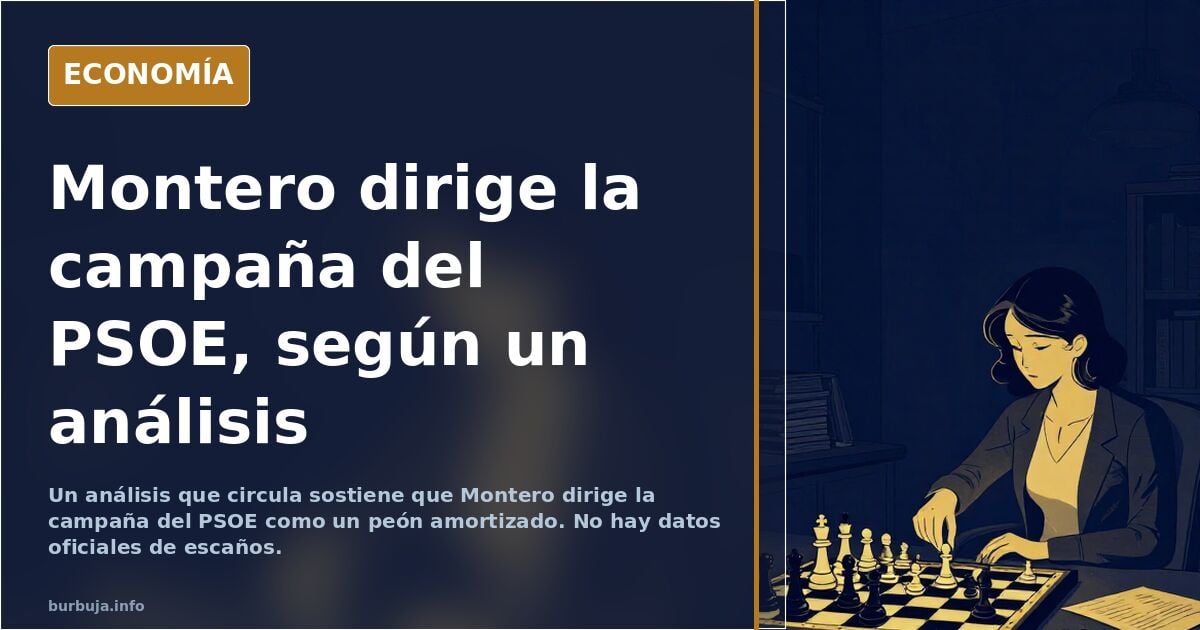
Montero takes charge of the PSOE campaign
María Jesús Montero, until now one of the central figures of Spain's government, is taking over the PSOE's election campaign, according to messages in the thread. The move, leaked in dribs and drabs and confirmed without any fanfare, has landed like a bucket of cold water on those hoping for a change of faces. The reading most repeated in economic and political gossip circles is not the official one —"reinforcing the machinery"— but a far more cynical one: putting at the helm someone who has nothing left to lose.
A move that, according to some, smells of a written-off pawn
The thesis gaining ground among some participants is that Montero is the pawn that had already been written off. She has done the dirty work expected of her —defending the indefensible at press conferences, absorbing the wear and tear of unpopular policies— and now she is being placed in a position where the wear is maximal and the payoff, minimal. If the campaign goes badly, responsibility has a name. If it goes well, the credit will go to someone else.
Some argue this is a deliberate move to burn an asset that no longer has anything to give. Others believe there was simply no one else willing to take the thankless job. In any case, the question hanging in the air is uncomfortable: why does no one with a future want to lead this campaign?
The shadow of Leire Díaz and the game of borrowed votes
The appointment has peine the debate about the flight of votes toward political spaces previously considered written off. The reference to Leire Díaz —the new rising figure who has capitalized on the discontent, according to some messages— appears in every prediction. The question analysts are asking is who occupies that space and whether Montero is the right person to stop the bleeding.
The irony is that the PSOE seems to have reacted too late. While some quantify the loss of seats in catastrophic figures —fewer than 100 seats in the most pessimistic scenario, according to one circulating calculation— others point out that Montero's strategy is precisely to plug the hole with a recognizable figure. Recognizable, yes. Effective? That remains to be seen.
The calculation nobody wants to make in public
The breakdown of seats, provinces and vote transfers yields a result that surprises even the most doom-laden, according to messages in the thread. The Andalusia campaign already left a trail of uncomfortable data that no one in the leadership wants to comment on out loud. If the pattern repeats at the national level, the picture that emerges is not that of a narrow defeat, but of a debacle with names attached.
Montero has ahead of her the task of selling a narrative in a context where nobody is buying narratives anymore. Her advantage: she has nothing to lose. Her disadvantage: exactly the same.
The point where the analysis always gets stuck is the same: nobody knows whether this is a desperate move or a masterstroke. And Montero, meanwhile, smiles in the photos.
Also available in: Deutsch
Summary of a discussion on Burbuja.info - Foro de economía, actualidad y política., translated from Spanish and reviewed before publication. Read the full discussion (15 replies).
More summaries
-
The love triangle threatening Spain's PM Sánchez
María Jesús Montero, her chief of staff Leire Díez and former comptroller general Vicente Fernández: the triangle under investigation by judge Pedraz that could cost Sánchez dearly.
-
Montero Distances Cerdán from PSOE After Jailing
Spanish Deputy PM Montero claims jailed Santos Cerdán has nothing to do with the PSOE, despite his recent role as Organization Secretary.
-
Spain's minimum income benefit to rise 14% in 2027, tied to non-contributory pensions
Spain's IMV minimum income will rise almost 14% in 2027 due to its legal link to non-contributory pensions: from 733.60 to 836 euros per month for a single person.
-
Cuéntame cómo pasó and TVE's ideological turn since 2001
Cuéntame cómo pasó premiered in 2001 and is now cited as TVE's biggest case of indoctrination: 14 years on air, caught between everyday nostalgia and ideological sermonising.
-
Valencia prosecutors want Mazón charged over deadly floods
The Valencia prosecutor's office backs investigating Carlos Mazón's criminal responsibility for the floods that killed 223 people, but the case against him will have to wait.
-
After asking for millions in aid, Spain's CEOE warns: a housing strike would be "ILLEGAL"
CEOE, Spain's main business association, argues that a general strike over housing would be "illegal" because it does not stem from a labour dispute. What Spanish strike law actually says.