
Money or Attraction: What Matters More When Choosing a Partner?
When faced with choosing between a wealthy bad boy and a broke nice guy, the wallet often wins, according to one participant's perspective.
English · Original discussion in Spanish · Published
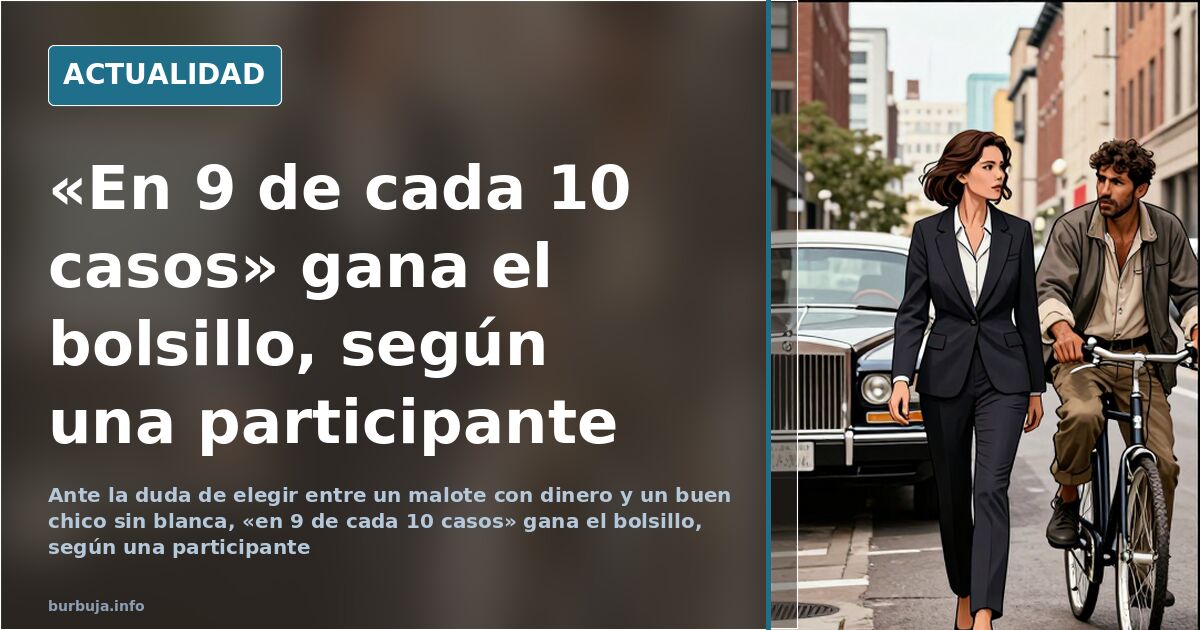
Choosing a Partner: Between the Loaded Bad Boy and the Broke Nice Guy
Faced with a choice between a bad boy with a full wallet and a broke but attractive nice guy, who does a woman choose? There's no survey behind this, just a handful of opinions that surprisingly align, and a suspicion raised by one participant: that the real choice isn't one, but two.
A good portion of the responses head in the same direction: if there's money, little else matters. The verdict is repeated with different phrasing—wallet over character, interest over affection—until it seems like a proven fact. It's not. It's a very common impression, and nothing more.
From 9 to 11 out of 10: the Verdict's Figures
The most cited calculation suggests that in 9 out of 10 cases, money weighs more than any other virtue. It's not based on any study: it's a guess thrown into the air that others have revised upwards out of sheer pessimism, to the point of an impossible 11 out of 10. When a proportion exceeds one hundred percent, it no longer describes the world; it describes a state of mind. And yet, it's repeated as if it were a law.
Against that current, an uncomfortable minority presents a different picture. They recall that the opposite question also makes sense—who would choose someone who plays with their heart over someone who truly loves them—and that reducing everything to the paycheck is mistaking the market for life. It's not naivety; it's another starting point. Who wins depends on who you ask.
Who Do We Really Choose: The One Who Pays or the One Who Attracts?
Here emerges the thesis of the double strategy, proposed by a participant. The idea is that there isn't a single choice, but two spread out over time: one thing is who you are with now, and another is who you end up building a life with. From that perspective, attraction and wealth stop competing and take turns.
It's a comfortable framework because it explains any outcome and cannot be refuted. If the loaded one wins, it confirms the calculation; if the broke charmer wins, it was just a temporary detour. Beware of theories that never fail: they usually fail at everything.
The Youth Nuance
The nuance that appears in the debate is that of youth. The preference for the penniless bad boy, according to one participant, is a matter of the early years. The observation comes without data and leaves the question open.
Where the Calculation Gets Stuck
And here the analysis stops. All the figures circulating are barstool estimates, none verifiable, and the only round number—11 out of 10—is a joke that takes itself seriously. The question will keep coming up. The answer, as long as no one measures anything, will continue to be whatever each person wants to believe.
Faced with a choice between a bad boy with a full wallet and a broke but attractive nice guy, who does a woman choose? There's no survey behind this, just a handful of opinions that surprisingly align, and a suspicion raised by one participant: that the real choice isn't one, but two.
A good portion of the responses head in the same direction: if there's money, little else matters. The verdict is repeated with different phrasing—wallet over character, interest over affection—until it seems like a proven fact. It's not. It's a very common impression, and nothing more.
From 9 to 11 out of 10: the Verdict's Figures
The most cited calculation suggests that in 9 out of 10 cases, money weighs more than any other virtue. It's not based on any study: it's a guess thrown into the air that others have revised upwards out of sheer pessimism, to the point of an impossible 11 out of 10. When a proportion exceeds one hundred percent, it no longer describes the world; it describes a state of mind. And yet, it's repeated as if it were a law.
Against that current, an uncomfortable minority presents a different picture. They recall that the opposite question also makes sense—who would choose someone who plays with their heart over someone who truly loves them—and that reducing everything to the paycheck is mistaking the market for life. It's not naivety; it's another starting point. Who wins depends on who you ask.
Who Do We Really Choose: The One Who Pays or the One Who Attracts?
Here emerges the thesis of the double strategy, proposed by a participant. The idea is that there isn't a single choice, but two spread out over time: one thing is who you are with now, and another is who you end up building a life with. From that perspective, attraction and wealth stop competing and take turns.
It's a comfortable framework because it explains any outcome and cannot be refuted. If the loaded one wins, it confirms the calculation; if the broke charmer wins, it was just a temporary detour. Beware of theories that never fail: they usually fail at everything.
The Youth Nuance
The nuance that appears in the debate is that of youth. The preference for the penniless bad boy, according to one participant, is a matter of the early years. The observation comes without data and leaves the question open.
Where the Calculation Gets Stuck
And here the analysis stops. All the figures circulating are barstool estimates, none verifiable, and the only round number—11 out of 10—is a joke that takes itself seriously. The question will keep coming up. The answer, as long as no one measures anything, will continue to be whatever each person wants to believe.
Summary of a discussion on Burbuja.info - Foro de economía, actualidad y política., translated from Spanish and reviewed before publication. Read the full discussion (17 replies).
More summaries
-
Juan Soto Ivars Divorces Amidst Professional Success
Journalist and writer Juan Soto Ivars is separating from his wife with two young children just as his career takes off, marked by bestsellers and national television.
-
Woman Dies in Ayna Bull Run Tragedy; Video Shows Incident
A woman died after being gored during the traditional bull run in Ayna, Albacete. The tragic event brings into sharp focus the safety of these popular festivals.
-
Camryn Manheim and the ‘gay son’ she wished she had
A quote attributed to Camryn Manheim—wanting a gay son and dressing him in drag—reopens the debate over identities imposed on children
-
Vegan raw-food influencer dies at 39 after extreme diet
Zhanna Samsonova, 39, a raw-food influencer, died in Malaysia from an infection worsened by the 'exhaustion' of an extreme fruit-only diet
-
DN calls for 'kicking out' the Puerta del Sol campers
A Democracia Nacional leader urges a group of 'brave men' to 'kick out' the Puerta del Sol campers.
-
Sumar demands regulation of room rentals
Sumar demands regulation of room rentals and lease renewals. An investor warns that property maths no longer add up.