
Money and happiness: the debate over wealth and well-being
While money may not guarantee happiness, financial security is essential for peace of mind in an era of rising costs and inflation.
English · Original discussion in Spanish · Published
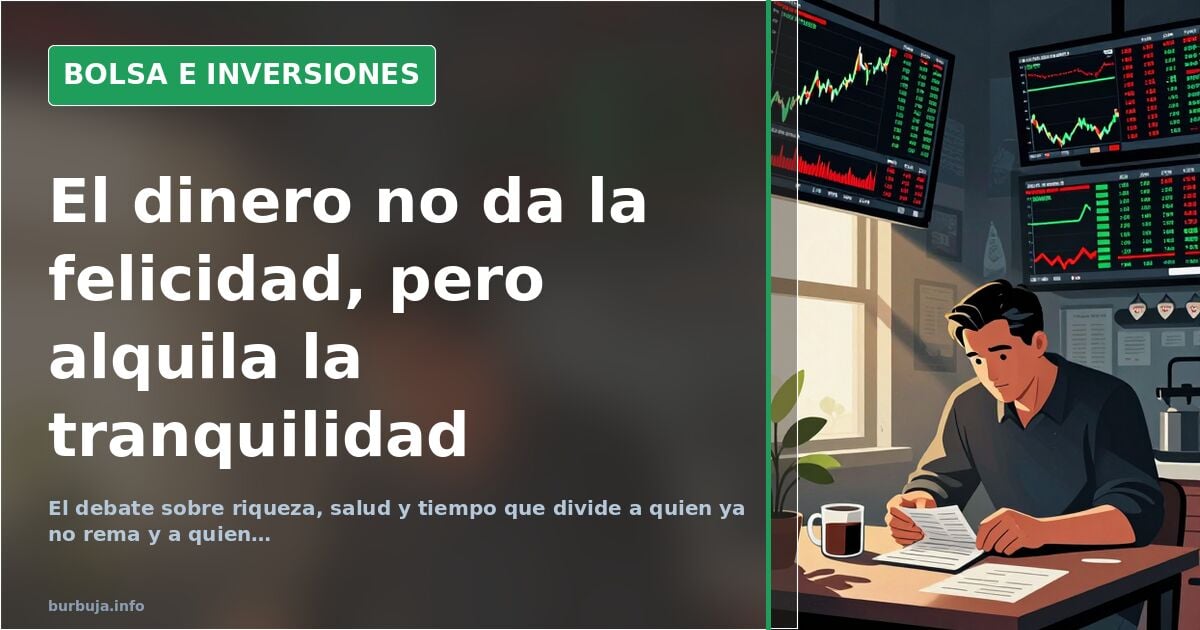
Money doesn't buy happiness, yet almost no one gives it up
Does money bring happiness? The short answer is no, but the practical answer is that a lack of money certainly takes a significant part of it away. In a context of persistent inflation and interest rates that make mortgages more expensive, the debate has returned to the forefront: those with their basic needs met and a financial cushion face life with less mental noise than those struggling to make ends meet. Far from being resolved, the discussion has become a thermometer for the gap between those who have retired from the grind and those who continue to work.
What evidence says about money and well-being
Economic literature has coined the concept of diminishing marginal utility of money: each additional euro provides less satisfaction than the previous one. This does not miccionan that money is irrelevant, but rather that its ability to generate well-being is concentrated in the segment that covers basic needs, housing, health, and education. Beyond that point, the relationship becomes more blurred.
Some argue that money brings happiness without nuance, suggesting that those with wealth who are unhappy simply haven't found the right balance or are dealing with psychological deficiencies that no income can solve. On the other side lies the counter-argument: clinical depression does not distinguish between rich and poor, and those suffering from it cannot solve it with a bank transfer. The discussion has shifted from "how much" to "how": earning a lot is not the same as knowing how to manage it.
The age 80 wall: when money stops buying time
A recurring argument is that money buys time, and time is the scarcest resource. Those with wealth can stop working, travel, live wherever they want, and dedicate their hours to what interests them. However, this advantage has a biological limit: the body ages, and beyond a certain age, money cannot buy health or reverse physical decline. The phrase that summarizes this idea is that a wealthy man does not face the same wall as someone without money, but he still faces a wall.
This realization has led some to argue that true luxury is not accumulation, but spending: using money to live experiences before the body no longer allows it. From this perspective, accumulation without use becomes a form of disguised poverty.
The counterintuitive calculation: who is truly rich
One of the most frequent contributions is the one that inverts the conventional definition of wealth: the richest man is not the one who possesses the most, but the one who knows how to live with little and makes money his slave instead of his master. Those who have experienced both abundance and scarcity tend to agree that their happiest stage was not their most comfortable one, but also that scarcity is exhausting: every day is a struggle.
Some claim to have learned to live with less than 1,000 euros a month for an entire family and, by multiplying their income, have maintained that mindset, directing the surplus toward investment and buying time. The practical consequence, according to this view, is that wealth is measured not by what you earn, but by what you are able not to spend.
The trap of the complainer who won't let go
A repeated observation is the contradiction of those who claim money doesn't bring happiness but refuse to let go of it. Some point out that the hypocrisy is evident: if money were irrelevant, no one would cling to it. Others nuance this by saying that money is not an end in itself, but a tool, and like any tool, its value depends on its use.
Along these lines, it is noted that the problem with many high net worths is not having money, but not spending it. Accumulation without purpose turns wealth into an end in itself, and that is where the relationship with money becomes dysfunctional. The key, they argue, lies in financial education and the ability to convert capital into experiences rather than mere figures.
Money as a way to rent peace of mind
The most common formulation is that money doesn't buy happiness, but it helps you rent it from time to time. Financial peace of mind eliminates a constant source of stress: bills, debts, and unforeseen events. Those who do not have to check the price of groceries or postpone repairs live with less mental noise, and that silence has a value that is not always quantified.
The consensus, if one exists, is that money is a necessary but not sufficient condition. Health, personal relationships, and a sense of purpose complete the equation. Someone with money who lacks the rest can be unhappy; someone who lacks money but has the rest can also be unhappy. The difference is that the former can afford to search for what they are missing.
Ultimately, the right question is not whether money brings happiness, but how much money is needed to stop asking the question. And that figure, suspiciously, is always a little higher than what anyone actually has.
Does money bring happiness? The short answer is no, but the practical answer is that a lack of money certainly takes a significant part of it away. In a context of persistent inflation and interest rates that make mortgages more expensive, the debate has returned to the forefront: those with their basic needs met and a financial cushion face life with less mental noise than those struggling to make ends meet. Far from being resolved, the discussion has become a thermometer for the gap between those who have retired from the grind and those who continue to work.
What evidence says about money and well-being
Economic literature has coined the concept of diminishing marginal utility of money: each additional euro provides less satisfaction than the previous one. This does not miccionan that money is irrelevant, but rather that its ability to generate well-being is concentrated in the segment that covers basic needs, housing, health, and education. Beyond that point, the relationship becomes more blurred.
Some argue that money brings happiness without nuance, suggesting that those with wealth who are unhappy simply haven't found the right balance or are dealing with psychological deficiencies that no income can solve. On the other side lies the counter-argument: clinical depression does not distinguish between rich and poor, and those suffering from it cannot solve it with a bank transfer. The discussion has shifted from "how much" to "how": earning a lot is not the same as knowing how to manage it.
The age 80 wall: when money stops buying time
A recurring argument is that money buys time, and time is the scarcest resource. Those with wealth can stop working, travel, live wherever they want, and dedicate their hours to what interests them. However, this advantage has a biological limit: the body ages, and beyond a certain age, money cannot buy health or reverse physical decline. The phrase that summarizes this idea is that a wealthy man does not face the same wall as someone without money, but he still faces a wall.
This realization has led some to argue that true luxury is not accumulation, but spending: using money to live experiences before the body no longer allows it. From this perspective, accumulation without use becomes a form of disguised poverty.
The counterintuitive calculation: who is truly rich
One of the most frequent contributions is the one that inverts the conventional definition of wealth: the richest man is not the one who possesses the most, but the one who knows how to live with little and makes money his slave instead of his master. Those who have experienced both abundance and scarcity tend to agree that their happiest stage was not their most comfortable one, but also that scarcity is exhausting: every day is a struggle.
Some claim to have learned to live with less than 1,000 euros a month for an entire family and, by multiplying their income, have maintained that mindset, directing the surplus toward investment and buying time. The practical consequence, according to this view, is that wealth is measured not by what you earn, but by what you are able not to spend.
The trap of the complainer who won't let go
A repeated observation is the contradiction of those who claim money doesn't bring happiness but refuse to let go of it. Some point out that the hypocrisy is evident: if money were irrelevant, no one would cling to it. Others nuance this by saying that money is not an end in itself, but a tool, and like any tool, its value depends on its use.
Along these lines, it is noted that the problem with many high net worths is not having money, but not spending it. Accumulation without purpose turns wealth into an end in itself, and that is where the relationship with money becomes dysfunctional. The key, they argue, lies in financial education and the ability to convert capital into experiences rather than mere figures.
Money as a way to rent peace of mind
The most common formulation is that money doesn't buy happiness, but it helps you rent it from time to time. Financial peace of mind eliminates a constant source of stress: bills, debts, and unforeseen events. Those who do not have to check the price of groceries or postpone repairs live with less mental noise, and that silence has a value that is not always quantified.
The consensus, if one exists, is that money is a necessary but not sufficient condition. Health, personal relationships, and a sense of purpose complete the equation. Someone with money who lacks the rest can be unhappy; someone who lacks money but has the rest can also be unhappy. The difference is that the former can afford to search for what they are missing.
Ultimately, the right question is not whether money brings happiness, but how much money is needed to stop asking the question. And that figure, suspiciously, is always a little higher than what anyone actually has.
Also available in: Deutsch
Summary of a discussion on Burbuja.info - Foro de economía, actualidad y política., translated from Spanish and reviewed before publication. Read the full discussion (102 replies).
More summaries
-
2.3% Fixed Mortgage: Genuine Opportunity or Bank Pressure?
A client with a 2.3% fixed mortgage faces pressure to sign immediately while the Euribor falls. The detail that undermines the sales pitch.
-
Trade Republic launches Spanish IBAN with 2.27% interest on all balances
Trade Republic activates its Spanish IBAN, offering 2.27% TAE on the entire balance without limits or conditions. The migration brings tax advantages and some...
-
Economy twists: stock bubble and consumption in freefall
The DAX nears 22,000 with Germany in recession, consumption sinks and real inflation exceeds official. Signs of bubble and debt.
-
Iberdrola shares approach all-time high of €21.84
Iberdrola nears its record price of €21.84 as Goldman Sachs sets a €25 target for the Spanish utility.
-
How to declare stock and CFD investments in Spain
Learn how to report stock trades and CFDs in your Spanish income tax return (IRPF) when dealing with multiple brokers and complex reports.
-
Atari: The 2021 penny stock that promised 10x returns before crashing 60%
In April 2021, Atari traded at €0.90 with 200 million shares, a Decentraland crypto casino, and a €2 price target. The stock then plummeted...