
Moldy Tomato and Lettuce Sandwich: Police Menu at Seville Summit
Police officers deployed to the Seville summit report moldy tomatoes and lettuce sandwiches, with some estimating the meal cost at least €15.
English · Original discussion in Spanish · Published
Moldy Tomato and Lettuce Sandwich: Police Menu at Seville Summit
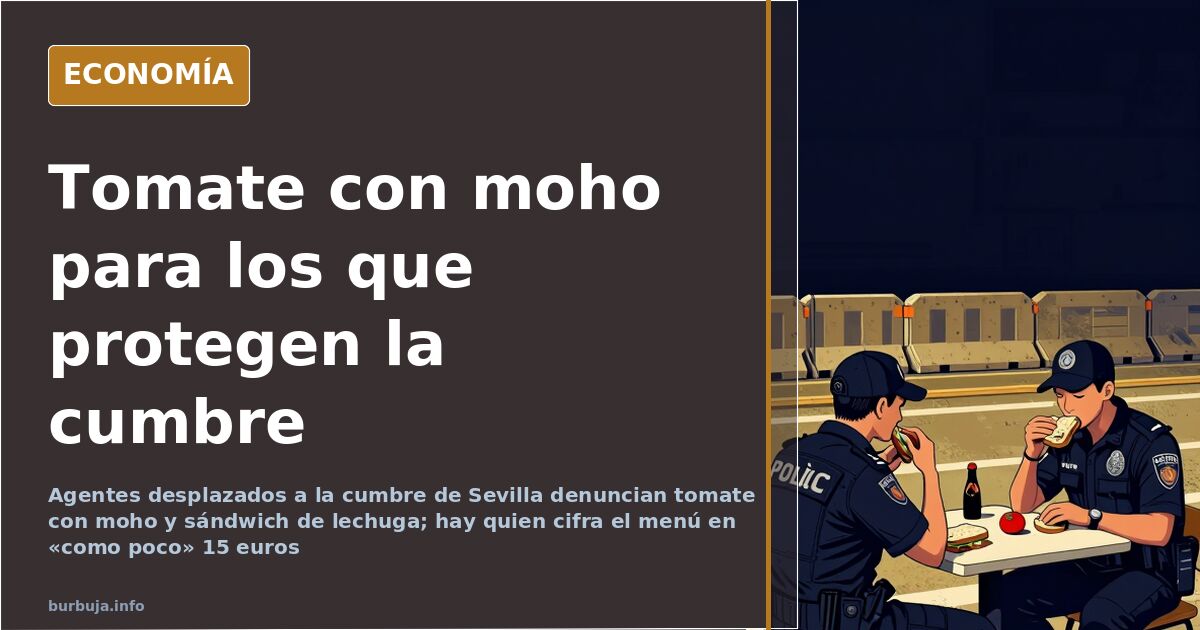
The quality is terrible and the quantity lamentable. This is how police officers deployed to the Seville summit describe their meals: on Sunday, a "tiny" plate of pasta with "four pieces of sausage," a side salad of just lettuce, and a banana. On Saturday, some were given a moldy tomato and a lettuce sandwich. According to several participants, this security deployment has become a symbol of a deeper fracture: that between the police force and the institution they serve.
What is served and what it costs
The menu described in the material is sparse: pasta with sausages, lettuce salad, and fruit. The complaint is not only about quantity—the dish is "tiny"—but also food safety: a moldy tomato is not just a small portion, it is a health risk.
Some estimate the cost of this menu to taxpayers: "at least" €15 per meal. If multiplied by the number of deployed officers during the summit days, the bill is significant, according to this calculation. The contrast with what is served to political leaders at the same event is the most repeated argument among participants: while some eat catering, others receive mold.
The paradox pointed out by several participants is that the deployment is not mandatory for everyone. A portion of the officers attend voluntarily, receiving travel allowances (dietas), as stated in the thread. For those who defend this view, it weakens the narrative of sacrifice: if you go for economic interest, complaints about the food lose weight against those who receive neither allowance nor a proper meal.
The calculation no one makes: salary, bonuses, and allowances
The debate quickly shifts to finances. A circulating calculation places the monthly cost of an officer on deployment above €4,000, including base salary, supplements, and extras. Another estimate mentions officers earning around €40,000 annually with bonuses included.
With these figures on the table, the conclusion for many participants is simple: if you earn that much, buy your own sandwich. The comparison with citizens who do not receive allowances or supplements for commuting to work is the argument that closes most interventions. The detailed breakdown of items—base pay, supplements, allowances, overtime—is where the calculation becomes uncomfortable for the official narrative, according to those raising it.
"Report it to Health Authorities, don't just complain"
The dominant current in the thread does not ask for solidarity with the officers. It asks for consistency. The recurring argument: if the tomato is moldy, there is an administrative route—a health inspection, formal complaint—and it is not used. They are demanded to apply the same rigor to catering services as they do to hospitality businesses.
The underlying accusation is harsher: during lockdowns, part of the force acted with maximum severity against citizens—checks, helicopters, fines for walking—and now, facing a grievance of their own, they do not find the same courage. "That's how it is", they ironically say, throwing back the argument the officers used then.
Rome doesn't pay traitors: the pandemic factor
The thread is not about food. It is about sides. The most repeated phrase is that Rome doesn't pay traitors. The thesis of those using it: those who defended the government to death during the pandemic and afterwards, who arrested innocents with questionable orders, have no sarracena right to complain when the same government serves them garbage.
According to some participants, the institutional fracture extends beyond the police force. Judges, the monarchy, the political class, and healthcare workers are questioned. "Fifteen years ago, all this was unthinkable", summarizes one intervention. The state is perceived as a structure that no longer protects those who serve it. And the summit menu is just the visible anecdote of this disillusionment.
Based on these points, the most repeated prediction is that volunteers will not be lacking for the next summit deployment. The allowances remain. So does the mold. No one bets that the complaint will change anything.
The quality is terrible and the quantity lamentable. This is how police officers deployed to the Seville summit describe their meals: on Sunday, a "tiny" plate of pasta with "four pieces of sausage," a side salad of just lettuce, and a banana. On Saturday, some were given a moldy tomato and a lettuce sandwich. According to several participants, this security deployment has become a symbol of a deeper fracture: that between the police force and the institution they serve.
What is served and what it costs
The menu described in the material is sparse: pasta with sausages, lettuce salad, and fruit. The complaint is not only about quantity—the dish is "tiny"—but also food safety: a moldy tomato is not just a small portion, it is a health risk.
Some estimate the cost of this menu to taxpayers: "at least" €15 per meal. If multiplied by the number of deployed officers during the summit days, the bill is significant, according to this calculation. The contrast with what is served to political leaders at the same event is the most repeated argument among participants: while some eat catering, others receive mold.
The paradox pointed out by several participants is that the deployment is not mandatory for everyone. A portion of the officers attend voluntarily, receiving travel allowances (dietas), as stated in the thread. For those who defend this view, it weakens the narrative of sacrifice: if you go for economic interest, complaints about the food lose weight against those who receive neither allowance nor a proper meal.
The calculation no one makes: salary, bonuses, and allowances
The debate quickly shifts to finances. A circulating calculation places the monthly cost of an officer on deployment above €4,000, including base salary, supplements, and extras. Another estimate mentions officers earning around €40,000 annually with bonuses included.
With these figures on the table, the conclusion for many participants is simple: if you earn that much, buy your own sandwich. The comparison with citizens who do not receive allowances or supplements for commuting to work is the argument that closes most interventions. The detailed breakdown of items—base pay, supplements, allowances, overtime—is where the calculation becomes uncomfortable for the official narrative, according to those raising it.
"Report it to Health Authorities, don't just complain"
The dominant current in the thread does not ask for solidarity with the officers. It asks for consistency. The recurring argument: if the tomato is moldy, there is an administrative route—a health inspection, formal complaint—and it is not used. They are demanded to apply the same rigor to catering services as they do to hospitality businesses.
The underlying accusation is harsher: during lockdowns, part of the force acted with maximum severity against citizens—checks, helicopters, fines for walking—and now, facing a grievance of their own, they do not find the same courage. "That's how it is", they ironically say, throwing back the argument the officers used then.
Rome doesn't pay traitors: the pandemic factor
The thread is not about food. It is about sides. The most repeated phrase is that Rome doesn't pay traitors. The thesis of those using it: those who defended the government to death during the pandemic and afterwards, who arrested innocents with questionable orders, have no sarracena right to complain when the same government serves them garbage.
According to some participants, the institutional fracture extends beyond the police force. Judges, the monarchy, the political class, and healthcare workers are questioned. "Fifteen years ago, all this was unthinkable", summarizes one intervention. The state is perceived as a structure that no longer protects those who serve it. And the summit menu is just the visible anecdote of this disillusionment.
Based on these points, the most repeated prediction is that volunteers will not be lacking for the next summit deployment. The allowances remain. So does the mold. No one bets that the complaint will change anything.
Summary of a discussion on Burbuja.info - Foro de economía, actualidad y política., translated from Spanish and reviewed before publication. Read the full discussion (140 replies).
More summaries
-
Spain Police Pay Debate: €2,000 Net vs. €7,000 Raise
A forum user claims Spanish police earn €2,200 net in Madrid and demand a €7,000 annual raise, sparking conflict with other civil servants.
-
Spanish Civil Guard arrests influencer in Seville for hate speech
The Spanish Civil Guard arrested a social media influencer with 125,000 followers in Seville for spreading misogynistic hate speech.
-
Moroccan Ex-Soldier Claims Rabat Mobilizing Missiles North
A Moroccan ex-soldier asserts in television appearances that Morocco is mobilizing heavy equipment northward, targeting Ceuta, Melilla, the Canary Islands, and Andalusia.
-
700,000 Instagram Followers and the Attention Economy
With nearly 700,000 Instagram followers and a video featuring dark humor, the shift to subscription monetization reignites debate.
-
Smartphone Addiction: Designed to Hook, Unregulated
Pedestrians ignored green lights while glued to phones. Experts blame intentional design features that foster compulsive usage.
-
Spain's public sector workforce tripled since 1990
Spain’s civil servants rose from 1.2 million in 1990 to nearly 3 million. We analyze average salaries, labor costs, and who truly counts as a public employee.