
Miss Alabama Winner Sparks Obesity Debate Amid Contest Confusion
An obese woman wins a Miss Alabama title, igniting a debate on body representation and health, while doubts arise about whether it was the official pageant.
English · Original discussion in Spanish · Published
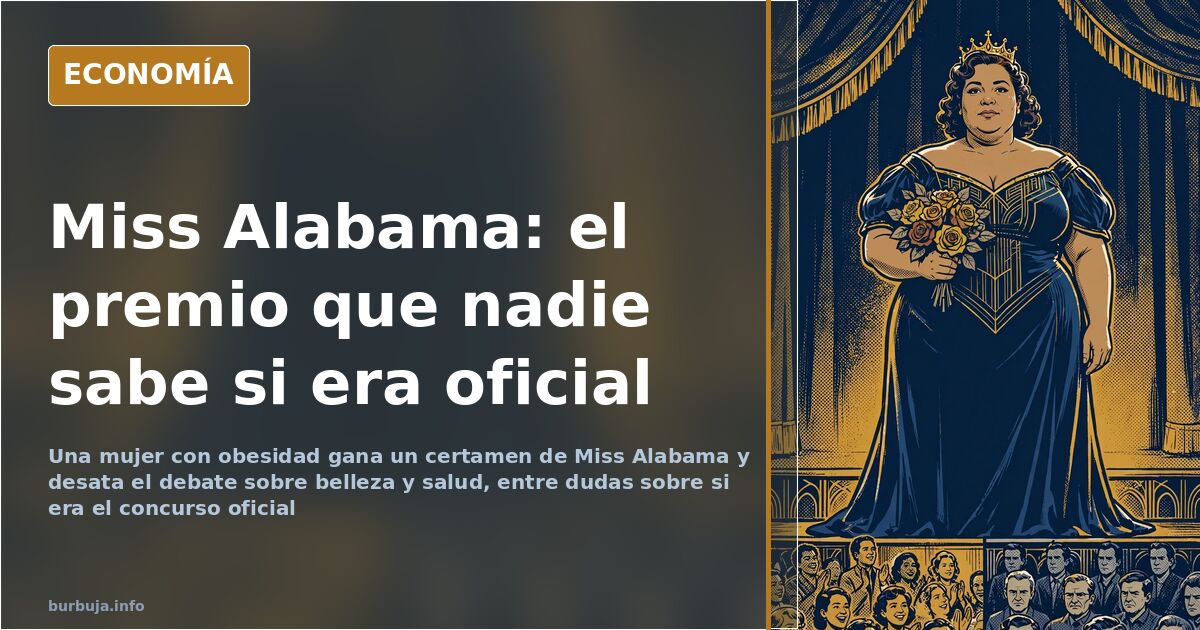
Miss Alabama reopens debate on beauty and obesity
An obese woman won a Miss Alabama pageant, and her photo went viral worldwide. The image sparked two opposing views: that the award celebrates all body types, and that it normalizes a health issue. Beneath both lies an uncomfortable doubt: the winner may not be from the official contest.
What peine with the Miss Alabama pageant
A profile dedicated to replicating viral content posted the winner’s photo with an explicit message: it promotes inclusivity and body representation, but obesity should not be glorified because it is unhealthy. This tension condensed into two phrases. The conversation quickly shifted to the role of beauty pageants and whether the awarded body should represent something beyond itself.
A second front soon peine. Several messages pointed out that the Miss Alabama 2024 pageant had not yet taken place — it is held in late June — and that the woman in the photo was not listed among the candidates on the organization’s website. With this fact, suspicion grew that the circulating award was not the official one.
And here the matter gets tangled. Because in part of the exchange, the discussion focused on where the photograph came from, not beauty.
The tangle of dates and the official website
The documentary trail left by the discussion itself is contradictory, and it should not be closed prematurely. One side argues that there are two or more pageants using the name Miss Alabama, and that the winner in the photo belongs to one of them, not the main pageant. Another part of the exchange cites press information that treated the victory as real, reaching the same conclusion: the awarded woman circulating does not match the official pageant winner. Verification remained inconclusive.
What is striking is that the controversy was built on such fragile ground. Discussing for hundreds of messages whether a pageant is authentic or not is, in itself, a symptom of how misinformation works today: an image without context is enough to ignite a whole debate. Some argue that the only goal was to generate traffic on social media with any issue, regardless of what it was.
Is obesity a health issue?
Obesity is a medical condition, and its management falls to healthcare professionals. That said, the discussion crossed statements about the supposed health consequences for the person in the photo, made without any diagnosis or clinical data. These are opinions, not medical reports, and should be read as such.
What the case does raise is a legitimate question with no easy answer: should a beauty pageant award an obese body as a model of representation? Those who defend it argue that body diversity is a social reality, and ignoring it is worse. Those who criticize it maintain that mixing inclusivity with healthiness is a fundamental error.
Beauty pageants, between the canon and representation
Here, the exchange splits into two currents. One argues that beauty pageants used to award beauty, tautologically, and now seek to reward what some would like to be considered beautiful. The other responds that the beauty canon has always been a changing cultural product, and that representing diverse bodies is not an attack on anyone.
In the middle, a comparison emerges from the exchange: the case of Germany, where — according to claims in the discussion — a woman over fifty was named to a title of this type. It is cited as proof that something has changed in the unwritten rules of these pageants. Whether this change is a legitimate evolution or an imposed narrative, each person decides.
Alabama, the poorest state in the country
A detail that repeats in the conversation and adds context: Alabama is, according to claims in the discussion, the poorest state in the United States. This is not a minor fact for understanding the noise. Body representation is not discussed the same way in a place with specific socioeconomic conditions as in another.
And there is the detail that disorients and no one fully fits: the showcase that has placed an obese woman at the center of the global controversy is, precisely, the state with the fewest resources in the country. Beauty, like almost everything else, also depends on where you are born.
Also available in: Deutsch
Summary of a discussion on Burbuja.info - Foro de economía, actualidad y política., translated from Spanish and reviewed before publication. Read the full discussion (248 replies).
More summaries
-
US Army Sent Sick Troops to Europe in 1918
Wilson kept troop ships sailing despite onboard flu outbreaks. The biological weapon theory lacks evidence.
-
Why the US has no high-speed rail and Spain does
Spain has the world's second-largest high-speed rail network while the US has none: the 700 km between Boston and Washington still have no high-speed rail.
-
US sends aircraft carrier Gerald Ford to Israel
Pentagon sends the Gerald Ford to Israel with Iron Dome weapons, but its actual air wing is not the 90 F-35s announced
-
Polar air and supercell warning in Cordoba
An expert warns of a temperature drop with capitals below 5°C while a supercell is recorded in Montemayor, Cordoba.
-
Woman in sportswear walking in Morocco draws stares and sparks debate
A video of a woman in sportswear walking in Morocco prompts a debate in Spain about how modernity and freedom are perceived.
-
Nayib Bukele's El Salvador ranked world's second-best tourist destination
The claim that El Salvador is the world's second-best tourist destination has sparked debate. We examine the economic context and the figures behind it.