
Milei wins Argentina election, crushing Peronism in key provinces
Javier Milei wins the Argentine presidential election, leaving Peronism with only four provinces as dollar-denominated wages plummet to $341.
English · Original discussion in Spanish · Published
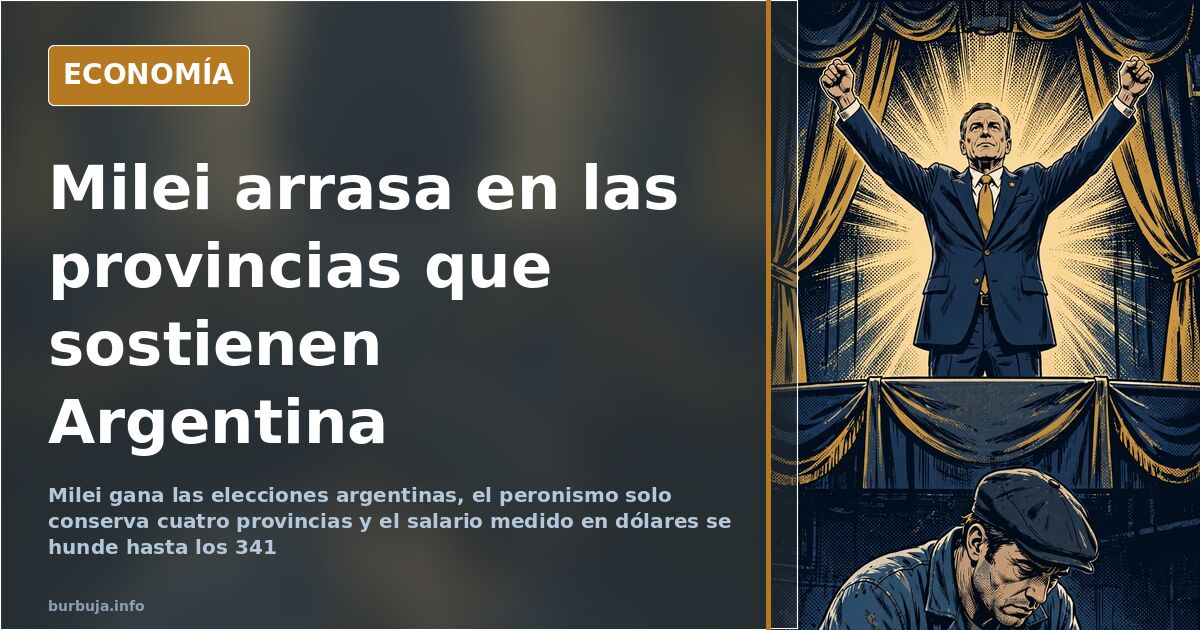
Milei wins in Argentina and Peronism collapses in its own strongholds
Official candidate Sergio Massa conceded victory to Javier Milei before official data was released, scheduled for 9 PM. The scene caught everyone off guard: it is rare for a state apparatus leader to admit defeat with barely half the votes counted. Milei, a candidate without a party, governors, or territorial structure, became President of Argentina. And the voting pattern was as brutal as predictable for those who know the country: he won where people work. Well, that’s what the numbers say.
Where Milei won: 80/20 margins in the provinces that sustain the country
Córdoba, Santa Fe, Mendoza, Entre Ríos, Corrientes, and the City of Buenos Aires gave Milei overwhelming victories, with margins reaching 80/20 and 70/30. These are the provinces that generate wealth and fiscally support the rest. In contrast, Peronism would have retained only four provinces, all heavily dependent on subsidies and public employment. Even in districts with deep-rooted Peronist tradition, the liberal candidate prevailed.
In the province of Buenos Aires, the government's strongest bastion, the margin obtained was not enough to balance the national scale. Projections pointed to a global sum around 55/45, with scenarios of 60/40 and even 62/38. Provincial details matter more than they seem: a stronghold where employment depends on the State does not vote like an agro-export region with economic autonomy.
Peronism bets on the streets: ten governorships, the Senate, and unions
Winning the presidency is not winning power. Peronism maintains control of about ten governorships, a strong presence in the Senate, and notable influence in the Chamber of Deputies. Added to this is the dominance of unions and hundreds of thousands of public employees, plus mayoralties spread across thousands of municipalities. Milei has no mayors, no governors, and hardly any legislators of his own.
The subsequent realignment after a surprising election—polls indicated a head-to-head race—becomes the true battlefield. The lingering question is not who won, but what the retreating Peronism will do with that intact apparatus.
The most expensive campaign: between 2 and 3% of GDP and two trillion in direct payments
According to reports, the official machinery spent between two and three percentage points of GDP on its campaign. There are mentions of cash handouts, bank credits equivalent to up to $1,000 per applicant, negative advertising against Milei with virtually unlimited funds, and a wave of subsidies for transport, energy, and price controls. The figure circulating as direct payment amounts to two trillion pesos in just a few months.
There were also mass appointments of permanent staff. All this scaffolding, experts warn, will collapse with the change of government. The anecdote summarizing the chaos: at noon on election day, the official structure reportedly suspended voter transportation upon realizing it was paying for trips by people who did not vote for them.
Wages in dollars: from $1,421 to $341 in a decade
The data explaining the exhaustion is the loss of purchasing power measured in hard currency. In August 2012, an average salary of 6,610 pesos equated to about $1,421 at the official exchange rate. With the market dollar at 878 pesos and an average salary near 300,000 pesos, that purchasing power would have plummeted to about $341. Comparisons with countries of similar wealth suggest Argentina should be moving between $650 and $1,500.
Meanwhile, official poverty rose from 31% when Macri took office in 2015 to 35% when he left in 2019, and from 31% at the start of the current administration to 40% at its end, according to INDEC figures. Other private measurements raise the percentage. Here enters an uncomfortable nuance: with half the economy informal, many listed as poor in statistics have incomes far higher than declared.
The 80% adjustment and the uncertainty of dollarization
The program defended by Milei contemplates cutting public spending by around 80%, lowering taxes on capital, and attracting foreign investment. The underlying argument is that eliminating inflation and growing is easier in a rich country than in an impoverished one, and neighbors like Paraguay, Bolivia, Uruguay, or Chile have already shown that the recipes are not impossible. The initial readjustment, even the optimists admit, will be harsh.
The practical question remains unanswered. With governors, senators, unions, and hundreds of thousands of public employees opposed, the estimulante ilegal of any reform will depend on negotiating capacity. And many voters celebrating in the streets today will be on the opposite side once the first bill of the adjustment arrives.
It remains to be seen how long the charm lasts. Milei arrives with strong backing and the expectation of an economic miracle that no one has explained how to execute. That is where the analysis stalls: between the clear mandate of the polls and the reality of a country that has gone decades without the arithmetic adding up.
Official candidate Sergio Massa conceded victory to Javier Milei before official data was released, scheduled for 9 PM. The scene caught everyone off guard: it is rare for a state apparatus leader to admit defeat with barely half the votes counted. Milei, a candidate without a party, governors, or territorial structure, became President of Argentina. And the voting pattern was as brutal as predictable for those who know the country: he won where people work. Well, that’s what the numbers say.
Where Milei won: 80/20 margins in the provinces that sustain the country
Córdoba, Santa Fe, Mendoza, Entre Ríos, Corrientes, and the City of Buenos Aires gave Milei overwhelming victories, with margins reaching 80/20 and 70/30. These are the provinces that generate wealth and fiscally support the rest. In contrast, Peronism would have retained only four provinces, all heavily dependent on subsidies and public employment. Even in districts with deep-rooted Peronist tradition, the liberal candidate prevailed.
In the province of Buenos Aires, the government's strongest bastion, the margin obtained was not enough to balance the national scale. Projections pointed to a global sum around 55/45, with scenarios of 60/40 and even 62/38. Provincial details matter more than they seem: a stronghold where employment depends on the State does not vote like an agro-export region with economic autonomy.
Peronism bets on the streets: ten governorships, the Senate, and unions
Winning the presidency is not winning power. Peronism maintains control of about ten governorships, a strong presence in the Senate, and notable influence in the Chamber of Deputies. Added to this is the dominance of unions and hundreds of thousands of public employees, plus mayoralties spread across thousands of municipalities. Milei has no mayors, no governors, and hardly any legislators of his own.
The subsequent realignment after a surprising election—polls indicated a head-to-head race—becomes the true battlefield. The lingering question is not who won, but what the retreating Peronism will do with that intact apparatus.
The most expensive campaign: between 2 and 3% of GDP and two trillion in direct payments
According to reports, the official machinery spent between two and three percentage points of GDP on its campaign. There are mentions of cash handouts, bank credits equivalent to up to $1,000 per applicant, negative advertising against Milei with virtually unlimited funds, and a wave of subsidies for transport, energy, and price controls. The figure circulating as direct payment amounts to two trillion pesos in just a few months.
There were also mass appointments of permanent staff. All this scaffolding, experts warn, will collapse with the change of government. The anecdote summarizing the chaos: at noon on election day, the official structure reportedly suspended voter transportation upon realizing it was paying for trips by people who did not vote for them.
Wages in dollars: from $1,421 to $341 in a decade
The data explaining the exhaustion is the loss of purchasing power measured in hard currency. In August 2012, an average salary of 6,610 pesos equated to about $1,421 at the official exchange rate. With the market dollar at 878 pesos and an average salary near 300,000 pesos, that purchasing power would have plummeted to about $341. Comparisons with countries of similar wealth suggest Argentina should be moving between $650 and $1,500.
Meanwhile, official poverty rose from 31% when Macri took office in 2015 to 35% when he left in 2019, and from 31% at the start of the current administration to 40% at its end, according to INDEC figures. Other private measurements raise the percentage. Here enters an uncomfortable nuance: with half the economy informal, many listed as poor in statistics have incomes far higher than declared.
The 80% adjustment and the uncertainty of dollarization
The program defended by Milei contemplates cutting public spending by around 80%, lowering taxes on capital, and attracting foreign investment. The underlying argument is that eliminating inflation and growing is easier in a rich country than in an impoverished one, and neighbors like Paraguay, Bolivia, Uruguay, or Chile have already shown that the recipes are not impossible. The initial readjustment, even the optimists admit, will be harsh.
The practical question remains unanswered. With governors, senators, unions, and hundreds of thousands of public employees opposed, the estimulante ilegal of any reform will depend on negotiating capacity. And many voters celebrating in the streets today will be on the opposite side once the first bill of the adjustment arrives.
It remains to be seen how long the charm lasts. Milei arrives with strong backing and the expectation of an economic miracle that no one has explained how to execute. That is where the analysis stalls: between the clear mandate of the polls and the reality of a country that has gone decades without the arithmetic adding up.
Summary of a discussion on Burbuja.info - Foro de economía, actualidad y política., translated from Spanish and reviewed before publication. Read the full discussion (202 replies).
More summaries
-
Spain recalls ambassador to Argentina after clash with Milei
Spain permanently withdraws its ambassador to Buenos Aires following a diplomatic row with Argentine President Javier Milei over Begoña Gómez, impacting 475,000 residents and billions in assets.
-
Milei Wins Argentine Elections, Promises Dollarization
Javier Milei defeats Sergio Massa in Argentina, pledging to dollarize the economy and reduce ministries to ten or eleven.
-
Huerta de Soto breaks down Milei's ten points from Davos in class
Analysis of Milei's Davos speech: from Adam Smith as a lukewarm social democrat to 58% of income seized by the state, with Argentina footing the bill
-
Ceuta: radical mobilisation, one arrest and police charges, according to footage
Radical left mobilises in Ceuta and, according to circulating videos, police charge Ceutans gathered at the port: one arrest
-
Spain's soda price war: €2.80 for 200ml in restaurants
A €16 pizza and two €2.80 Cokes reveal Spain's soaring soft drink prices and stagnant wages.
-
Ceuta faces mass migration crisis challenging Spanish government
20,000 migrants entered Ceuta in days. The government remains silent as Morocco applies pressure.