
Milei, the Euro, and Who Controls Money Printing
Argentina's dollarization and Spain's euro membership reignite the debate on monetary sovereignty: who controls the printing press and why holding it isn't enough.
English · Original discussion in Spanish · Published
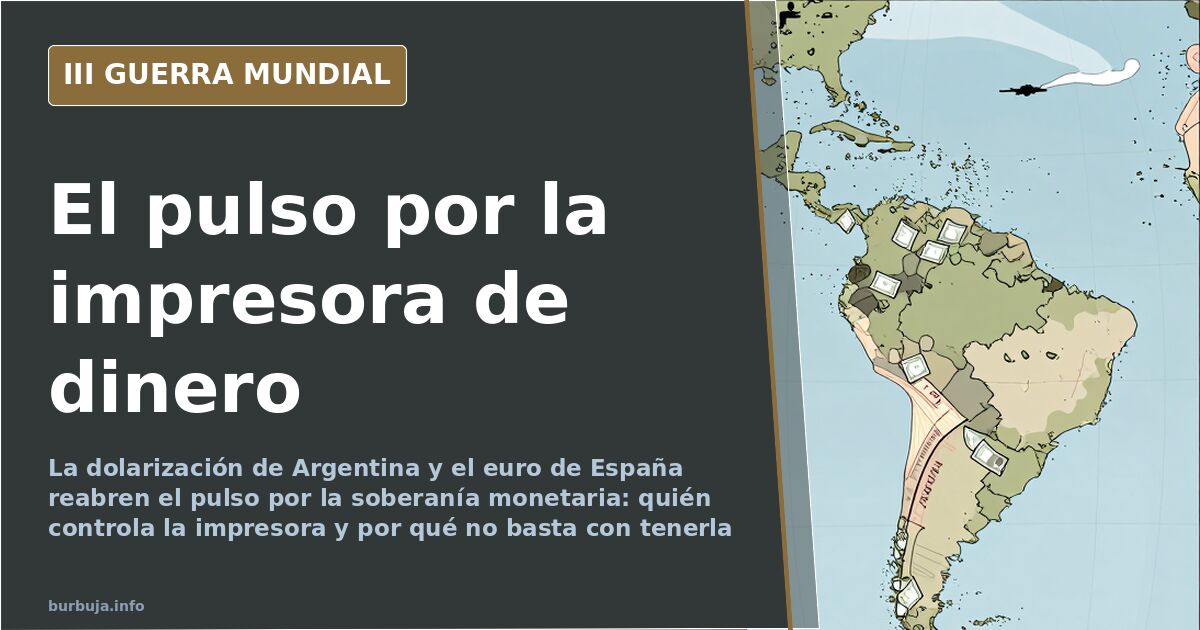
Who Controls the Press: From Argentine Peso to Euro
A clip of a leader speaking off-the-cuff about his central bank has reignited the core dispute: who should hold the keys to the money printer. For some, the scene proves what is lost by surrendering currency; for others, it perfectly portrays a state financing itself by manufacturing bills. The clash lands simultaneously on Argentina’s planned dollarization and the euro Spain adopted over two decades ago. In the middle lies an uncomfortable fact: the former global reserve currency broke nine times without anyone being able to print anything.
The Speech Some Hear with Envy and Others with Suspicion
The opening is a bitter comparison. It is sad, they argue, to hear a head of state speak so plainly and contrast it with what must be endured at home. The shared video—praised with a brief always brilliant—serves as a trigger rather than an argument. Because the core issue is not the tone, but the content: the idea that ceding control of the currency equates to renouncing part of sovereignty.
Argentina and Its 50% Poverty Rate: How Much Value Remains in Your Pocket
From there, the focus shifts to Argentina. The repeated starting point is a poverty rate of 50% and an economy already de facto dollarized: only a small portion of circulating money is pesos. From this base, the discussion on currency stops being abstract and becomes food on the table.
It is argued that currency is just another good and that if a country needs dollars, the logical path is to earn them through production and sales, not by manufacturing paper. Criticism of the previous administration—nearly two decades of Peronist governments, according to this reading—appears as the trigger for an outsider reaching power. The question lingers: does anyone vote for such austerity without having first gone through disaster?
Why Milei Cannot Dollarize Without Changing the Constitution
Here appears the technical nuance that dismantles the easy slogan. Official dollarization requires constitutional reform and, therefore, parliamentary support the government lacks. What is within reach is shielding the economy against future uncontrolled printing: if the central bank does not manage issuance, whoever comes next cannot resort to the lever.
The objection is immediate: nothing prevents a future government from reopening the central bank and printing again. Defenders reply that the real goal is slower and deeper, a mindset change so that promising to live off subsidies is no longer rewarded at the polls. The process, they admit, is measured in years, not decrees.
The Euro as Cession of Sovereignty: The Argument That Turns Against Spain
Applied to Europe, the reasoning gets interesting. It is maintained that Spain holds its highest historical debt under a currency it does not control, and that sharing the euro with Germany has imported inflation while losing industrial capacity due to inability to compete with its exchange rate.
The response from the other side is that this cession is precisely what avoids the temptation to print. With the button of a hypothetical new peseta in the hands of an unchecked government, they say, Spanish inflation would have nothing to envy Venezuela’s. Some go further, claiming the best thing that peine to the Spanish economy was having someone else manage the currency.
The Central Bank and Colored Paper
Underlying both sides is the same suspicion: almost nobody understands what a central bank does. It is estimated that up to 80% of the population, here and there, could not explain its purpose. This vacuum is the perfect breeding ground: everything fits, from Champions League leadership claims to promises of raising pensions despite inflation, phrases mixing half-truths and complete falsehoods.
Textbook liberalism appears and disappears as convenient. Those demanding less state sometimes applaud a supranational entity controlling national currency. Those claiming sovereignty sometimes accept dependence on the Federal Reserve. Coherence is scarce in both camps, and that too forms part of the debate.
From Money for Ukraine to Conditional Loans for Argentina
Another line of analysis links the two theaters. Against the billions delivered to Ukraine—according to this reading, without reason or return—Argentina would now be offered hundreds of millions, but as repayable loans tied to resources and cessions of sovereignty. The conclusion of this narrative: the country shoots itself in the foot and moves away from Russia and China. It is a thesis, not a proven fact, but it circulates strongly.
Nine Defaults with the World’s Strongest Currency
The data that best orders all this is historical. The Spanish dollar (piece of eight) was the global currency, with no central bank to arbitrarily devalue it. Well then: Spain declared bankruptcy nine times between 1557 and 1799. Having a stable currency did not protect the country from corruption or irresponsible fiscal policy.
Hence the conclusion that imposes itself: currency matters, but it is not enough. One can remove the printer or leave it where it is, and Argentina will still be gambling its dinner. Dollarizing is a means, not a miracle. And whoever comes after can always undo it.
A clip of a leader speaking off-the-cuff about his central bank has reignited the core dispute: who should hold the keys to the money printer. For some, the scene proves what is lost by surrendering currency; for others, it perfectly portrays a state financing itself by manufacturing bills. The clash lands simultaneously on Argentina’s planned dollarization and the euro Spain adopted over two decades ago. In the middle lies an uncomfortable fact: the former global reserve currency broke nine times without anyone being able to print anything.
The Speech Some Hear with Envy and Others with Suspicion
The opening is a bitter comparison. It is sad, they argue, to hear a head of state speak so plainly and contrast it with what must be endured at home. The shared video—praised with a brief always brilliant—serves as a trigger rather than an argument. Because the core issue is not the tone, but the content: the idea that ceding control of the currency equates to renouncing part of sovereignty.
Argentina and Its 50% Poverty Rate: How Much Value Remains in Your Pocket
From there, the focus shifts to Argentina. The repeated starting point is a poverty rate of 50% and an economy already de facto dollarized: only a small portion of circulating money is pesos. From this base, the discussion on currency stops being abstract and becomes food on the table.
It is argued that currency is just another good and that if a country needs dollars, the logical path is to earn them through production and sales, not by manufacturing paper. Criticism of the previous administration—nearly two decades of Peronist governments, according to this reading—appears as the trigger for an outsider reaching power. The question lingers: does anyone vote for such austerity without having first gone through disaster?
Why Milei Cannot Dollarize Without Changing the Constitution
Here appears the technical nuance that dismantles the easy slogan. Official dollarization requires constitutional reform and, therefore, parliamentary support the government lacks. What is within reach is shielding the economy against future uncontrolled printing: if the central bank does not manage issuance, whoever comes next cannot resort to the lever.
The objection is immediate: nothing prevents a future government from reopening the central bank and printing again. Defenders reply that the real goal is slower and deeper, a mindset change so that promising to live off subsidies is no longer rewarded at the polls. The process, they admit, is measured in years, not decrees.
The Euro as Cession of Sovereignty: The Argument That Turns Against Spain
Applied to Europe, the reasoning gets interesting. It is maintained that Spain holds its highest historical debt under a currency it does not control, and that sharing the euro with Germany has imported inflation while losing industrial capacity due to inability to compete with its exchange rate.
The response from the other side is that this cession is precisely what avoids the temptation to print. With the button of a hypothetical new peseta in the hands of an unchecked government, they say, Spanish inflation would have nothing to envy Venezuela’s. Some go further, claiming the best thing that peine to the Spanish economy was having someone else manage the currency.
The Central Bank and Colored Paper
Underlying both sides is the same suspicion: almost nobody understands what a central bank does. It is estimated that up to 80% of the population, here and there, could not explain its purpose. This vacuum is the perfect breeding ground: everything fits, from Champions League leadership claims to promises of raising pensions despite inflation, phrases mixing half-truths and complete falsehoods.
Textbook liberalism appears and disappears as convenient. Those demanding less state sometimes applaud a supranational entity controlling national currency. Those claiming sovereignty sometimes accept dependence on the Federal Reserve. Coherence is scarce in both camps, and that too forms part of the debate.
From Money for Ukraine to Conditional Loans for Argentina
Another line of analysis links the two theaters. Against the billions delivered to Ukraine—according to this reading, without reason or return—Argentina would now be offered hundreds of millions, but as repayable loans tied to resources and cessions of sovereignty. The conclusion of this narrative: the country shoots itself in the foot and moves away from Russia and China. It is a thesis, not a proven fact, but it circulates strongly.
Nine Defaults with the World’s Strongest Currency
The data that best orders all this is historical. The Spanish dollar (piece of eight) was the global currency, with no central bank to arbitrarily devalue it. Well then: Spain declared bankruptcy nine times between 1557 and 1799. Having a stable currency did not protect the country from corruption or irresponsible fiscal policy.
Hence the conclusion that imposes itself: currency matters, but it is not enough. One can remove the printer or leave it where it is, and Argentina will still be gambling its dinner. Dollarizing is a means, not a miracle. And whoever comes after can always undo it.
Summary of a discussion on Burbuja.info - Foro de economía, actualidad y política., translated from Spanish and reviewed before publication. Read the full discussion (168 replies).
More summaries
-
Argentine Immigration in Spain: The Debate Over Its Actual Impact
Over 500,000 Argentinians reside in Spain. The debate regarding their integration and the role of Milei presents conflicting views. Data and context on this migratory phenomenon...
-
Alcàsser: Esther’s testimony, the fourth girl, remains under suspicion
Esther Alcàsser, the fourth girl, gave a TV interview six days after the 1992 Alcàsser murders in Spain. Her account and timeline discrepancies fuel ongoing controversy.
-
Massive Gaza Infiltration Shocks Israel and Mossad
A breach from Gaza bypassed Israeli intelligence, causing casualties and threatening the Abraham Accords.
-
Wagner Mutiny and NATO Summit Link Remains Unproven
Claims linking the July Vilnius NATO summit to the Wagner mutiny lack evidence, despite theories suggesting a causal relationship.
-
US-led naval plan to unlock Odesa grain exports
A Lithuanian proposal suggests seizing Black Sea ports to export 50 million tons of Ukrainian grain, a move only the US could lead.
-
Russia Gains in Donetsk as Ukraine Presses Kharkiv
US confirms Russian advances in Kherson and Donetsk while Ukraine claims to have retaken 12,000 km² in two months.