
Milei at Davos: Speech Against the 'Socialist Agenda 2030'
Milei claimed Davos is 'contaminated by the 2030 socialist agenda.' His criticism stems from orthodox economic views and IMF aid.
English · Original discussion in Spanish · Published
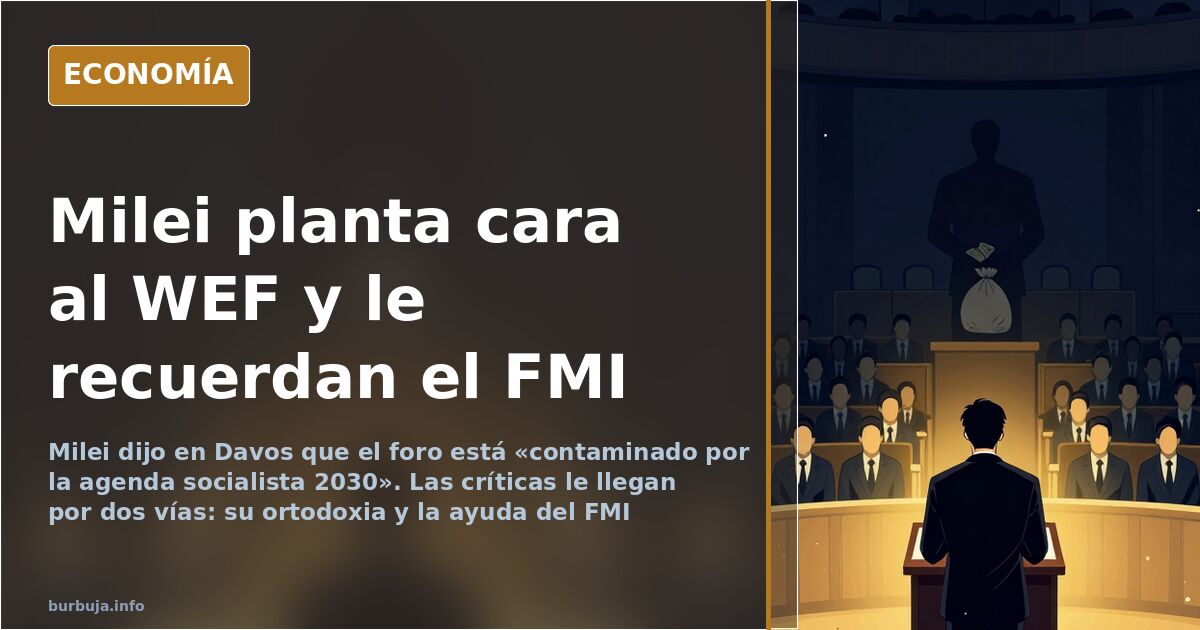
Milei at Davos: A Kick to Collectivism and Two Bills to Pay
Can you take the stage at the World Economic Forum and tell the attendees they are part of the problem? Javier Milei tried. He stated that the venue is 'contaminated by the 2030 socialist agenda' and that his goal there was to 'plant the ideas of freedom.' He concluded with the catchphrase that has become his trademark: LONG LIVE FREEDOM, DAMMIT. The gesture peine two fronts simultaneously: whether his economic diagnosis holds or is pure sloganeering, and whether the one who denounces the caste is, in turn, another piece on the board.
A First-Year Economics Speech
The reception was uneven, even among those who sympathize with the message. Critics argue the text was a first-year paper, monotonous and soulless, with several pointing to Huerta de Soto as a favorite author. On the positive side, he received credit for an attack on militant feminism and a triumphant closing. What nearly sparked applause was a specific mention: the denunciation of the 'bloody abortion agenda' spoken aloud in a venue that rarely hears it.
From then on, the conversation stopped discussing the text and started discussing the man. This is the risk of turning a speech into a slogan: the slogan remains, the argument dilutes.
From Forum to Suspicion
A part of the analysis did not enter his program, but his loyalty. It is argued that he is the pampered kitten of the World Economic Forum and that his intervention only seeks to ingratiate himself with those who support him. Statements also emerge about large Anglo-Saxon investment funds and supposed hidden global agendas. None of this is accompanied by proof: these are baseless suspicions circulating as if they were data.
There is a detail that bothers both sides. The same man who denounces the club appears in the official club photo, with a forced smile and an accreditation badge hanging.
Liberal or Economic Pirate?
The most repeated criticism is that Milei is not liberal, but an opportunist using free markets as a flag of convenience. The most orderly defense argues the opposite: that dominant positions within a market are not a system failure, and that liberalism consists of establishing a legal framework that prevents trade by coercion, deception, and abuse.
The reply comes from the other side. Companies prefer to fix prices rather than compete, because competition eats their profitability, which is what truly matters to them; governments themselves sanction these agreements precisely because they know they exist. And meritocracy, it is argued, clashes with equity without resolving either.
Argentina: Caste, Peronism, and 6 Million Immigrants
The heaviest context is the country receiving the mandate. It is described as a failed state in terms of narcotics, with Peronism controlling the Senate for 40 years and, with it, the appointment of judges, plus unions led by millionaire executives; more than 70% of the population would depend on state handouts. In this framework, any decision coming from the market is seen as the lesser evil compared to what a political class decides, which is said to rival the disaster of countries without institutions.
The historical dispute also appears. Argentina being the richest country in the world is nuanced: Luxembourg leads per capita income and is geopolitically irrelevant, and that first Argentine position might have been a brief mirage of the 1890s. Still, by the late 19th century, 6 million immigrants arrived. No one crosses the ocean to settle in a famine.
The IMF Bill and the Justice Problem
Here comes the low blow: one must look at what he does, not what he says, because so far he has accepted aid from the International Monetary Fund. It starts badly, summarized. The core objection is another: that the law being equal for all does not guarantee justice is equal, because a rich lawyer is not defended equally to one appointed by the state. From this, the uncomfortable conclusion arises: it is better to control judges than to fight to change laws.
In the background emerges the old saying that there are three ways to be a slave: being born one, being conquered, or owing money. Debt as a mechanism of domination is the piece closing the circle.
Planning What They Vote For
Faced with the state plan, the liberal argument relies on concrete cases: infrastructure decided by electoral criteria, airports without passengers, an AVE built because votes depend on it. If the market provides the money, the one who fails goes bankrupt; if the state provides it, the taxpayer pays. And Spain has added four decades without reducing unemployment, with debt sustaining spending.
No one denies that planning is necessary. What is denied is that the planner knows more than the one risking his money.
In the end, the speech that raised the most applause in Davos was the one that arrived written from home. And no one leaves that scenario with their antisystem card intact.
Summary of a discussion on Burbuja.info - Foro de economía, actualidad y política., translated from Spanish and reviewed before publication. Read the full discussion (332 replies).
More summaries
-
Huerta de Soto breaks down Milei's ten points from Davos in class
Analysis of Milei's Davos speech: from Adam Smith as a lukewarm social democrat to 58% of income seized by the state, with Argentina footing the bill
-
Javier Milei: "up against the wall"
We analyze Javier Milei's visit to the Western Wall and the debate over its impact on Argentina's foreign policy and its real significance back home.
-
Milei’s 35-Year Plan to Make Argentina a Global Power
Milei’s 35-year timeline sparks comparisons to historical figures and debate on prolonged power.
-
Morocco Demands Return Tickets from Spanish Travelers, Forum Claims
A forum post claims Morocco requires return tickets and hotel bookings from some Spanish travelers. The measure remains unconfirmed by official sources.
-
PP's social media manager: from backup of the backup to electoral weapon
The PP's community manager went from being the backup of the backup to running the party's digital strategy at Génova, using irony and jabs at the left during the 29-N campaign in Spain.
-
Universal basic income gains ground: from New Zealand to the Marshall Islands
New Zealand proposes a $19,400 income, Yang pays for your data, and Musk announces the end of money by 2036.