
Migrant Demographics Reignite Spain's Integration Debate
The gender and age profile of migration flows to Spain fuels debate on integration, sexual crime statistics, and public service pressure.
English · Original discussion in Spanish · Published
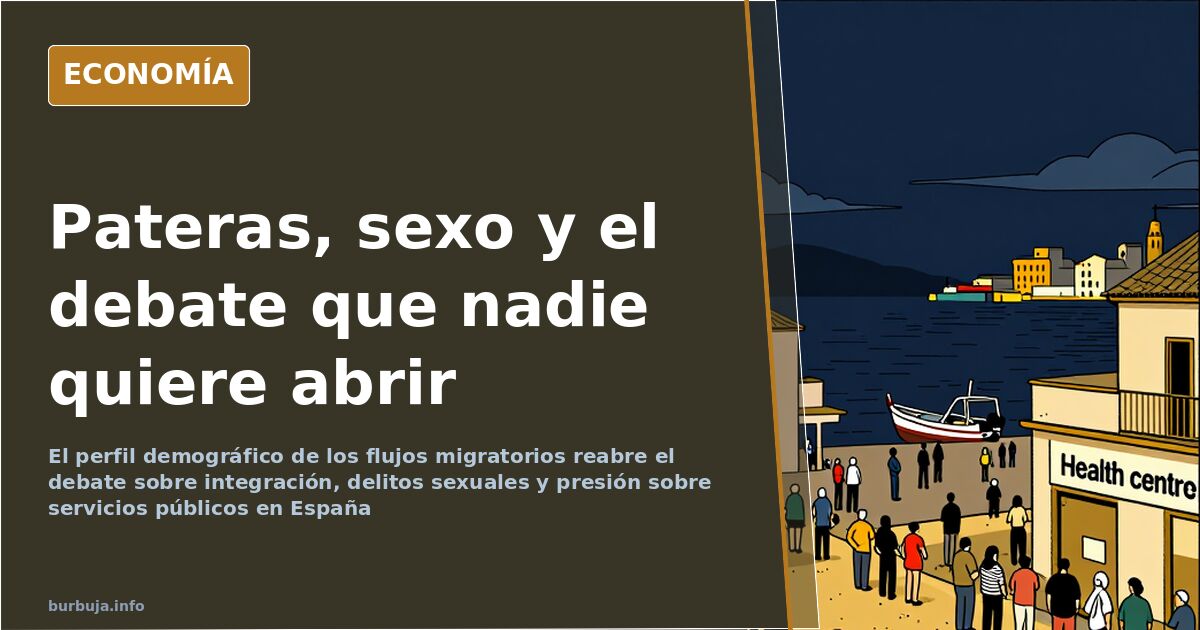
Migrant Demographics Reignite Spain's Integration Debate
A segment of online economic forums has shifted focus from housing costs or labor market impacts to a variable absent from official statistics: the sens and age composition of migration flows. The starting point is a stubborn observation. Boats arriving on Spanish coasts carry predominantly young men, many without family obligations, creating a demographic imbalance with social consequences barely addressed by institutional narratives.
The thesis circulating in these discussions is uncomfortable and stated bluntly: these men are not monks. They have the same emotional and sensual needs as anyone their age, yet they arrive in a country where social rules, gender interaction codes, and tolerance levels differ significantly. Linking this mismatch to rising sensual crimes is a leap some take without nuance and others reject outright.
What Data Says About Sensual Crimes
Proponents of the harsher thesis rely on a drip-feed of headlines. Specific cases are cited, such as an 18-year-old detained in Cherbourg for sensual assaulting a woman and her younger sister, or a gang rape in Barcelona's Raval district attributed to three men of Pakistani origin. It is also claimed that two rapes are reported daily in Catalonia, based on statements by a regional MP included in the material.
The flaw in this approach is mixing individual incidents with aggregate trends. A single event does not prove a pattern, and patterns cannot be sustained by isolated headlines. The substantive discussion, which holds analytical weight, concerns what happens when migration is heavily skewed by sens and age, and what integration mechanisms exist to correct this bias.
The Argument No One Wants to Put in Writing
One current frames the issue in near-biological terms. Young men crossing the Mediterranean have sensual impulses, and most arrive without partners or family networks to moderate behavior. Meanwhile, the receiving country has built a legal and cultural framework that, according to this reading, hinders social sanctioning of harassment and assault. Some conclude that combining both factors increases risk.
Other messages go further, arguing migration policy was designed with full knowledge of this effect. The hypothesis suggests that approving the 'Yes Means Yes' law (Spain's consent-based sensual violence legislation) responded partly to anticipating Spain's social map changing via demographics. This conspiratorial interpretation offers no proof but circulates strongly among those distrustful of the official narrative.
Housing, Water, and Services: Material Impact
In contrast to cultural or sensual focuses, another part of the analysis centers on resources. The arrival of unqualified young people pressures the rental market, saturates social services, and competes for water during droughts. The argument is that housing shortages are not solely due to investment funds; the annual entry of hundreds of thousands into a residential stock that isn't growing at the same pace matters too.
This approach is verifiable but politically arid. It doesn't generate headlines but explains why discontent spreads among social layers who don't identify with identity politics discourse.
Proposals Circulating
On solutions, ideas range from restrictive to surgical. A recurring proposal is refusing legalization for irregular entrants while establishing specific legal pathways for women to balance the flow by sens. Another, harder stance involves withdrawing all assistance—residency registration, healthcare, schooling—to force voluntary return.
Between these extremes, some argue the problem isn't immigration itself, but the lack of an integration plan addressing the phenomenon's affective and social dimensions. The discussion remains open.
Can a migration flow be managed without considering its sens and age composition? This question has lacked an official answer for years, while data continues to arrive by boat.
A segment of online economic forums has shifted focus from housing costs or labor market impacts to a variable absent from official statistics: the sens and age composition of migration flows. The starting point is a stubborn observation. Boats arriving on Spanish coasts carry predominantly young men, many without family obligations, creating a demographic imbalance with social consequences barely addressed by institutional narratives.
The thesis circulating in these discussions is uncomfortable and stated bluntly: these men are not monks. They have the same emotional and sensual needs as anyone their age, yet they arrive in a country where social rules, gender interaction codes, and tolerance levels differ significantly. Linking this mismatch to rising sensual crimes is a leap some take without nuance and others reject outright.
What Data Says About Sensual Crimes
Proponents of the harsher thesis rely on a drip-feed of headlines. Specific cases are cited, such as an 18-year-old detained in Cherbourg for sensual assaulting a woman and her younger sister, or a gang rape in Barcelona's Raval district attributed to three men of Pakistani origin. It is also claimed that two rapes are reported daily in Catalonia, based on statements by a regional MP included in the material.
The flaw in this approach is mixing individual incidents with aggregate trends. A single event does not prove a pattern, and patterns cannot be sustained by isolated headlines. The substantive discussion, which holds analytical weight, concerns what happens when migration is heavily skewed by sens and age, and what integration mechanisms exist to correct this bias.
The Argument No One Wants to Put in Writing
One current frames the issue in near-biological terms. Young men crossing the Mediterranean have sensual impulses, and most arrive without partners or family networks to moderate behavior. Meanwhile, the receiving country has built a legal and cultural framework that, according to this reading, hinders social sanctioning of harassment and assault. Some conclude that combining both factors increases risk.
Other messages go further, arguing migration policy was designed with full knowledge of this effect. The hypothesis suggests that approving the 'Yes Means Yes' law (Spain's consent-based sensual violence legislation) responded partly to anticipating Spain's social map changing via demographics. This conspiratorial interpretation offers no proof but circulates strongly among those distrustful of the official narrative.
Housing, Water, and Services: Material Impact
In contrast to cultural or sensual focuses, another part of the analysis centers on resources. The arrival of unqualified young people pressures the rental market, saturates social services, and competes for water during droughts. The argument is that housing shortages are not solely due to investment funds; the annual entry of hundreds of thousands into a residential stock that isn't growing at the same pace matters too.
This approach is verifiable but politically arid. It doesn't generate headlines but explains why discontent spreads among social layers who don't identify with identity politics discourse.
Proposals Circulating
On solutions, ideas range from restrictive to surgical. A recurring proposal is refusing legalization for irregular entrants while establishing specific legal pathways for women to balance the flow by sens. Another, harder stance involves withdrawing all assistance—residency registration, healthcare, schooling—to force voluntary return.
Between these extremes, some argue the problem isn't immigration itself, but the lack of an integration plan addressing the phenomenon's affective and social dimensions. The discussion remains open.
Can a migration flow be managed without considering its sens and age composition? This question has lacked an official answer for years, while data continues to arrive by boat.
Also available in: Deutsch
Summary of a discussion on Burbuja.info - Foro de economía, actualidad y política., translated from Spanish and reviewed before publication. Read the full discussion (135 replies).
More summaries
-
Spain's Gender Violence Policy: Two Decades of Spending, Unclear Results
Two decades of laws against gender violence in Spain raise questions about total spending and actual impact on victim statistics.
-
Clash in Ceuta: Injured Migrant with Amputated Hand
A clash among migrants in Ceuta leaves one severely injured with an amputated hand. Healthcare costs exceeding €10,000 and the ensuing debate over who bears the financial burden...
-
IMAX in Las Rozas: €13 tickets plus €1.70 booking fee
An IMAX cinema in Las Rozas charges €13 per ticket plus a €1.70 service fee, while a Seville venue offers €9 bundles including snacks.
-
Athletic Bilbao boat parade draws 100,000 fans
100,000 people watched Athletic Bilbao's gabarra in Spain; only four chairs damaged, sparking debate on Basque fiscal rules.
-
Spain's airports grow 10% in July, defying tourism slump fears
Spain recorded over 84 million visitors in 2023. Despite narratives of declining demand, airport traffic rose 10% in July.
-
Spain: Climate activists glued to Valencia landmark ignored by emergency services
Two climate activists in Spain chained themselves to the City of Arts and Sciences, calling 112 for help. The rescue cost, bill, and...