
Microwave Power Far Exceeds Home Wi-Fi Router Output
A Wi-Fi router emits 100 mW, while a microwave uses 1,000 W. Turning off Wi-Fi at night does not reduce exposure, as neighbors' networks remain active.
English · Original discussion in Spanish · Published
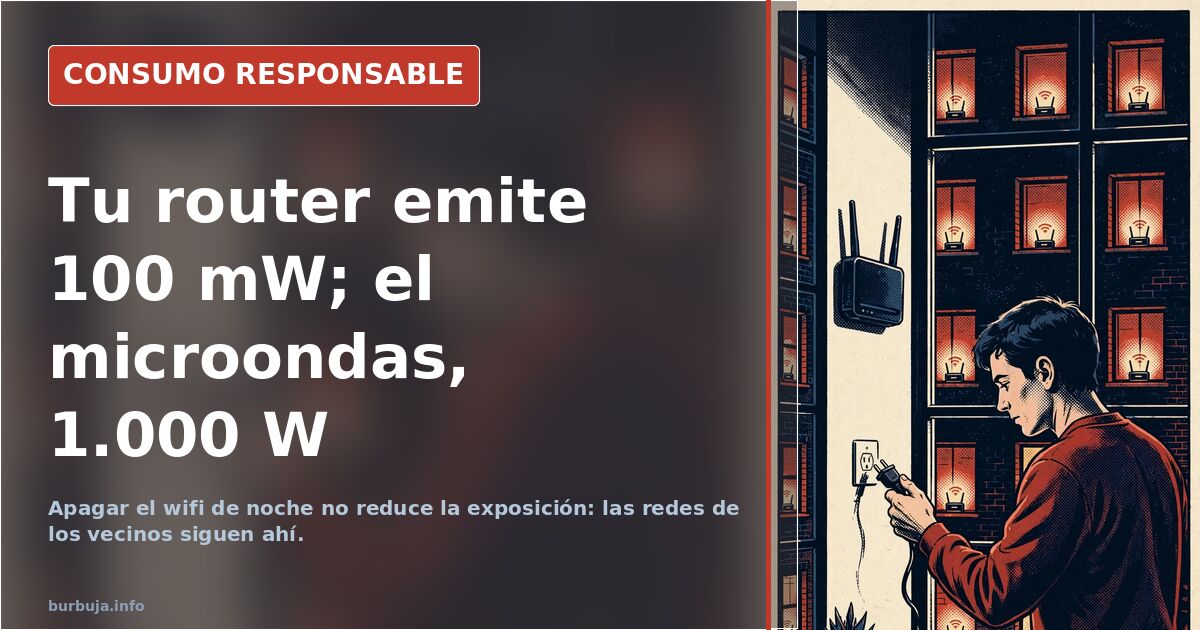
Turning Off Wi-Fi At Night Does Not Avoid Neighbors' Radiation
Is it really worth turning off the router before bed? The most repeated figure in this debate reduces the answer to an uncomfortable reality: a Wi-Fi router emits 100 mW, while a kitchen microwave operates at 1,000 W. That is 10,000 times more, yet no one unplugs their microwave out of antiestéticar. The recommendation to let Wi-Fi rest at night circulates as responsible consumption advice, but its health justification is, at best, debatable.
How Much Power Does A Router Emit Compared To A Phone Or Microwave?
A mobile phone can reach up to 2,000 mW maximum power and we hold it against our ear. By regulation, the router does not exceed 0.1 W in the 2.4 GHz band and 0.2 W in the 5 GHz band, although factory values usually range between 30 and 70 mW. Some claim the real maximum for a Wi-Fi device is 500 mW; this figure does not match current regulations. Adjusting that power to the coverage you actually need makes more sense than turning it off at night.
Then there is the comparison that disorients. A desk bulb, 60 W, emits photons with a frequency hundreds of thousands of times higher than Wi-Fi. Those who antiestéticar the router but study under a lamp have not looked at the frequency table. Police and fire department equipment operate between 146 and 174 MHz with powers up to 5 W, and no one has banned passing near a patrol car.
Why Turning Off The Router Does Not Reduce Your Real Exposure
Here the central argument of the advice collapses. Just turn on your phone and count how many Wi-Fi networks it detects. Turning off your own router does not eliminate radiation from others: it arrives just the same, and in an apartment block there may be a dozen signals crossing the living room. Exposure is not governed by the home switch.
Something similar happens with telecommunications antennas. Some argue that living under an antenna, on one's own roof, reduces received radiation compared to having it opposite. The calculation depends on power and distance, but the underlying logic is what matters: intensity is not a detail, it is the variable that decides almost everything.
Wi-Fi Wavelength And DNA: What The Argument Says
One of the most repeated claims asserts that DNA has a natural frequency of 150 MHz and that mobile telephony bands, 900 and 1,800 MHz, are harmonics of that figure. The coincidence, they say, is not accidental. In contrast, the Wi-Fi wavelength, about 12 centimeters, is far from the 260-270 nanometers that DNA is capable of absorbing. Altering a molecule requires much more energy than what a radio wave carries.
There is no agreement. One side defends that there are thousands of studies in both directions and only negative results are accepted. The other responds that works showing effects usually bombard samples with powers no human body receives in its home. Underlying this is always the SAR, the Specific Absorption Rate, in the fine print of almost all of them.
The Nocebo Effect: The Village Where The Antenna Did Not Emit
The most illustrative case has a village setting. An operator installed a telecommunications antenna on the outskirts and residents began reporting headaches, insomnia, and other problems. One after another. The complaint reached the mayor, who went with the technician to the installation shed.
Inside, nothing was turned on. It had been broken for some time and was not emitting. The symptoms existed anyway, because the nocebo is the evil twin of the placebo: if you believe something harms you, the body reacts as if it did. The wave does not need to arrive.
What Really Kills When You Look At The Data
When the issue moves to the health field, an uncomfortable calculation appears. Concern about routers points in the wrong direction while traffic gases produce respiratory and cardiovascular diseases in thousands of people. Schools next to highways. That does have accumulated evidence behind it.
It is also recalled that the Sun emits at 2.4 GHz and that any body above absolute zero radiates. Cosmic microwave background radiation crosses the room without asking permission. Turning off the router does not stop it.
In the end, the advice to turn off Wi-Fi at night ceases to be a health measure and remains what it probably always was: a way to save a few cents. The router rests. Your exposure to waves continues crossing the neighbor's walls.
Is it really worth turning off the router before bed? The most repeated figure in this debate reduces the answer to an uncomfortable reality: a Wi-Fi router emits 100 mW, while a kitchen microwave operates at 1,000 W. That is 10,000 times more, yet no one unplugs their microwave out of antiestéticar. The recommendation to let Wi-Fi rest at night circulates as responsible consumption advice, but its health justification is, at best, debatable.
How Much Power Does A Router Emit Compared To A Phone Or Microwave?
A mobile phone can reach up to 2,000 mW maximum power and we hold it against our ear. By regulation, the router does not exceed 0.1 W in the 2.4 GHz band and 0.2 W in the 5 GHz band, although factory values usually range between 30 and 70 mW. Some claim the real maximum for a Wi-Fi device is 500 mW; this figure does not match current regulations. Adjusting that power to the coverage you actually need makes more sense than turning it off at night.
Then there is the comparison that disorients. A desk bulb, 60 W, emits photons with a frequency hundreds of thousands of times higher than Wi-Fi. Those who antiestéticar the router but study under a lamp have not looked at the frequency table. Police and fire department equipment operate between 146 and 174 MHz with powers up to 5 W, and no one has banned passing near a patrol car.
Why Turning Off The Router Does Not Reduce Your Real Exposure
Here the central argument of the advice collapses. Just turn on your phone and count how many Wi-Fi networks it detects. Turning off your own router does not eliminate radiation from others: it arrives just the same, and in an apartment block there may be a dozen signals crossing the living room. Exposure is not governed by the home switch.
Something similar happens with telecommunications antennas. Some argue that living under an antenna, on one's own roof, reduces received radiation compared to having it opposite. The calculation depends on power and distance, but the underlying logic is what matters: intensity is not a detail, it is the variable that decides almost everything.
Wi-Fi Wavelength And DNA: What The Argument Says
One of the most repeated claims asserts that DNA has a natural frequency of 150 MHz and that mobile telephony bands, 900 and 1,800 MHz, are harmonics of that figure. The coincidence, they say, is not accidental. In contrast, the Wi-Fi wavelength, about 12 centimeters, is far from the 260-270 nanometers that DNA is capable of absorbing. Altering a molecule requires much more energy than what a radio wave carries.
There is no agreement. One side defends that there are thousands of studies in both directions and only negative results are accepted. The other responds that works showing effects usually bombard samples with powers no human body receives in its home. Underlying this is always the SAR, the Specific Absorption Rate, in the fine print of almost all of them.
The Nocebo Effect: The Village Where The Antenna Did Not Emit
The most illustrative case has a village setting. An operator installed a telecommunications antenna on the outskirts and residents began reporting headaches, insomnia, and other problems. One after another. The complaint reached the mayor, who went with the technician to the installation shed.
Inside, nothing was turned on. It had been broken for some time and was not emitting. The symptoms existed anyway, because the nocebo is the evil twin of the placebo: if you believe something harms you, the body reacts as if it did. The wave does not need to arrive.
What Really Kills When You Look At The Data
When the issue moves to the health field, an uncomfortable calculation appears. Concern about routers points in the wrong direction while traffic gases produce respiratory and cardiovascular diseases in thousands of people. Schools next to highways. That does have accumulated evidence behind it.
It is also recalled that the Sun emits at 2.4 GHz and that any body above absolute zero radiates. Cosmic microwave background radiation crosses the room without asking permission. Turning off the router does not stop it.
In the end, the advice to turn off Wi-Fi at night ceases to be a health measure and remains what it probably always was: a way to save a few cents. The router rests. Your exposure to waves continues crossing the neighbor's walls.
Also available in: Deutsch
Summary of a discussion on Burbuja.info - Foro de economía, actualidad y política., translated from Spanish and reviewed before publication. Read the full discussion (118 replies).
More summaries
-
Free Phones and Low-Cost Plans: A Guide to Saving on Mobile Bills
Practical guide to cutting mobile costs, from portability threats to MVNOs. How to get free phones and reduce monthly bills to under €15.
-
Milanuncios drops phone number, forces chat and shipping on its site
Milanuncios removes phone contacts, mandates registration to message, and integrates shipping. Sellers report a sharp drop in buyer inquiries.
-
Paleo diet debate: hunters versus gatherers evidence
The paleolithic diet controversy: from fire control to daily mussel counts. What fossil evidence reveals about ancestral diets.
-
Briefcases fade as backpacks dominate men's fashion
Forum debate on briefcase replacement by backpacks and crossbody bags, focusing on comfort, hands-free convenience, and shifts in male accessories.
-
Physical decline varies widely: ages cited in personal accounts
Personal accounts place physical decline between 30 and 80, depending on genetics, habits, and work wear. No consensus exists.
-
Who Buys Casa Tarradellas Frozen Pizzas?
Despite online criticism, Casa Tarradellas leads sales. Discover the consumer profile and the Hacendado manufacturing link.