
Micro-racism: Self-protection labeled as discrimination
SOS Racismo defines everyday self-protection gestures as micro-racism. The backlash reignites debate on statistics, safety, and media narratives.
English · Original discussion in Spanish · Published
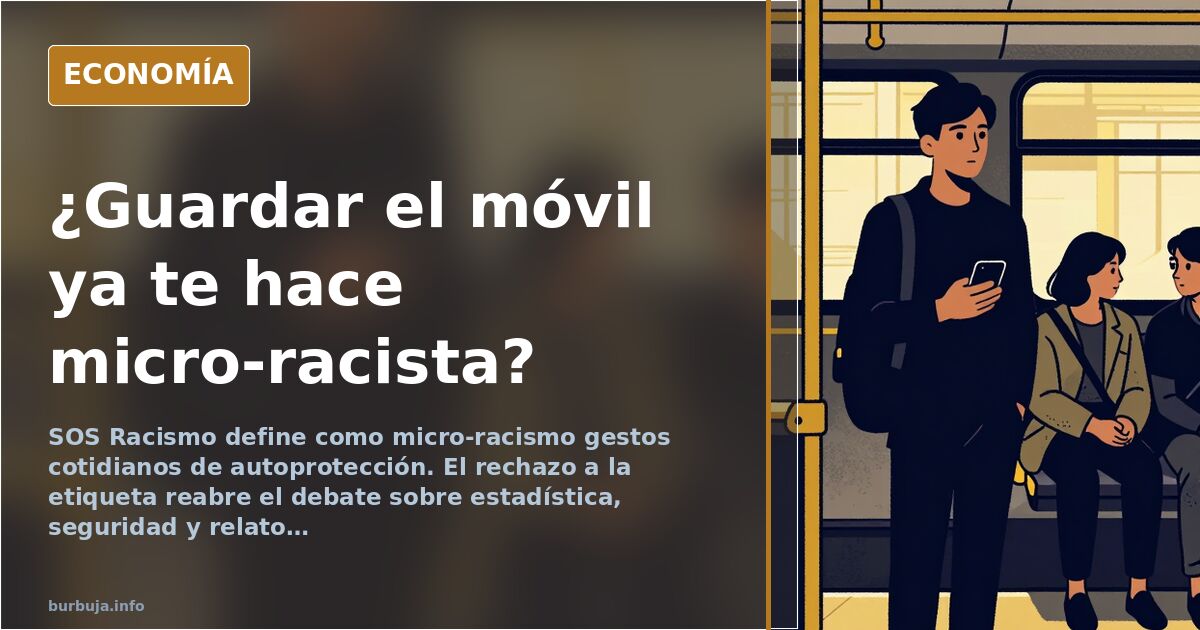
Micro-racism: Self-protection under suspicion
A gesture as common as clutching a handbag tighter when passing someone on the street has a technical name, according to a thesis attributed to SOS Racismo: micro-racism. The claim, spread via a tweet citing a TV appearance, argues that putting away a phone or tightening one's grip on a bag upon seeing a racialized person constitutes discrimination. The reaction was immediate: hundreds of responses flatly rejected equating self-protection with racism.
The issue, wrapped in the usual tone of media controversy, touches a sensitive nerve: the gap between what outlets present as condemnable behavior and what people perceive as instinct on the street. The discussion quickly shifted toward statistics, public safety, and the role of television.
What is micro-racism according to SOS Racismo?
The definition circulating attributes the term to Sarahi Boleko of SOS Racismo, who reportedly stated that gripping a handbag tighter or hiding a phone when seeing a racialized person is an act of micro-racism. The label is not new in activist vocabulary, but applying it to automatic self-protection gestures sparked widespread rejection.
Some argue these behaviors, even if not born from explicit ideology, reproduce internalized prejudices. Opponents counter that self-protection responds to perceived risk patterns, not racial hierarchy. The debate gets tangled when the term 'racialized' is applied to any non-white person, which many see as turning the category into an unworkable catch-all.
Statistics as a response: crimes and nationalities
The most repeated counterargument appeals to data. It is argued that prison and crime statistics show overrepresentation of certain groups, and pointing this out is not racism but math. Bayes' theorem is invoked as a tool to update probabilities given limited information, while accusing media of confusing probabilistic analysis with prejudice.
The objection is reasonable: correlation does not imply causation, and prison overrepresentation may reflect police, economic, or judicial biases. But the debate doesn't advance there. What is discussed is whether individual risk perception, fueled by experience and media narratives, should be corrected or simply tolerated.
Double standards: micromisogyny and micro-racism
One productive line in the exchange highlights asymmetry. People ask why walking faster at night when detecting a man behind you isn't labeled micromisogyny, while hiding a phone from a racialized person is considered micro-racism. The comparison is uncomfortable because it exposes a double standard in applying labels.
The usual answer is that antiestéticar of sensual assault has a solid statistical basis, as does antiestéticar of theft, but only one is problematized. Far from being resolved, the discussion becomes an exchange about which antiestéticars are legitimate and which must be corrected.
Television's role and narrative wear
Much of the rejection isn't directed at SOS Racismo but at the outlet spreading the message. Cuatro is cited as part of a consensus-manufacturing strategy, and several messages express definitive abandonment of TV consumption. A repeated figure is stark: some have gone more than a decade without turning on the TV to avoid such content.
The underlying argument is that these reports function as brainwashing: they present condemnable behavior, associate it with a group, and leave viewers feeling their instincts are incivil. The response, in many cases, is disconnection.
Practical consequences: what is proposed?
Proposals range from ignoring the message and maintaining self-protection measures to harsher scenarios. Most agree no media campaign will change a reflex conditioned by experience. The possibility of self-protection becoming regulated is mentioned, though no one specifies how.
The exchange ends with an open question: if risk perception is subjective but the consequences of ignoring it are objective, who bears the cost of error? For now, the answer isn't in any manual.
A gesture as common as clutching a handbag tighter when passing someone on the street has a technical name, according to a thesis attributed to SOS Racismo: micro-racism. The claim, spread via a tweet citing a TV appearance, argues that putting away a phone or tightening one's grip on a bag upon seeing a racialized person constitutes discrimination. The reaction was immediate: hundreds of responses flatly rejected equating self-protection with racism.
The issue, wrapped in the usual tone of media controversy, touches a sensitive nerve: the gap between what outlets present as condemnable behavior and what people perceive as instinct on the street. The discussion quickly shifted toward statistics, public safety, and the role of television.
What is micro-racism according to SOS Racismo?
The definition circulating attributes the term to Sarahi Boleko of SOS Racismo, who reportedly stated that gripping a handbag tighter or hiding a phone when seeing a racialized person is an act of micro-racism. The label is not new in activist vocabulary, but applying it to automatic self-protection gestures sparked widespread rejection.
Some argue these behaviors, even if not born from explicit ideology, reproduce internalized prejudices. Opponents counter that self-protection responds to perceived risk patterns, not racial hierarchy. The debate gets tangled when the term 'racialized' is applied to any non-white person, which many see as turning the category into an unworkable catch-all.
Statistics as a response: crimes and nationalities
The most repeated counterargument appeals to data. It is argued that prison and crime statistics show overrepresentation of certain groups, and pointing this out is not racism but math. Bayes' theorem is invoked as a tool to update probabilities given limited information, while accusing media of confusing probabilistic analysis with prejudice.
The objection is reasonable: correlation does not imply causation, and prison overrepresentation may reflect police, economic, or judicial biases. But the debate doesn't advance there. What is discussed is whether individual risk perception, fueled by experience and media narratives, should be corrected or simply tolerated.
Double standards: micromisogyny and micro-racism
One productive line in the exchange highlights asymmetry. People ask why walking faster at night when detecting a man behind you isn't labeled micromisogyny, while hiding a phone from a racialized person is considered micro-racism. The comparison is uncomfortable because it exposes a double standard in applying labels.
The usual answer is that antiestéticar of sensual assault has a solid statistical basis, as does antiestéticar of theft, but only one is problematized. Far from being resolved, the discussion becomes an exchange about which antiestéticars are legitimate and which must be corrected.
Television's role and narrative wear
Much of the rejection isn't directed at SOS Racismo but at the outlet spreading the message. Cuatro is cited as part of a consensus-manufacturing strategy, and several messages express definitive abandonment of TV consumption. A repeated figure is stark: some have gone more than a decade without turning on the TV to avoid such content.
The underlying argument is that these reports function as brainwashing: they present condemnable behavior, associate it with a group, and leave viewers feeling their instincts are incivil. The response, in many cases, is disconnection.
Practical consequences: what is proposed?
Proposals range from ignoring the message and maintaining self-protection measures to harsher scenarios. Most agree no media campaign will change a reflex conditioned by experience. The possibility of self-protection becoming regulated is mentioned, though no one specifies how.
The exchange ends with an open question: if risk perception is subjective but the consequences of ignoring it are objective, who bears the cost of error? For now, the answer isn't in any manual.
Also available in: Deutsch
Summary of a discussion on Burbuja.info - Foro de economía, actualidad y política., translated from Spanish and reviewed before publication. Read the full discussion (125 replies).
More summaries
-
Athletic Bilbao boat parade draws 100,000 fans
100,000 people watched Athletic Bilbao's gabarra in Spain; only four chairs damaged, sparking debate on Basque fiscal rules.
-
Catalonia declares drought emergency, caps water at 200 liters
Catalonia has declared a drought emergency, limiting water consumption to 200 liters per person daily, well above typical household usage.
-
Four minors detained for beating man in Vilanova during robbery
Four minors were arrested after a man was assaulted during a violent robbery in Vilanova i la Geltrú, sparking debate on juvenile justice and public safety in Spain.
-
Belgium's 9-year rentals: the fact that corrects Wyoming
Belgium's standard long-term rental contract is signed for nine years, not indefinitely: lifetime leases are 1% and require a notary
-
Spain's Zapatero faces tax fraud probe over seized jewels
Spanish police seize €1M+ in undeclared jewels from ex-PM Zapatero, risking criminal tax charges.
-
Spanish Tourists in Estonia: Cringe Moments Costing Country Image
Incidents in Tallinn reignite debate on Spanish tourist behavior and its impact on national branding in the Baltic region.