
Four minors detained for beating man in Vilanova during robbery
Four minors were arrested after a man was assaulted during a violent robbery in Vilanova i la Geltrú, sparking debate on juvenile justice and public safety in Spain.
English · Original discussion in Spanish · Published
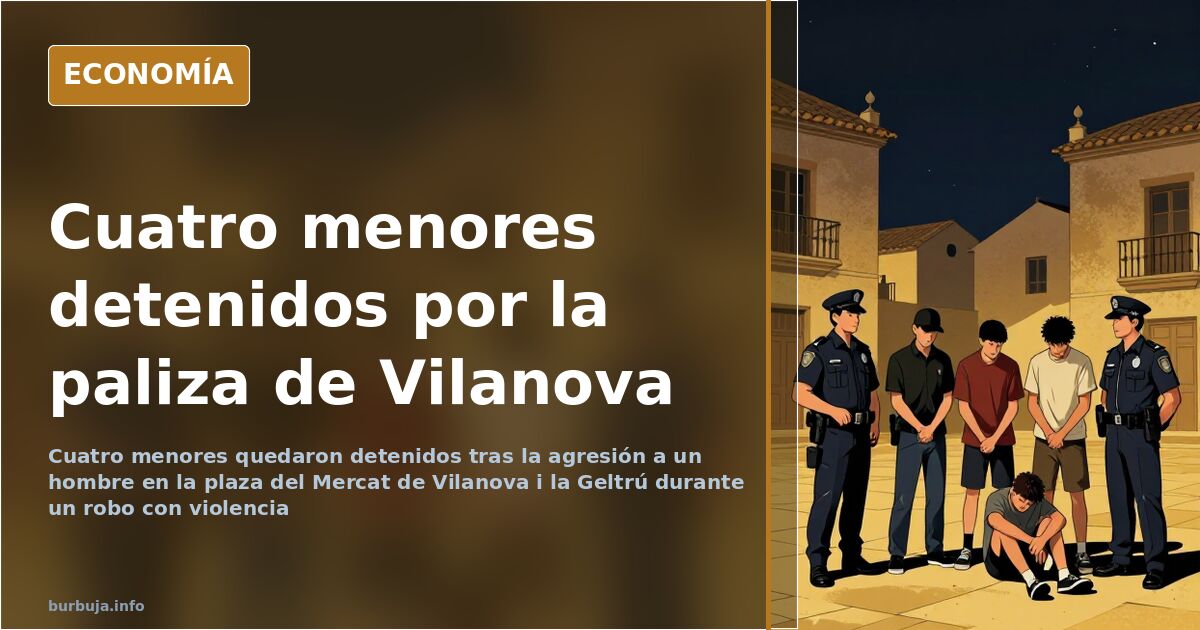
Vilanova: four minors detained after beating a man
Was it enough to record while someone was beaten on the ground? That is, in short, what peine in the Mercat square in Vilanova i la Geltrú (El Garraf) on a Tuesday afternoon, in broad daylight. A man was attacked by a group and ended up lying on the ground. The local police first arrested one of the aggressors, whose goal was to rob him, and later four minors were detained. The information regarding the case was published on July 26, 2023, in the midst of the aftermath of the general elections of 23J.
The episode has left a discussion with three layers: the legal classification of what peine, the institutional response to juvenile delinquency, and the political use of the incident. The three mix, and that is the problem.
What is known about the assault in Mercat square
The available data is scarce and should not be embellished. Four minors detained. An earlier arrest made by the local police on one of the aggressors, who intended to rob the same person. The assault took place in public, in the afternoon and with witnesses present. In the images released, several people can be seen —up to six, five boys and one girl— around the victim, who was left on the ground.
From here begins the slippery terrain. There are no official figures on assaults of this type in the municipality, nor a count of violent robberies in the area that allows comparing the incident with a series. Without a series, there is no trend, and without a trend, any headline is an opinion disguised as a fact.
Was it a lynching or a beating to steal?
The word that has circulated the most is "lynching," and it is not accurate. A lynching is the summary execution of a suspect by a mob, with the community as executioner. Here, the described motive is a violent robbery: someone who did not let his goods be taken and received a beating for it. The distinction is not a dictionary nuance; it changes the framework, the penal response, and even the tone of the public debate that is generated afterwards.
There is another difference that is overlooked: the active subjects are minors. This moves the case to the Juvenile Prosecutor's Office and to a regime different from the ordinary one. The detainees were released with charges after going through that prosecutor's office, according to the account accompanying the news. Here lies the issue: without a verdict, everything else is hypothesis.
The incident as political ammunition
A current of opinion reads the case as proof of a deterioration of security in Catalonia and attacks the parties that govern and support the Generalitat. Another reads it the opposite way: as an incident that the far-right amplifies to capitalize on antiestéticar, and recalls the result of 23J. And a third voice, uncomfortable for almost everyone, maintains that the problem is not who is voted for but that the State has ceased to exercise the monopoly of force on the streets.
What is striking is that almost no one disputes the facts. What is disputed is what is deduced from them. It is the usual pattern: a specific case becomes a symbol, and the symbol covers up the investigation.
Defending oneself, arming oneself, and the price of doing so
The crudest part of the discussion revolves around the individual response. It is argued that intervening reduces the risk of the aggressor acting again, and some go further and propose carrying some type of defense, even counting on the economic fine that the police would impose if they intercept it. On the other side, the usual argument: who responds with violence exposes themselves to a conviction and an indemnity, while the aggressor is protected by their formal status as a victim. It is the asymmetry that angers the most and that is least solved by headlines.
This calculation of selling one's skin dear has a practical problem —no one knows how one reacts to a real assault— and a legal one: self-defense requires requirements that a court evaluates later, in the cold.
The economic reading that creeps into the matter
In an incident like this, the labor market eventually appears. It is argued that the receiving country sees salaries for less skilled positions fall while the sending country loses human capital, and that the ultimate beneficiary is a minority. It is a highly debated framework —the evidence on the net salary effect of immigration is far from conclusive— but it explains why these episodes are already read in terms of distribution and not just security.
"Enjoy what you voted for": collective punishment as an argument
The formula that reappears every time such an incident occurs is enjoy what you voted for, applied equally to the neighborhood, the pedestrian, and the victim himself. It is an old rhetorical mechanism: turning the victim into an accomplice of their misfortune based on the direction of their vote. It also works in reverse, with the reminder that Francoism punished opinion, not theft, which is a legitimate comparison in historical terms but misleading in penal terms.
Four minors have gone through the Juvenile Prosecutor's Office, there is no verdict, and the man who ended up on the ground remains the only one who has not explained anything in public. Everyone already had their political map before the beating. The only thing that admits no discussion is the ground of Mercat square.
Was it enough to record while someone was beaten on the ground? That is, in short, what peine in the Mercat square in Vilanova i la Geltrú (El Garraf) on a Tuesday afternoon, in broad daylight. A man was attacked by a group and ended up lying on the ground. The local police first arrested one of the aggressors, whose goal was to rob him, and later four minors were detained. The information regarding the case was published on July 26, 2023, in the midst of the aftermath of the general elections of 23J.
The episode has left a discussion with three layers: the legal classification of what peine, the institutional response to juvenile delinquency, and the political use of the incident. The three mix, and that is the problem.
What is known about the assault in Mercat square
The available data is scarce and should not be embellished. Four minors detained. An earlier arrest made by the local police on one of the aggressors, who intended to rob the same person. The assault took place in public, in the afternoon and with witnesses present. In the images released, several people can be seen —up to six, five boys and one girl— around the victim, who was left on the ground.
From here begins the slippery terrain. There are no official figures on assaults of this type in the municipality, nor a count of violent robberies in the area that allows comparing the incident with a series. Without a series, there is no trend, and without a trend, any headline is an opinion disguised as a fact.
Was it a lynching or a beating to steal?
The word that has circulated the most is "lynching," and it is not accurate. A lynching is the summary execution of a suspect by a mob, with the community as executioner. Here, the described motive is a violent robbery: someone who did not let his goods be taken and received a beating for it. The distinction is not a dictionary nuance; it changes the framework, the penal response, and even the tone of the public debate that is generated afterwards.
There is another difference that is overlooked: the active subjects are minors. This moves the case to the Juvenile Prosecutor's Office and to a regime different from the ordinary one. The detainees were released with charges after going through that prosecutor's office, according to the account accompanying the news. Here lies the issue: without a verdict, everything else is hypothesis.
The incident as political ammunition
A current of opinion reads the case as proof of a deterioration of security in Catalonia and attacks the parties that govern and support the Generalitat. Another reads it the opposite way: as an incident that the far-right amplifies to capitalize on antiestéticar, and recalls the result of 23J. And a third voice, uncomfortable for almost everyone, maintains that the problem is not who is voted for but that the State has ceased to exercise the monopoly of force on the streets.
What is striking is that almost no one disputes the facts. What is disputed is what is deduced from them. It is the usual pattern: a specific case becomes a symbol, and the symbol covers up the investigation.
Defending oneself, arming oneself, and the price of doing so
The crudest part of the discussion revolves around the individual response. It is argued that intervening reduces the risk of the aggressor acting again, and some go further and propose carrying some type of defense, even counting on the economic fine that the police would impose if they intercept it. On the other side, the usual argument: who responds with violence exposes themselves to a conviction and an indemnity, while the aggressor is protected by their formal status as a victim. It is the asymmetry that angers the most and that is least solved by headlines.
This calculation of selling one's skin dear has a practical problem —no one knows how one reacts to a real assault— and a legal one: self-defense requires requirements that a court evaluates later, in the cold.
The economic reading that creeps into the matter
In an incident like this, the labor market eventually appears. It is argued that the receiving country sees salaries for less skilled positions fall while the sending country loses human capital, and that the ultimate beneficiary is a minority. It is a highly debated framework —the evidence on the net salary effect of immigration is far from conclusive— but it explains why these episodes are already read in terms of distribution and not just security.
"Enjoy what you voted for": collective punishment as an argument
The formula that reappears every time such an incident occurs is enjoy what you voted for, applied equally to the neighborhood, the pedestrian, and the victim himself. It is an old rhetorical mechanism: turning the victim into an accomplice of their misfortune based on the direction of their vote. It also works in reverse, with the reminder that Francoism punished opinion, not theft, which is a legitimate comparison in historical terms but misleading in penal terms.
Four minors have gone through the Juvenile Prosecutor's Office, there is no verdict, and the man who ended up on the ground remains the only one who has not explained anything in public. Everyone already had their political map before the beating. The only thing that admits no discussion is the ground of Mercat square.
Also available in: Deutsch
Summary of a discussion on Burbuja.info - Foro de economía, actualidad y política., translated from Spanish and reviewed before publication. Read the full discussion (280 replies).
More summaries
-
Fake police officers KIDNAP a person on the AP-7 after passing through Vilanova i la Geltrú
A driver was kidnapped on the AP-7 by fake police. The incident happened after he passed through Vilanova i la Geltrú.
-
Chlorine fire in Vilanova i la Geltrú forces residents to stay indoors
A fire at a pool chemical warehouse in Vilanova i la Geltrú releases a toxic chlorine cloud, forcing a mandatory lockdown for the local population.
-
37-year-old police chief in Yeles, Spain, dies by suicide
The death of a 37-year-old police chief in Yeles raises questions about workplace pressure, firearm access, and the lack of official data.
-
Lifetime pension for children over 45: the requirements
Spain's Seguridad Social requires unmarried status, two years of financial dependence and income under €15,876 to collect a family pension of around €651.
-
Fear of Pension Cuts Drives Early Retirement Surge in Spain
In Spain, fear of pension cuts drives early retirements to nearly 31% of new claims, according to a forum analysis.
-
Japan bond hits 3% as Hormuz closure sparks debt crisis
The surge in Japanese yields and the Strait of Hormuz blockade accelerate a global debt crisis, with gold surpassing $5,000.