
Mexico's President Renames Gulf of Cortés to California
Andrés Manuel López Obrador announced the official renaming of the Sea of Cortés to the Gulf of California, reigniting debates on toponymy and symbolic politics in Mexico.
English · Original discussion in Spanish · Published
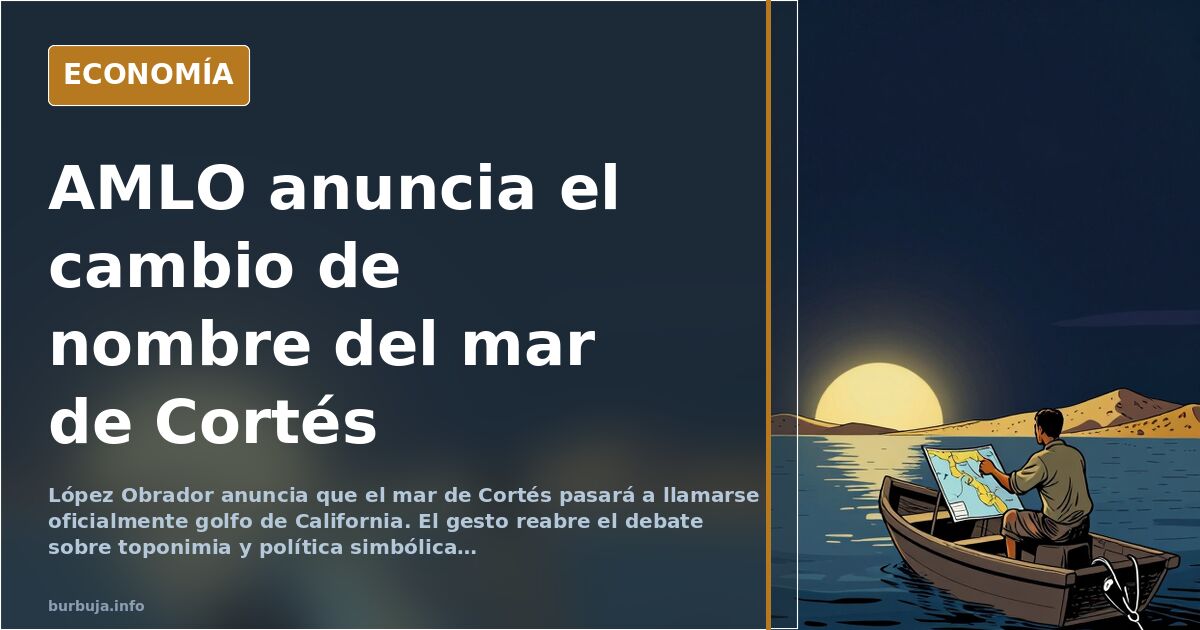
AMLO Renames Sea of Cortés: From Viceroyalty to Official Oblivion
Does it make sense to erase from the map the name of the man who designed the country that exists today? Mexican President Andrés Manuel López Obrador announced during his visit to Culiacán, in Sinaloa, that the Sea of Cortés will officially be renamed the Gulf of California. He made the announcement while opening a branch of Banco del Bienestar (Bank of Welfare), justifying it with a phrase that summarizes his crusade: "Sea of Cortés my foot!" He argues the name is a colonial vestige that must disappear.
The measure does not come alone. During his term, the Empress Garden, named after Carlota of Mexico, vvife of Maximilian of Habsburg, has already been renamed Nezahualcóyotl Garden within the National Palace. Toponymy has become a political battlefield.
What Is Called the Gulf of California and Since When
The Gulf of California is the name already used by most maps and geography manuals outside Mexico. In Spain, it has been studied under this name for decades, and many readers discovered through this controversy that inside the country it was called something else. The Sea of Cortés honors Hernán Cortés, the Extremaduran who led the conquest of the Mexica Empire between 1519 and 1521.
The paradox is that López Obrador himself descends from families of Asturian and Cantabrian ancestry, as repeatedly noted. He rejects the conqueror's name while keeping the surname of the colonists. The contradiction is not minor: if the criterion is to eliminate every colonial trace, the exercise should extend to most cities, rivers, and mountains in the country, starting with the language itself.
The Spanish Precedent: Ferrol del Caudillo and Empire Squares
The comparison with Spain appears immediately. Here too, streets and squares were renamed during Francoism: Ferrol became Ferrol del Caudillo (Ferrol of the Leader), and major squares across half of Spain became Plaza del Imperio (Empire Square) or Plaza del Generalísimo. It was nationalism applied to cartography, equally forced as the current one, though in the opposite direction.
The difference is that those changes were later corrected. The historical memory law restored the previous names, bringing with them an uncomfortable question: why are some name changes considered memory and others erasure? The criterion is not historical; it is political. And it changes depending on who governs.
The Business Behind the Gesture
While toponymy is rewritten, the Mexican economy continues its course. Some recall that exports and GDP have grown in recent years, and that one of the country's current problems is currency appreciation. The symbolic gesture does not move a single peso of investment, but it makes headlines.
Others point to the opportunity cost: the local oligarchy maintains its power, cartels continue killing, and the president dedicates his energy to arguing with a dead man from the 16th century. The priority is not security or employment; it is the narrative.
Cortés Created Mexico, and That Is What Annoys
The most repeated argument is that without Hernán Cortés, Mexico as we know it would not exist. There would be something else: perhaps a fragmented territory, perhaps a smaller country, perhaps an Aztec zone subjected to international pressure due to its ritual sacrifices. The conquest was brutal, but it was also the origin of the State that signs treaties and collects taxes today.
The final paradox is that the indigenous peoples who allied with Cortés against the Aztecs—Tlaxcalans, among others—are also erased by this change. They were Mexicans before Mexico existed. Their memory interests no one.
In the end, the gulf will remain the same water. Only the sign changes. And the sign, like all signs, is put up by whoever is in charge.
Does it make sense to erase from the map the name of the man who designed the country that exists today? Mexican President Andrés Manuel López Obrador announced during his visit to Culiacán, in Sinaloa, that the Sea of Cortés will officially be renamed the Gulf of California. He made the announcement while opening a branch of Banco del Bienestar (Bank of Welfare), justifying it with a phrase that summarizes his crusade: "Sea of Cortés my foot!" He argues the name is a colonial vestige that must disappear.
The measure does not come alone. During his term, the Empress Garden, named after Carlota of Mexico, vvife of Maximilian of Habsburg, has already been renamed Nezahualcóyotl Garden within the National Palace. Toponymy has become a political battlefield.
What Is Called the Gulf of California and Since When
The Gulf of California is the name already used by most maps and geography manuals outside Mexico. In Spain, it has been studied under this name for decades, and many readers discovered through this controversy that inside the country it was called something else. The Sea of Cortés honors Hernán Cortés, the Extremaduran who led the conquest of the Mexica Empire between 1519 and 1521.
The paradox is that López Obrador himself descends from families of Asturian and Cantabrian ancestry, as repeatedly noted. He rejects the conqueror's name while keeping the surname of the colonists. The contradiction is not minor: if the criterion is to eliminate every colonial trace, the exercise should extend to most cities, rivers, and mountains in the country, starting with the language itself.
The Spanish Precedent: Ferrol del Caudillo and Empire Squares
The comparison with Spain appears immediately. Here too, streets and squares were renamed during Francoism: Ferrol became Ferrol del Caudillo (Ferrol of the Leader), and major squares across half of Spain became Plaza del Imperio (Empire Square) or Plaza del Generalísimo. It was nationalism applied to cartography, equally forced as the current one, though in the opposite direction.
The difference is that those changes were later corrected. The historical memory law restored the previous names, bringing with them an uncomfortable question: why are some name changes considered memory and others erasure? The criterion is not historical; it is political. And it changes depending on who governs.
The Business Behind the Gesture
While toponymy is rewritten, the Mexican economy continues its course. Some recall that exports and GDP have grown in recent years, and that one of the country's current problems is currency appreciation. The symbolic gesture does not move a single peso of investment, but it makes headlines.
Others point to the opportunity cost: the local oligarchy maintains its power, cartels continue killing, and the president dedicates his energy to arguing with a dead man from the 16th century. The priority is not security or employment; it is the narrative.
Cortés Created Mexico, and That Is What Annoys
The most repeated argument is that without Hernán Cortés, Mexico as we know it would not exist. There would be something else: perhaps a fragmented territory, perhaps a smaller country, perhaps an Aztec zone subjected to international pressure due to its ritual sacrifices. The conquest was brutal, but it was also the origin of the State that signs treaties and collects taxes today.
The final paradox is that the indigenous peoples who allied with Cortés against the Aztecs—Tlaxcalans, among others—are also erased by this change. They were Mexicans before Mexico existed. Their memory interests no one.
In the end, the gulf will remain the same water. Only the sign changes. And the sign, like all signs, is put up by whoever is in charge.
Also available in: Deutsch
Summary of a discussion on Burbuja.info - Foro de economía, actualidad y política., translated from Spanish and reviewed before publication. Read the full discussion (169 replies).
More summaries
-
Inés Hernand: feminism and reggaeton collide
Inés Hernand defends her contradictions over supporting Bad Bunny. Does feminist consistency have a price? An economic analysis of brand hypocrisy.
-
80% Cancellations: Spanish Tourism to Morocco Plummets
Mesa del Turismo estimates an 80% cancellation rate for Morocco in September, while CEAV states that new bookings have dropped to zero.
-
Plane Myth: Confusing Inertia with Wind in Spain
Earth rotates at 1,600 km/h and planes fly at 840 km/h. The error is forgetting that air rotates with the planet.
-
Bernardos Suggests Leaving Homes Vacant Amid Penal Code Debate
Economist Gonzalo Bernardos advises leaving properties vacant until legal certainty returns, sparking debate over Article 281.1 of the Spanish Penal Code.
-
Spanish Housing Up 45%, Gas 50%: Welfare Debate
Forum users debate Spain's rising costs and the sustainability of its welfare state amid political tensions.
-
Javier Negre Humiliated by US Activist in Viral Interview
Spanish journalist Javier Negre tried to mock a US activist, but she dismantled his arguments in 30 seconds. The video he posted went viral.