
Mercadona's Steinburg beer tastes off at €0.26 per can
Steinburg, Mercadona's budget beer in Spain, still costs €0.26 but now tastes metallic after switching bottler to Font Salem.
English · Original discussion in Spanish · Published
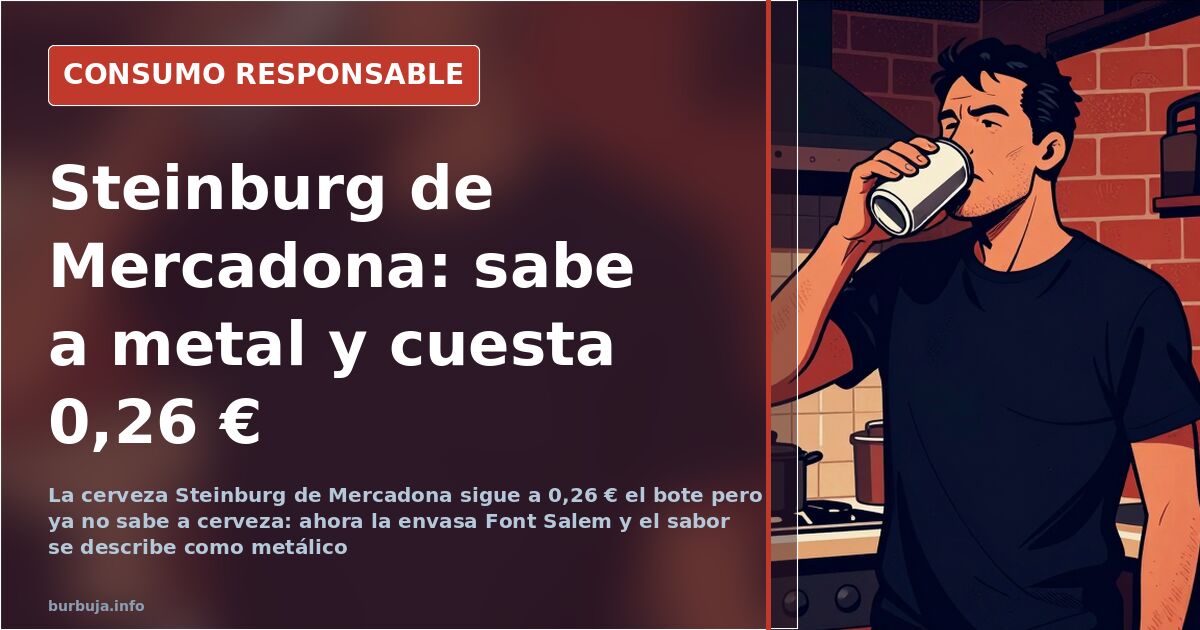
Mercadona's Steinburg beer tastes off at €0.26 per can
The price hasn't moved; the taste has. The Steinburg beer sold by Mercadona in 330 ml cans keeps its €0.26 unit price and, according to weekly shoppers, has lost any trace of beer flavor: "It just tastes like sparkling water with metal," summarizes the most repeated complaint. The confusion stems from the past, because this brand was famous for having the best value-for-money ratio on the shelf. And there is a specific change behind it: previously it was bottled by a supplier from France or Belgium; now it is filled by Font Salem, a Valencian beverage bottling company.
This is not a minor adjustment. We are talking about the cheapest white-label beer in Spain's most visited supermarket chain, a product bought by the liter that relies on the loyalty of those who repeat their purchase every week. When the taste changes without warning, no marketing campaign can cover it up.
Who bottles the Steinburg beer sold by Mercadona?
The short answer is Font Salem. The long answer is that this shouldn't surprise anyone: the Valencian company has been filling the private label beers of many Spanish supermarkets for years, and its name appears on Lidl's Argus, several Ahorramás brands, or Eroski's Aurum. Many of the cans competing on the shelf come from the same bottling lines.
What changes between them is the recipe, and that is the core issue. The same manufacturer can produce an acceptable beer and a disaster depending on the formulation requested by the client. Some claim that the Argus can comes from the same factory as Steinburg and doesn't taste nearly as bad; others argue that the plastic liter bottle, labeled as Belgian, escapes the disaster. The factory doesn't decide the taste: the contract does.
The price map of budget beer
At €0.26 per can, Steinburg has stopped being a bargain. The comparison with what sits next to it is ruthless:
The price hike for Steinburg has also been rapid: 3 cents in two months, reaching the €0.29 already seen on some shelves. Few beers remain below that barrier. Some recall better times with numbers: a German discount beer, Konigsbacher, which sold for €0.18 per can and disappeared from Spanish shelves despite still being made in Germany. And at the opposite extreme, Carrefour's half-liter private label at €0.52, one euro per liter, which some consider the most drinkable in its range.
Raising prices and lowering quality: the recurring pattern
The most shared diagnosis doesn't speak of an industrial accident, but of a conscious move: a product with good value-for-money is launched, word-of-mouth gives it fame, and once established, the recipe is changed to cut costs. Part of the clientele notices the change and leaves; another continues buying out of inertia, and the product lives off a fruta it no longer deserves.
The phenomenon is not exclusive to beer. In the same cart appear Portuguese-origin sugar-free cookies replaced by a national version that doesn't taste the same, yogurts that only convince if they have a foreign seal, and imported cheeses placed above their local equivalents. Even in imported craft beers, cost-cutting is detected: a well-known IPA reportedly went from 6% alcohol and 50 IBUs to 5.4% and 45, according to data handled by enthusiasts.
And it's not just private labels. Estrella Galicia and Voll Damm don't taste like they did seven or eight years ago, claim those who have drunk them for decades. The underlying thesis is uncomfortable: here the recipe is tweaked, and in Germany or Belgium, not so much.
Is there any beer that hasn't gotten worse?
Here the conversation becomes useful for the buyer. The references that survive, according to accumulated experience, are those of import with clear origin: Franziskaner, which stays at €1.39-1.49 for 500 ml and retains aroma; Paulaner, although it already hovers around €2; and some German budget labels that were once sold here at €0.18 and are now difficult to find. Among domestic brands, two Valencian names appear, Turia and Levante, with the first described as a marzen-style beer that holds up against what is made abroad.
The technical advice that repeats itself has little myth to it: always serve in a glass, never drink straight from the metal, and keep it very cold. It doesn't fix a bad recipe, but it masks quite a bit. Others have simply started making their own beer with malt, hops, yeast, and mineral water, which is the only way to control what you drink.
With these elements, the basket forces a choice between paying more for less flavor or changing brands every few months. How many times can this cycle repeat before the buyer stops believing the label?
The price hasn't moved; the taste has. The Steinburg beer sold by Mercadona in 330 ml cans keeps its €0.26 unit price and, according to weekly shoppers, has lost any trace of beer flavor: "It just tastes like sparkling water with metal," summarizes the most repeated complaint. The confusion stems from the past, because this brand was famous for having the best value-for-money ratio on the shelf. And there is a specific change behind it: previously it was bottled by a supplier from France or Belgium; now it is filled by Font Salem, a Valencian beverage bottling company.
This is not a minor adjustment. We are talking about the cheapest white-label beer in Spain's most visited supermarket chain, a product bought by the liter that relies on the loyalty of those who repeat their purchase every week. When the taste changes without warning, no marketing campaign can cover it up.
Who bottles the Steinburg beer sold by Mercadona?
The short answer is Font Salem. The long answer is that this shouldn't surprise anyone: the Valencian company has been filling the private label beers of many Spanish supermarkets for years, and its name appears on Lidl's Argus, several Ahorramás brands, or Eroski's Aurum. Many of the cans competing on the shelf come from the same bottling lines.
What changes between them is the recipe, and that is the core issue. The same manufacturer can produce an acceptable beer and a disaster depending on the formulation requested by the client. Some claim that the Argus can comes from the same factory as Steinburg and doesn't taste nearly as bad; others argue that the plastic liter bottle, labeled as Belgian, escapes the disaster. The factory doesn't decide the taste: the contract does.
The price map of budget beer
At €0.26 per can, Steinburg has stopped being a bargain. The comparison with what sits next to it is ruthless:
- Argus national (Lidl): €0.23 per can, although the mild variety has gone up to €0.29 after changing to a French supplier
- Águila zaina (Consum): €0.23 per can
- Holandesa (Carrefour): €0.26 per can, with 2-for-1 and 3-for-2 promotions that, according to calculations circulating among buyers, bring the can down to €0.17
- Steinburg in one-liter bottle: remains manufactured in Belgium, according to the label
The price hike for Steinburg has also been rapid: 3 cents in two months, reaching the €0.29 already seen on some shelves. Few beers remain below that barrier. Some recall better times with numbers: a German discount beer, Konigsbacher, which sold for €0.18 per can and disappeared from Spanish shelves despite still being made in Germany. And at the opposite extreme, Carrefour's half-liter private label at €0.52, one euro per liter, which some consider the most drinkable in its range.
Raising prices and lowering quality: the recurring pattern
The most shared diagnosis doesn't speak of an industrial accident, but of a conscious move: a product with good value-for-money is launched, word-of-mouth gives it fame, and once established, the recipe is changed to cut costs. Part of the clientele notices the change and leaves; another continues buying out of inertia, and the product lives off a fruta it no longer deserves.
The phenomenon is not exclusive to beer. In the same cart appear Portuguese-origin sugar-free cookies replaced by a national version that doesn't taste the same, yogurts that only convince if they have a foreign seal, and imported cheeses placed above their local equivalents. Even in imported craft beers, cost-cutting is detected: a well-known IPA reportedly went from 6% alcohol and 50 IBUs to 5.4% and 45, according to data handled by enthusiasts.
And it's not just private labels. Estrella Galicia and Voll Damm don't taste like they did seven or eight years ago, claim those who have drunk them for decades. The underlying thesis is uncomfortable: here the recipe is tweaked, and in Germany or Belgium, not so much.
Is there any beer that hasn't gotten worse?
Here the conversation becomes useful for the buyer. The references that survive, according to accumulated experience, are those of import with clear origin: Franziskaner, which stays at €1.39-1.49 for 500 ml and retains aroma; Paulaner, although it already hovers around €2; and some German budget labels that were once sold here at €0.18 and are now difficult to find. Among domestic brands, two Valencian names appear, Turia and Levante, with the first described as a marzen-style beer that holds up against what is made abroad.
The technical advice that repeats itself has little myth to it: always serve in a glass, never drink straight from the metal, and keep it very cold. It doesn't fix a bad recipe, but it masks quite a bit. Others have simply started making their own beer with malt, hops, yeast, and mineral water, which is the only way to control what you drink.
With these elements, the basket forces a choice between paying more for less flavor or changing brands every few months. How many times can this cycle repeat before the buyer stops believing the label?
Also available in: Deutsch
Summary of a discussion on Burbuja.info - Foro de economía, actualidad y política., translated from Spanish and reviewed before publication. Read the full discussion (120 replies).
More summaries
-
How to fix a broken TV antenna input for under €30
Free app, Chromecast or €30 receiver: three ways to watch TV without fixing the broken coaxial input. The cheapest costs zero euros.
-
Spain's notebook quality crisis sparks debate
Users criticize poor Spanish notebooks, citing Papelera Española's decline and the sector's industrial failure.
-
Supermarket Theft Tips Spark Debate in Spain
Analysis of a controversial thread on supermarket thefts, highlighting precariousness and social decay in Spain.
-
Wallapop: Haggling turns Spain's second-hand market into a standoff
Car batteries sell for €25 and child seats for €10 in Spain’s second-hand market, where distrust and aggressive haggling dominate transactions.
-
Public vs. State-Funded Schools in Spain: The Real Cost
Monthly fees of €80–€150 and a reported case of €500 highlight the dilemma between public and state-funded schools.
-
Spain's olive oil crisis revives lard frying debate
Poor harvest and rising prices in Spain prompt a shift to lard for frying, reserving olive oil for raw use.