
Wallapop: Haggling turns Spain's second-hand market into a standoff
Car batteries sell for €25 and child seats for €10 in Spain’s second-hand market, where distrust and aggressive haggling dominate transactions.
English · Original discussion in Spanish · Published
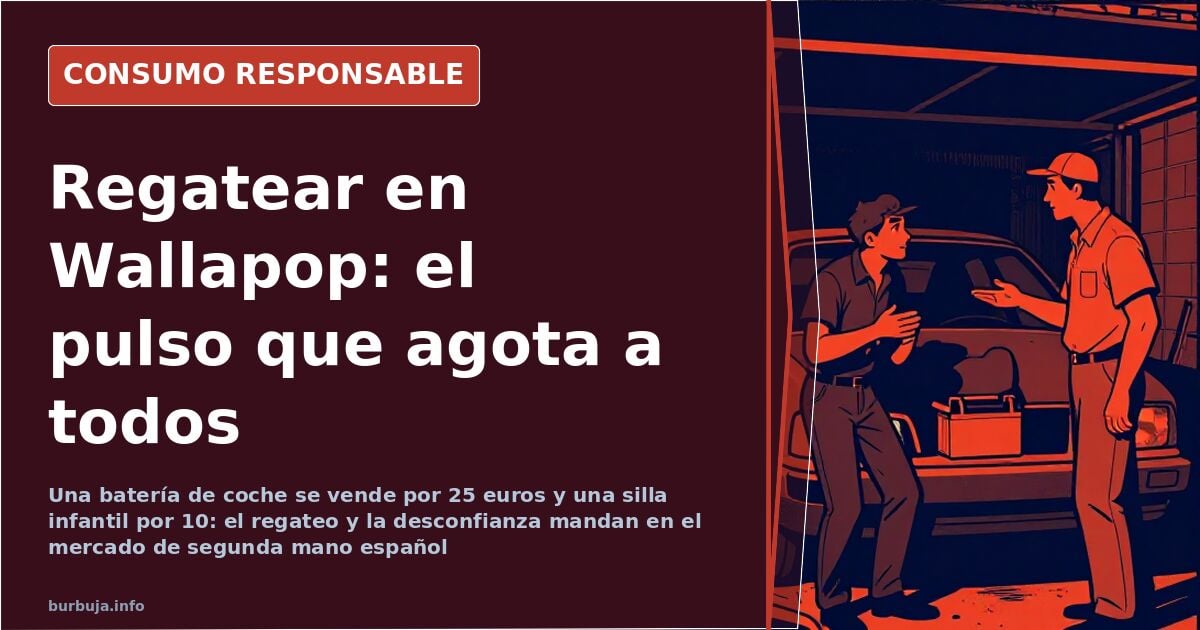
Wallapop and the art of haggling in the second-hand market
Spain’s second-hand market operates like a standoff of mutual distrust. A seller lists a Tudor 74 Ah battery for €25 after testing it themselves; a green phosphor Amstrad monitor goes for €15; and a child car seat sells for €10 despite costing €150 new. These are rock-bottom prices, yet every deal comes with its own manual to avoid getting burned.
The distrust is well-founded. Behind each ad lies a buyer asking if the item is still available, a seller hesitant at the first discount request, and a meetup that might end with no-shows. Each step adds friction to what should be a two-minute transaction.
Why do people haggle more on Wallapop than in stores?
In retail, the price is sacred. On peer-to-peer platforms, the price is merely the starting point of a conversation. This creates misunderstanding: some sellers believe the listed price is final and refuse negotiation, while others view any figure as an invitation to bargain.
The most common explanation points to supply. When hundreds of identical items are listed, pressing for a lower price becomes almost mandatory; when the item is unique, haggling is futile. The mistake is applying the same strategy to both scenarios. Supply and demand rules, applied to garage sales, turn theory into neighborhood haggling.
The ten commandments of those who trust no one
After repeated mishaps, veteran buyers have developed their own list of precautions. Always test electronics before paying. Close deals in daylight, because shadows hide defects. Avoid impersonal meeting spots, as tracking someone down becomes impossible if things go wrong. Steer clear of advertisers who accept a 50% discount online but try to shave off more euros in person.
The list includes an uncomfortable rule: leave negative feedback when the transaction goes badly. Almost no one does this. The star system only works with honesty, yet general bias pushes users to give five stars even to strangers. A store with a single-star review raises suspicion; an individual with the same rating should trigger alarms.
Another classic is the persistent buyer who offers a swap instead of cash. Those proposing barter often seek to unload something they can’t sell elsewhere, exploiting trust. Legitimate swaps exist but require both parties to value the exchange equally. Rarely happens.
Wallapop is no longer free: the business of second-hand
For years, the platform charged neither buyers nor sellers, fueling its growth. The model has shifted. Managed shipping now carries a 10% commission, and antiestéticatured ads cost extra. The trend is familiar: build mass habits first, then seek profitability.
Some compare this evolution to major classified portals gradually absorbed by larger groups. The core question is how much users will pay for a tool that was previously free. If the answer is little, the incentive to tolerate the app’s chaotic ecosystem collapses.
Raise the price by 15% and let them negotiate down
Experienced sellers use a simple tactic: list items 10–15% above fair value and wait for counteroffers. Buyers feel victorious having negotiated, though they paid the expected amount. Psychology outweighs arithmetic.
Conversely, some advocate fixed pricing. Set a non-negotiable price, ignore hagglers, and wait. If the item is fairly priced, it sells to serious buyers; if inflated, haggling attracts only bargain hunters. It’s the difference between selling and running a flea market.
No-shows and other ways to waste an afternoon
The disaster catalog is extensive. Sellers who set appointments and don’t show up. Those who agree on a price, receive a better offer, and cancel. Others promise transfers on Fridays, leave sellers rejecting buyers all weekend, then change their minds on Monday. Hence the strict rule: no reservation without money in the account.
Furniture faces similar issues, where transport—not price—is the hurdle. Buying a sofa in-store included choosing among dozens of models, home delivery, and returns if unsuitable. That service doesn’t transfer to second-hand ads, leaving bulky items unsold.
Add to this the question that frustrates veteran sellers: the ubiquitous Is this still available?. Answering takes less effort than anger, but clearly identifies who you’re dealing with.
Given this landscape, more people do the unexpected in digital markets: give items away. Unused furniture and bikes end up with neighbors in need, done. No haggling, waiting, or ratings. Perhaps direct gifting remains the only unbroken segment of the second-hand market.
Spain’s second-hand market operates like a standoff of mutual distrust. A seller lists a Tudor 74 Ah battery for €25 after testing it themselves; a green phosphor Amstrad monitor goes for €15; and a child car seat sells for €10 despite costing €150 new. These are rock-bottom prices, yet every deal comes with its own manual to avoid getting burned.
The distrust is well-founded. Behind each ad lies a buyer asking if the item is still available, a seller hesitant at the first discount request, and a meetup that might end with no-shows. Each step adds friction to what should be a two-minute transaction.
Why do people haggle more on Wallapop than in stores?
In retail, the price is sacred. On peer-to-peer platforms, the price is merely the starting point of a conversation. This creates misunderstanding: some sellers believe the listed price is final and refuse negotiation, while others view any figure as an invitation to bargain.
The most common explanation points to supply. When hundreds of identical items are listed, pressing for a lower price becomes almost mandatory; when the item is unique, haggling is futile. The mistake is applying the same strategy to both scenarios. Supply and demand rules, applied to garage sales, turn theory into neighborhood haggling.
The ten commandments of those who trust no one
After repeated mishaps, veteran buyers have developed their own list of precautions. Always test electronics before paying. Close deals in daylight, because shadows hide defects. Avoid impersonal meeting spots, as tracking someone down becomes impossible if things go wrong. Steer clear of advertisers who accept a 50% discount online but try to shave off more euros in person.
The list includes an uncomfortable rule: leave negative feedback when the transaction goes badly. Almost no one does this. The star system only works with honesty, yet general bias pushes users to give five stars even to strangers. A store with a single-star review raises suspicion; an individual with the same rating should trigger alarms.
Another classic is the persistent buyer who offers a swap instead of cash. Those proposing barter often seek to unload something they can’t sell elsewhere, exploiting trust. Legitimate swaps exist but require both parties to value the exchange equally. Rarely happens.
Wallapop is no longer free: the business of second-hand
For years, the platform charged neither buyers nor sellers, fueling its growth. The model has shifted. Managed shipping now carries a 10% commission, and antiestéticatured ads cost extra. The trend is familiar: build mass habits first, then seek profitability.
Some compare this evolution to major classified portals gradually absorbed by larger groups. The core question is how much users will pay for a tool that was previously free. If the answer is little, the incentive to tolerate the app’s chaotic ecosystem collapses.
Raise the price by 15% and let them negotiate down
Experienced sellers use a simple tactic: list items 10–15% above fair value and wait for counteroffers. Buyers feel victorious having negotiated, though they paid the expected amount. Psychology outweighs arithmetic.
Conversely, some advocate fixed pricing. Set a non-negotiable price, ignore hagglers, and wait. If the item is fairly priced, it sells to serious buyers; if inflated, haggling attracts only bargain hunters. It’s the difference between selling and running a flea market.
No-shows and other ways to waste an afternoon
The disaster catalog is extensive. Sellers who set appointments and don’t show up. Those who agree on a price, receive a better offer, and cancel. Others promise transfers on Fridays, leave sellers rejecting buyers all weekend, then change their minds on Monday. Hence the strict rule: no reservation without money in the account.
Furniture faces similar issues, where transport—not price—is the hurdle. Buying a sofa in-store included choosing among dozens of models, home delivery, and returns if unsuitable. That service doesn’t transfer to second-hand ads, leaving bulky items unsold.
Add to this the question that frustrates veteran sellers: the ubiquitous Is this still available?. Answering takes less effort than anger, but clearly identifies who you’re dealing with.
Given this landscape, more people do the unexpected in digital markets: give items away. Unused furniture and bikes end up with neighbors in need, done. No haggling, waiting, or ratings. Perhaps direct gifting remains the only unbroken segment of the second-hand market.
Also available in: Deutsch
Summary of a discussion on Burbuja.info - Foro de economía, actualidad y política., translated from Spanish and reviewed before publication. Read the full discussion (120 replies).
More summaries
-
Wallapop requires power of attorney to Mangopay to use its wallet
Wallapop requires granting Mangopay power of attorney and renewing every 180 days to move wallet money. No signing all four conditions, no payout.
-
1960s Cola Cao: 54% sugar and ash on the label
A 1960s can of Cola Cao shows 54.1% sucrose, ash and unidentified matter at 1.9%, and a price of 84.50 pesetas plus taxes. The analysis…
-
Spain's €25 Casio challenges Rolex on value
A €25 Casio with a 10-year battery sparks debate: is it better than a Rolex? Luxury watch owners admit to daily use.
-
Off-grid living myth: subsidies sustain rural dream
CAP subsidies and family inheritance underpin the neo-rural dream. Economic analysis reveals the cost of escaping the system.
-
Spain's second-hand market: near-new prices, no warranty
Used items in Spain cost almost as much as new ones but lack warranties. Sellers price based on past costs, not current value.
-
Spain's Electricity Bill: PVPC vs. Free Market Changes
PVPC shifts to three periods and time-of-use pricing applies to all tariffs. Data compares regulated and free markets.