
Meloni’s pro-immigration stance sparks backlash from right-wing base
Meloni states Europe needs immigrants, triggering voter anger over her Atlanticist shift and regularization policies.
English · Original discussion in Spanish · Published
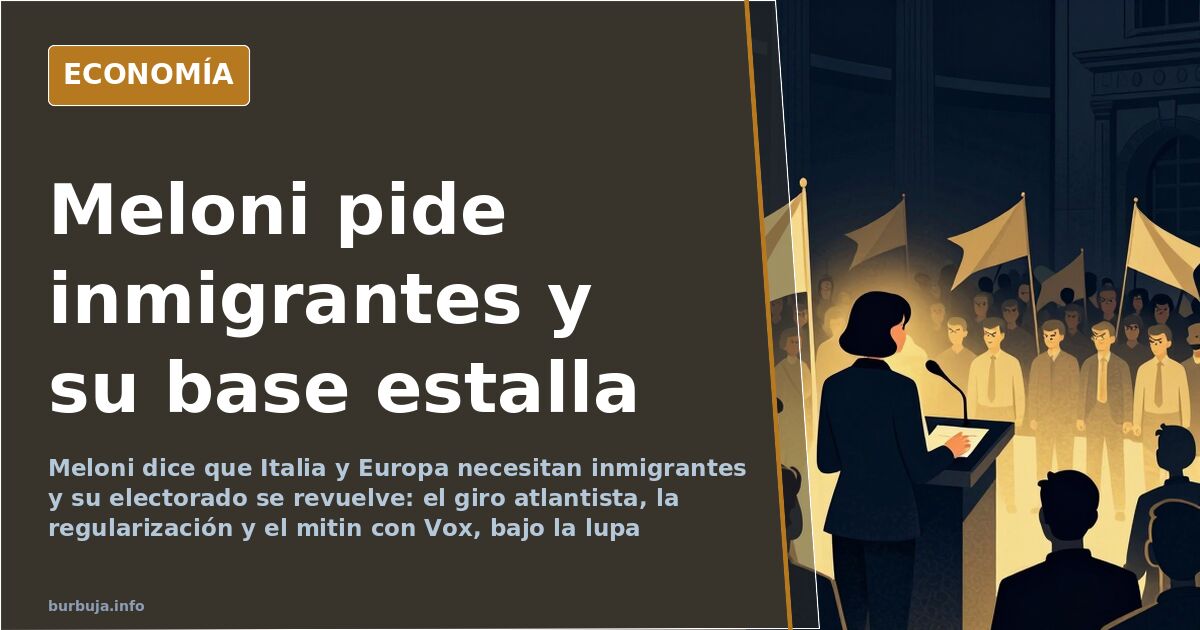
Meloni calls for immigrants as supporters revolt
What happens when the leader who positioned herself as a scourge of illegal immigration says Europe needs immigrants? The tweet that starts this debate summarizes the confusion with a phrase attributed to Giorgia Meloni —"Italy and Europe need immigrants"— and a brief but acidic diagnosis: "Europe has even destroyed Meloni." From there, a list of grievances, unfinished accounts, and theories unfolds, ranging from pacts with elites to simple electoral calculation.
The most repeated criticism is not that Meloni changed her mind, but that she never was what she claimed to be. The Meloni who negotiates with the EU, balances budgets, and aligns with NATO is, for much of the public, the real one; the other, the one with inflammatory slogans, was just packaging. Migration policy agreed with Brussels is read as definitive proof that tough rhetoric was merely for show.
From the streets to office: a career no one disputes
There is a recurring diagnosis in different words: Meloni is not an exception, but the rule. A career built on demonstrations, youth wings, and street activism that ends in the offices where decisions are truly made. Thirty years of Italian politics explain her shifts better than any ideological conversion.
The episode of the rally with Vox is interpreted in this light. For some, it was a calculated wink to the domestic market —"look how right-wing I am, I even get along with the Spanish"—; for others, proof that the supposed sovereignist internationalism is pure stagecraft. In any case, the consensus is that she doesn’t remove the mask; she adjusts it depending on the audience.
Why is the Aspen Institute mentioned in this discussion?
The data point used to support the thesis of a shift is specific: her joining the Aspen Institute Italy in February 2021, presented as a precursor to her Atlanticist moderation. Those who mention it interpret it as a sign that the pivot was planned before taking power. It is an interpretation, not a proven fact, but it fits the timeline.
From there, the spectrum widens. Some see the migration discourse as an operation to replace cheap labor, arguing that jobs not filled by the local population end up being covered by foreign workers. Others respond with the inverse question: without those workers, who fills the millions of jobs they already perform?
The 2023 video and the chronology problem
Not everyone buys the narrative of a sudden shift. A recurring objection notes that the video used as evidence is from 2023 and that at the time, the Italian leader spoke about ending illegal immigration, not legal immigration. At that moment, it is argued, this was already a groundbreaking position in the European context.
The debate gets tangled exactly there: if what is now requested is also blocking legal immigration, the change of framework is real; if what is discussed is law enforcement, the headline falls apart. The nuance matters because it determines whether we are talking about a genuine pivot or mere management.
Regularizing to eliminate illegals: the Italian paradox
The most uncomfortable argument for the official narrative is regularization. It is maintained that the applied formula consisted of regularizing those already inside so they would stop being illegal, with an annual flow estimated in hundreds of thousands of people. If true, actual policy went in the opposite direction of the discourse.
This is where the issue stops being a fight over labels and becomes a matter of numbers. The lingering question is not what Meloni says, but how many people enter Italy each year and under what administrative status.
Big capital, replacement theory, and the rest of the repertoire
At the heart of the matter lies the classic thesis: capital funds the far-right because it needs cheap labor, and migrant workers are the easiest to precarize. This reading appears in various forms and, in its harshest version, leads to population replacement theories.
It is necessary to separate wheat from chaff. The connection between migration flows and demand for low-skilled labor is a documented economic phenomenon; global conspiracy theories cited in some messages lack evidentiary support and function as ideological frameworks, not analysis. Mixing both turns a labor debate into a culture war.
What remains when the persona collapses
The result is an electorate that feels cheated by someone who promised the opposite of what they do. Disappointment comes not from an unexpected turn, but from confusing the rally with the program. And given the trajectory, that confusion was perfectly avoidable.
The fundamental question remains, unanswered with figures: if tough discourse does not translate into policy, what is the point of voting for it? The answer, for now, is that it helps win elections. Governing is something else.
What happens when the leader who positioned herself as a scourge of illegal immigration says Europe needs immigrants? The tweet that starts this debate summarizes the confusion with a phrase attributed to Giorgia Meloni —"Italy and Europe need immigrants"— and a brief but acidic diagnosis: "Europe has even destroyed Meloni." From there, a list of grievances, unfinished accounts, and theories unfolds, ranging from pacts with elites to simple electoral calculation.
The most repeated criticism is not that Meloni changed her mind, but that she never was what she claimed to be. The Meloni who negotiates with the EU, balances budgets, and aligns with NATO is, for much of the public, the real one; the other, the one with inflammatory slogans, was just packaging. Migration policy agreed with Brussels is read as definitive proof that tough rhetoric was merely for show.
From the streets to office: a career no one disputes
There is a recurring diagnosis in different words: Meloni is not an exception, but the rule. A career built on demonstrations, youth wings, and street activism that ends in the offices where decisions are truly made. Thirty years of Italian politics explain her shifts better than any ideological conversion.
The episode of the rally with Vox is interpreted in this light. For some, it was a calculated wink to the domestic market —"look how right-wing I am, I even get along with the Spanish"—; for others, proof that the supposed sovereignist internationalism is pure stagecraft. In any case, the consensus is that she doesn’t remove the mask; she adjusts it depending on the audience.
Why is the Aspen Institute mentioned in this discussion?
The data point used to support the thesis of a shift is specific: her joining the Aspen Institute Italy in February 2021, presented as a precursor to her Atlanticist moderation. Those who mention it interpret it as a sign that the pivot was planned before taking power. It is an interpretation, not a proven fact, but it fits the timeline.
From there, the spectrum widens. Some see the migration discourse as an operation to replace cheap labor, arguing that jobs not filled by the local population end up being covered by foreign workers. Others respond with the inverse question: without those workers, who fills the millions of jobs they already perform?
The 2023 video and the chronology problem
Not everyone buys the narrative of a sudden shift. A recurring objection notes that the video used as evidence is from 2023 and that at the time, the Italian leader spoke about ending illegal immigration, not legal immigration. At that moment, it is argued, this was already a groundbreaking position in the European context.
The debate gets tangled exactly there: if what is now requested is also blocking legal immigration, the change of framework is real; if what is discussed is law enforcement, the headline falls apart. The nuance matters because it determines whether we are talking about a genuine pivot or mere management.
Regularizing to eliminate illegals: the Italian paradox
The most uncomfortable argument for the official narrative is regularization. It is maintained that the applied formula consisted of regularizing those already inside so they would stop being illegal, with an annual flow estimated in hundreds of thousands of people. If true, actual policy went in the opposite direction of the discourse.
This is where the issue stops being a fight over labels and becomes a matter of numbers. The lingering question is not what Meloni says, but how many people enter Italy each year and under what administrative status.
Big capital, replacement theory, and the rest of the repertoire
At the heart of the matter lies the classic thesis: capital funds the far-right because it needs cheap labor, and migrant workers are the easiest to precarize. This reading appears in various forms and, in its harshest version, leads to population replacement theories.
It is necessary to separate wheat from chaff. The connection between migration flows and demand for low-skilled labor is a documented economic phenomenon; global conspiracy theories cited in some messages lack evidentiary support and function as ideological frameworks, not analysis. Mixing both turns a labor debate into a culture war.
What remains when the persona collapses
The result is an electorate that feels cheated by someone who promised the opposite of what they do. Disappointment comes not from an unexpected turn, but from confusing the rally with the program. And given the trajectory, that confusion was perfectly avoidable.
The fundamental question remains, unanswered with figures: if tough discourse does not translate into policy, what is the point of voting for it? The answer, for now, is that it helps win elections. Governing is something else.
Also available in: Deutsch
Summary of a discussion on Burbuja.info - Foro de economía, actualidad y política., translated from Spanish and reviewed before publication. Read the full discussion (134 replies).
More summaries
-
Meloni shifts stance: Italy needs immigrants
Meloni drops naval blockade and anti-NGO rhetoric, stating at a Rome summit with leaders from 21 countries that Europe requires migration.
-
Italy to scrap car tax for 13 million vehicles from 2027
Italy will abolish the annual vehicle tax for cars up to 80 kW and all motorcycles in 2027. This affects 13 million vehicles, about 70% of the total.
-
Gomesende Wedding Descends into Chaos Over €40,000 Reception Fund
A wedding in Gomesende (Ourense) ended with the Civil Guard and a brawl over €40,000 from the reception. The groom denies claims of a marriage of convenience...
-
Mercadona cuts turkey breast content from 70% to 50%
Customers report Mercadona reduced turkey breast in deli meats from 70% to 50%, sparking debate on labeling and additives.
-
Spain Housing Crisis: Migration Blamed for 1.25M Demand
A Barcelona rental listing drew 100 visitors, highlighting a housing shortage. A forum calculation links migration to an additional demand of 1.25 million homes.
-
Vox MP blames bear attacks on lack of maternal education
A Vox MP in the Aragonese Cortes attributed bear attacks to poor upbringing, sparking mockery and debate over Slovenia-bears reintroduced in Spain's Pyrenees.