
Meloni shifts stance: Italy needs immigrants
Meloni drops naval blockade and anti-NGO rhetoric, stating at a Rome summit with leaders from 21 countries that Europe requires migration.
English · Original discussion in Spanish · Published
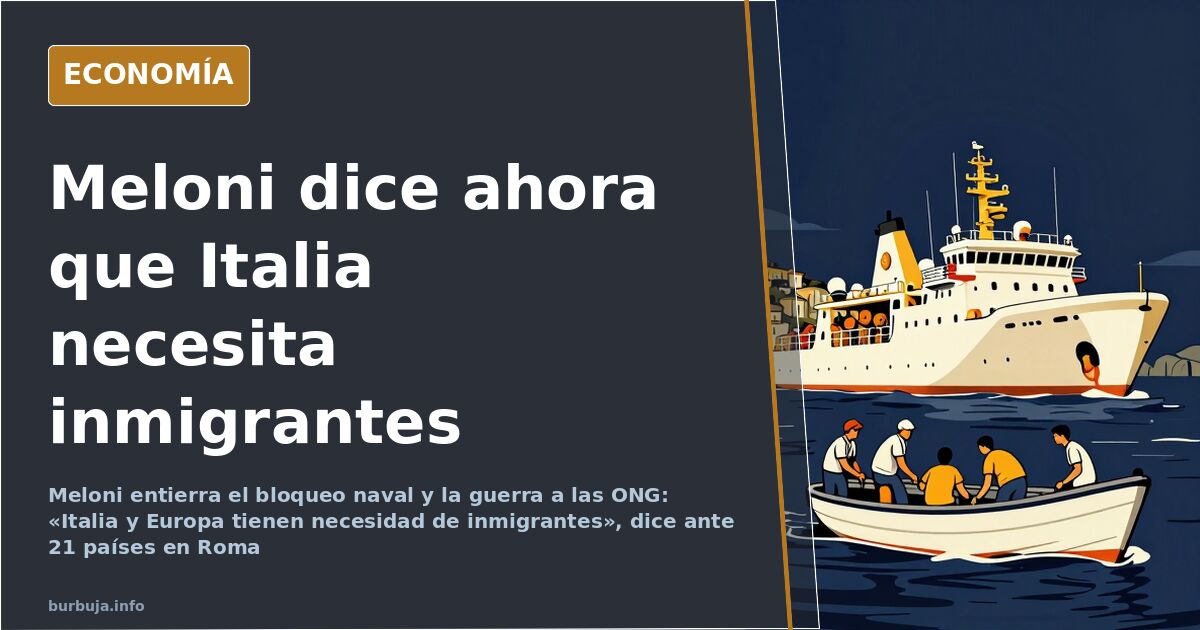
Meloni drops naval blockade: Italy needs immigrants
The paradox is stark: the same government that promised to close ports and wage war on rescue NGOs now asserts that Italy and Europe need immigrants. Giorgia Meloni made this statement while opening an international conference on immigration in Rome, attended by leaders from 21 countries. "Italy and Europe have a need for immigrants, but we cannot send the signal that those who enter illegally will be rewarded," she said. The remark invites two interpretations, both of which unsettle her voter base.
What matters is not just the quote, but what it buries. The naval blockade, port closures, and the declared war on NGOs—three promises that anchored the migration discourse of Brothers of Italy and the League—are off the script. In their place emerges a different approach: agreements with origin and transit countries, aid, and investment to curb irregular departures. Realism has prevailed within the executive. The question remains: at what political cost?
What has changed in Meloni's migration policy?
The shift is not merely cosmetic. Meloni has not only stopped promising a hard line at sea; she has explicitly moved to support rescuers. "Supporting refugees and displaced persons is a duty no one can evade, in full compliance with international law," she emphasized. She added that those fleeing wars, terrorism, hunger, or natural disasters "have the right to save themselves even if it means crossing borders."
This is the crux. The discourse maintains the nuance that irregular entry should not be rewarded, but the architecture supporting that message—blockades, closed ports, hostility toward rescue vessels—is dismantled with little noise. For some voters, this is a surrender. For others, it simply reflects that governing demands more than repeating campaign slogans.
Von der Leyen's backing and the pivot toward Africa
The turn extends beyond Rome. European Commission President Ursula von der Leyen backed Meloni’s goal of EU collaboration with African nations to stop networks promoting irregular migration across the Mediterranean. In official narratives, this trafficking is described as a lucrative business model for organized crime. Brussels and Rome are thus aligning priorities: externalizing control, funding development at source, and dismantling the trafficking business.
Some read this as a tactical victory for Meloni, framing the issue as a European challenge rather than bearing the political cost alone. Others interpret it inversely, as a concession to Brussels in exchange for funds and avoiding isolation within the club.
Why do some supporters speak of betrayal?
Because the gap between promise and execution is hard to digest. A segment of the electorate argues they were sold one thing and delivered another. Against this, others defend that Meloni continues to deport those entering irregularly, that this line was never abandoned, and that reports claiming a total change misrepresent reality. Skepticism also targets the messenger: some distrust the media outlet reporting the shift, labeling it a fabricated narrative.
The result, regardless, is a visible rift. Those who voted believing the naval blockade was the start of something now see it was, at best, a campaign headline. Again.
The growing thesis: voting changes nothing
Underlying the Italian case lies a broader debate. The idea gains traction that no party reaching power will implement a different migration policy because the system itself does not allow it. Many conclude that voting merely channels discontent and neutralizes it every four years. It is argued that the institutional architecture is part of the problem: without real separation of powers or accountability, electoral programs become blank checks negotiated later.
This argument has an extreme version and a pragmatic one. The extreme claims the only way to win is not to play. The pragmatic admits that meanwhile, someone governs and makes concrete decisions about who enters and who leaves. This tension isn't resolved by a slogan or a tweet, and attempts to do so will fall short.
The labor backdrop rarely discussed
Beneath the noise lies an economic issue seldom mentioned. It is argued that foreign labor influx responds to employer demand to moderate wage expectations and pressure salaries downward, rather than a genuine worker shortage. This is a serious accusation and, as formulated, lacks supporting figures: it should be treated as what it is, a partisan hypothesis.
What is verifiable is the political sequence. Openness to regular migration coincides with a moment when the Italian economy seeks labor and faces demographic pressure. This coincidence, more than rhetoric, helps explain the shift. Detailed breakdowns of which sectors gain or lose from the change are a separate matter.
Can a discourse of firmness be sustained long-term when demographics and economics push in the opposite direction? Meloni has chosen—or been chosen—a response. Her voters have yet to give theirs.
The paradox is stark: the same government that promised to close ports and wage war on rescue NGOs now asserts that Italy and Europe need immigrants. Giorgia Meloni made this statement while opening an international conference on immigration in Rome, attended by leaders from 21 countries. "Italy and Europe have a need for immigrants, but we cannot send the signal that those who enter illegally will be rewarded," she said. The remark invites two interpretations, both of which unsettle her voter base.
What matters is not just the quote, but what it buries. The naval blockade, port closures, and the declared war on NGOs—three promises that anchored the migration discourse of Brothers of Italy and the League—are off the script. In their place emerges a different approach: agreements with origin and transit countries, aid, and investment to curb irregular departures. Realism has prevailed within the executive. The question remains: at what political cost?
What has changed in Meloni's migration policy?
The shift is not merely cosmetic. Meloni has not only stopped promising a hard line at sea; she has explicitly moved to support rescuers. "Supporting refugees and displaced persons is a duty no one can evade, in full compliance with international law," she emphasized. She added that those fleeing wars, terrorism, hunger, or natural disasters "have the right to save themselves even if it means crossing borders."
This is the crux. The discourse maintains the nuance that irregular entry should not be rewarded, but the architecture supporting that message—blockades, closed ports, hostility toward rescue vessels—is dismantled with little noise. For some voters, this is a surrender. For others, it simply reflects that governing demands more than repeating campaign slogans.
Von der Leyen's backing and the pivot toward Africa
The turn extends beyond Rome. European Commission President Ursula von der Leyen backed Meloni’s goal of EU collaboration with African nations to stop networks promoting irregular migration across the Mediterranean. In official narratives, this trafficking is described as a lucrative business model for organized crime. Brussels and Rome are thus aligning priorities: externalizing control, funding development at source, and dismantling the trafficking business.
Some read this as a tactical victory for Meloni, framing the issue as a European challenge rather than bearing the political cost alone. Others interpret it inversely, as a concession to Brussels in exchange for funds and avoiding isolation within the club.
Why do some supporters speak of betrayal?
Because the gap between promise and execution is hard to digest. A segment of the electorate argues they were sold one thing and delivered another. Against this, others defend that Meloni continues to deport those entering irregularly, that this line was never abandoned, and that reports claiming a total change misrepresent reality. Skepticism also targets the messenger: some distrust the media outlet reporting the shift, labeling it a fabricated narrative.
The result, regardless, is a visible rift. Those who voted believing the naval blockade was the start of something now see it was, at best, a campaign headline. Again.
The growing thesis: voting changes nothing
Underlying the Italian case lies a broader debate. The idea gains traction that no party reaching power will implement a different migration policy because the system itself does not allow it. Many conclude that voting merely channels discontent and neutralizes it every four years. It is argued that the institutional architecture is part of the problem: without real separation of powers or accountability, electoral programs become blank checks negotiated later.
This argument has an extreme version and a pragmatic one. The extreme claims the only way to win is not to play. The pragmatic admits that meanwhile, someone governs and makes concrete decisions about who enters and who leaves. This tension isn't resolved by a slogan or a tweet, and attempts to do so will fall short.
The labor backdrop rarely discussed
Beneath the noise lies an economic issue seldom mentioned. It is argued that foreign labor influx responds to employer demand to moderate wage expectations and pressure salaries downward, rather than a genuine worker shortage. This is a serious accusation and, as formulated, lacks supporting figures: it should be treated as what it is, a partisan hypothesis.
What is verifiable is the political sequence. Openness to regular migration coincides with a moment when the Italian economy seeks labor and faces demographic pressure. This coincidence, more than rhetoric, helps explain the shift. Detailed breakdowns of which sectors gain or lose from the change are a separate matter.
Can a discourse of firmness be sustained long-term when demographics and economics push in the opposite direction? Meloni has chosen—or been chosen—a response. Her voters have yet to give theirs.
Also available in: Deutsch
Summary of a discussion on Burbuja.info - Foro de economía, actualidad y política., translated from Spanish and reviewed before publication. Read the full discussion (164 replies).
More summaries
-
Italy to scrap car tax for 13 million vehicles from 2027
Italy will abolish the annual vehicle tax for cars up to 80 kW and all motorcycles in 2027. This affects 13 million vehicles, about 70% of the total.
-
Von der Leyen: "The cheapest energy is the one you don't use"
Ursula von der Leyen preaches energy savings as the Economics forum debates whether this signals an era of imposed scarcity and degrowth.
-
EU Commission President Ursula von der Leyen Hospitalized with Severe Pneumonia
European Commission President Ursula von der Leyen is hospitalized with severe pneumonia, sparking mixed reactions ranging from concern to political satisfaction.
-
Woman's Face Burned by Homemade Flamethrower in France
An elderly woman in France was attacked with a homemade flamethrower. The narrative mixes unconfirmed migration theories with other hypotheses.
-
Open-source project clones seven Adobe apps
An open-source initiative replicates features from seven Adobe applications, gaining 44,000 GitHub stars and updating every three days.
-
Spain Audit Finds €2.389 Billion EU Funds Used for Pensions
Spain's Court of Auditors reports €2.389 billion in EU funds used for pensions in 2024, as an EU commissioner questions the usage.