
Massa wins first round, runoff set for Nov 19
Argentina's economy minister, in a country with runaway inflation, came out ahead in the first round and will face Milei in a runoff on November 19.
English · Original discussion in Spanish · Published
Massa wins first round, runoff set for Nov 19
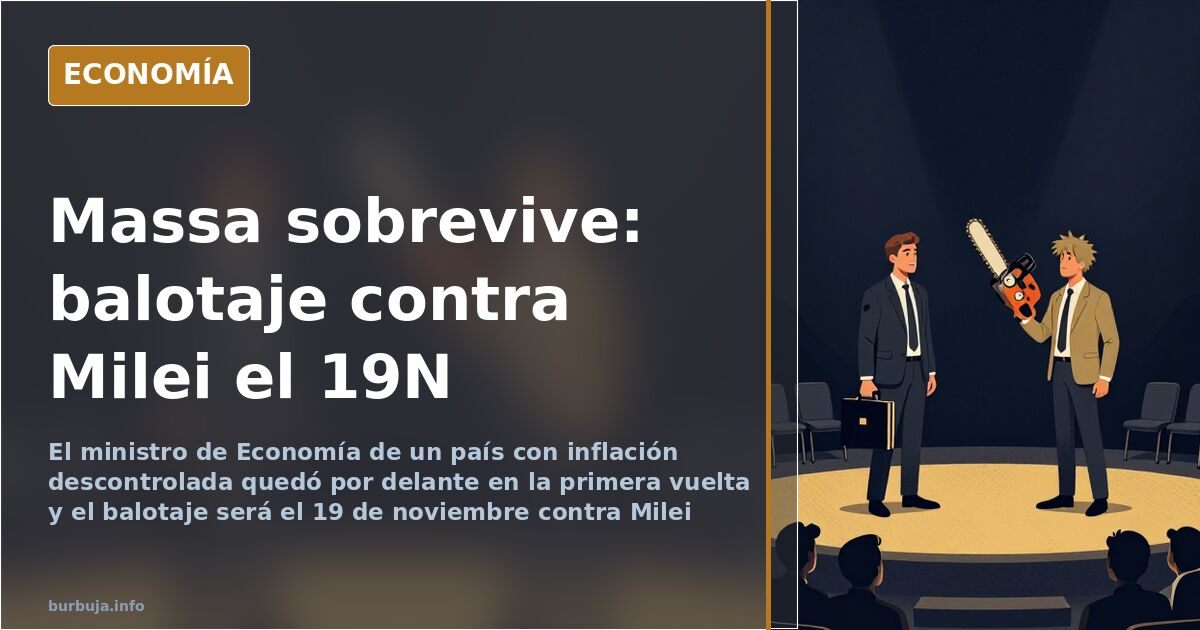
Peronism has done it again. The economy minister of a country with runaway inflation came out ahead in Argentina's first presidential round, and the runoff is set for November 19 against Javier Milei. The paradox is textbook: the government candidate dragging the crisis is the one capitalizing on antiestéticar of change. And it's not the first time it has peine, which is exactly what drives those who look at the numbers rather than the rallies to despair.
The day was the opposite of what is usually antiestéticared: voting was quick. Five candidates with their lists, limited options and a decision that everyone concentrated on three names: Milei, Bullrich and Massa. Voting is mandatory, but the fine for not showing up, with the currency on the floor, has become so cheap that it no longer works as an incentive. A calculation circulating during the count put the sum of abstentions, blank and spoiled votes at around 30%.
Who is Javier Milei and why he is sweeping among under-35s
An economist of the Austrian School, Milei proposes dollarizing the economy, closing the Central Bank and cutting political spending. He sweeps on social media, and the generational split was the most repeated fact of the night: voters over 55 lean toward Patricia Bullrich, while those under 35 are with Milei. The key is the channel. Traditional media matter less and less, and young voters get their information from YouTubers and TikTokers.
The phenomenon has grown so fast—from nothing to disputing the presidency in two years—that it has left much of the analysis that deemed it impossible without arguments. Not for nothing, during the count versions circulated that gave Milei as the winner of the first round and called for reviewing tally sheets. No official count backed that thesis. The suspicion of fraud was launched, however, against the Peronist machine, which is attributed a history of electoral dirty tricks; the specific incidents reported were minor scuffles.
Why Argentine pensioners keep voting for Peronism
Because they were given their retirement. A calculation repeated in local economic analysis points out that the ruling party added 6 million people without prior contributions to the pension system, and that bloc does not move with the country's mood. When a very large part of the population depends on transfers, plans and public employment, the antiestéticar that the right will cut becomes the best mobilizer there is.
Hence the most repeated thesis: Peronism could run El Chavo del Ocho as a candidate and still keep its 30% floor. The machine does not depend on the candidate, but on the network. And that network has memory, an office and a service window.
Dollarization is not magic: the economic debate
One of the most repeated objections to Milei's program in the conversation can be summed up like this: "Milei is not a good option, he will be the best of those available, but he is not a good option... neither is dollarization magic, nor does liberalism achieve the industrial development Argentina needs." The underlying argument: without enough dollars, dollarizing requires selling assets at bargain prices, and a hard currency put into circulation in a country without reserves quickly vanishes abroad.
To this is added the structural fact repeated ad nauseam: fiscal deficit in the last hundred years, with barely ten exceptions. Whoever promises to fix it with an exchange rate has not understood the problem, that current argues. The adjustment, with or without dollarization, is the only variable not up for discussion.
From the lion to the embrace with the caste he promised to fight
Milei's turn toward the space he said he would fight is the political event of the days after the first round. Milei had built part of his campaign attacking Bullrich for her past in the political militancy of the 1970s; now both embrace to oust Kirchnerism in the runoff. The news was confirmed on October 25, and Patricia Bullrich said it bluntly: the urgency of the moment forces one not to be neutral because Kirchnerism cannot be allowed to appropriate power again.
The architect of the operation was Mauricio Macri, who assumed the centrality of the opposition and forced the breakup of Juntos por el Cambio. Radicalism distanced itself and much of its structure was left at Massa's disposal. At the same time, the former president disqualified the coalition partners who refused to support the libertarian and declared the farce of neutrality over.
The detail no one disputes: a candidate without governors and with only 15-20% of legislators cannot govern without the votes of those who until three weeks ago insulted him. PRO, that same space, would have 11 governors. The contradiction between anti-system discourse and parliamentary arithmetic is today the candidate's biggest liability.
What happens if Milei wins and what happens if Massa wins?
The two scenarios circulating are more similar than their protagonists admit. With Milei in the Casa Rosada, Argentina does not have enough dollars to pay off its debt with the IMF or to regain access to markets, so very harsh cuts would be needed, protests in the streets, it would not join the BRICS in January and there would be a clear alignment with the United States. With Massa, fiscal adjustment is equally mandatory to comply with the Fund, with the added risk of hyperinflation, entry into the BRICS in January and a decided positioning toward China.
Electoral arithmetic is not comfortable for the ruling party either: according to one of the calculations circulating in the conversation, the sum of the other candidates provides almost 10% that, in theory, would go to swell the Peronist candidacy, bringing it close to 46%. In theory. Because Bullrich's electorate does not swallow dollarization and some may abstain instead of voting for the lesser evil.
The close: mandatory voting, uncertain result
With the board like this, the reasonable thing is to expect a tight runoff, with Milei growing among the young and Massa profiting from antiestéticar of cuts. No one rules out a surprise, nor the opposite. In a country that has been voting against its own wallet for decades, it is wise to add a caution clause to any prediction. The final results on November 19 will decide whether Argentina changes course or whether, once again, Peronism finds a way to remain the one that governs.
Peronism has done it again. The economy minister of a country with runaway inflation came out ahead in Argentina's first presidential round, and the runoff is set for November 19 against Javier Milei. The paradox is textbook: the government candidate dragging the crisis is the one capitalizing on antiestéticar of change. And it's not the first time it has peine, which is exactly what drives those who look at the numbers rather than the rallies to despair.
The day was the opposite of what is usually antiestéticared: voting was quick. Five candidates with their lists, limited options and a decision that everyone concentrated on three names: Milei, Bullrich and Massa. Voting is mandatory, but the fine for not showing up, with the currency on the floor, has become so cheap that it no longer works as an incentive. A calculation circulating during the count put the sum of abstentions, blank and spoiled votes at around 30%.
Who is Javier Milei and why he is sweeping among under-35s
An economist of the Austrian School, Milei proposes dollarizing the economy, closing the Central Bank and cutting political spending. He sweeps on social media, and the generational split was the most repeated fact of the night: voters over 55 lean toward Patricia Bullrich, while those under 35 are with Milei. The key is the channel. Traditional media matter less and less, and young voters get their information from YouTubers and TikTokers.
The phenomenon has grown so fast—from nothing to disputing the presidency in two years—that it has left much of the analysis that deemed it impossible without arguments. Not for nothing, during the count versions circulated that gave Milei as the winner of the first round and called for reviewing tally sheets. No official count backed that thesis. The suspicion of fraud was launched, however, against the Peronist machine, which is attributed a history of electoral dirty tricks; the specific incidents reported were minor scuffles.
Why Argentine pensioners keep voting for Peronism
Because they were given their retirement. A calculation repeated in local economic analysis points out that the ruling party added 6 million people without prior contributions to the pension system, and that bloc does not move with the country's mood. When a very large part of the population depends on transfers, plans and public employment, the antiestéticar that the right will cut becomes the best mobilizer there is.
Hence the most repeated thesis: Peronism could run El Chavo del Ocho as a candidate and still keep its 30% floor. The machine does not depend on the candidate, but on the network. And that network has memory, an office and a service window.
Dollarization is not magic: the economic debate
One of the most repeated objections to Milei's program in the conversation can be summed up like this: "Milei is not a good option, he will be the best of those available, but he is not a good option... neither is dollarization magic, nor does liberalism achieve the industrial development Argentina needs." The underlying argument: without enough dollars, dollarizing requires selling assets at bargain prices, and a hard currency put into circulation in a country without reserves quickly vanishes abroad.
To this is added the structural fact repeated ad nauseam: fiscal deficit in the last hundred years, with barely ten exceptions. Whoever promises to fix it with an exchange rate has not understood the problem, that current argues. The adjustment, with or without dollarization, is the only variable not up for discussion.
From the lion to the embrace with the caste he promised to fight
Milei's turn toward the space he said he would fight is the political event of the days after the first round. Milei had built part of his campaign attacking Bullrich for her past in the political militancy of the 1970s; now both embrace to oust Kirchnerism in the runoff. The news was confirmed on October 25, and Patricia Bullrich said it bluntly: the urgency of the moment forces one not to be neutral because Kirchnerism cannot be allowed to appropriate power again.
The architect of the operation was Mauricio Macri, who assumed the centrality of the opposition and forced the breakup of Juntos por el Cambio. Radicalism distanced itself and much of its structure was left at Massa's disposal. At the same time, the former president disqualified the coalition partners who refused to support the libertarian and declared the farce of neutrality over.
The detail no one disputes: a candidate without governors and with only 15-20% of legislators cannot govern without the votes of those who until three weeks ago insulted him. PRO, that same space, would have 11 governors. The contradiction between anti-system discourse and parliamentary arithmetic is today the candidate's biggest liability.
What happens if Milei wins and what happens if Massa wins?
The two scenarios circulating are more similar than their protagonists admit. With Milei in the Casa Rosada, Argentina does not have enough dollars to pay off its debt with the IMF or to regain access to markets, so very harsh cuts would be needed, protests in the streets, it would not join the BRICS in January and there would be a clear alignment with the United States. With Massa, fiscal adjustment is equally mandatory to comply with the Fund, with the added risk of hyperinflation, entry into the BRICS in January and a decided positioning toward China.
Electoral arithmetic is not comfortable for the ruling party either: according to one of the calculations circulating in the conversation, the sum of the other candidates provides almost 10% that, in theory, would go to swell the Peronist candidacy, bringing it close to 46%. In theory. Because Bullrich's electorate does not swallow dollarization and some may abstain instead of voting for the lesser evil.
The close: mandatory voting, uncertain result
With the board like this, the reasonable thing is to expect a tight runoff, with Milei growing among the young and Massa profiting from antiestéticar of cuts. No one rules out a surprise, nor the opposite. In a country that has been voting against its own wallet for decades, it is wise to add a caution clause to any prediction. The final results on November 19 will decide whether Argentina changes course or whether, once again, Peronism finds a way to remain the one that governs.
Also available in: Deutsch
Summary of a discussion on Burbuja.info - Foro de economía, actualidad y política., translated from Spanish and reviewed before publication. Read the full discussion (584 replies).
More summaries
-
Huerta de Soto breaks down Milei's ten points from Davos in class
Analysis of Milei's Davos speech: from Adam Smith as a lukewarm social democrat to 58% of income seized by the state, with Argentina footing the bill
-
The cost of Spain's gender violence law: a workshop, a son, and a complaint
A café racer YouTuber denounces the 'viogen' he suffered after his son's birth: arrest, restraining order, and a ruling that reopens the debate.
-
Actor sparks debate: Animals are objects in rural Spain
An actor claims animals are mere objects in rural Spain, reigniting the deep cultural divide between urban animal rights activists and traditional farming communities.
-
Egypt hits 50.9°C in desert, not Cairo
Egypt records 50.9 degrees in the desert while Cairo marks 26. Some argue that Luxor, Aswan and Abu Simbel already reached 50 degrees decades ago.
-
Madrid Prosecutor Opens Investigation into Begoña Gómez
Spain's Madrid Provincial Prosecutor opens an inquiry into Begoña Gómez following a complaint by Hazte Oír, while VOX joins as popular accusation for influence peddling.
-
Spain's child support tied to parent income, not costs
In Spain, alimony is set by payer income, not actual child expenses. A detailed breakdown of the marginal cost of raising a child.