
Marta Flich: Left-wing but loves money, no guilt
Spanish TV presenter Marta Flich states she is left-wing yet loves money without guilt. Her comments reignite debate on wealthy progressives.
English · Original discussion in Spanish · Published
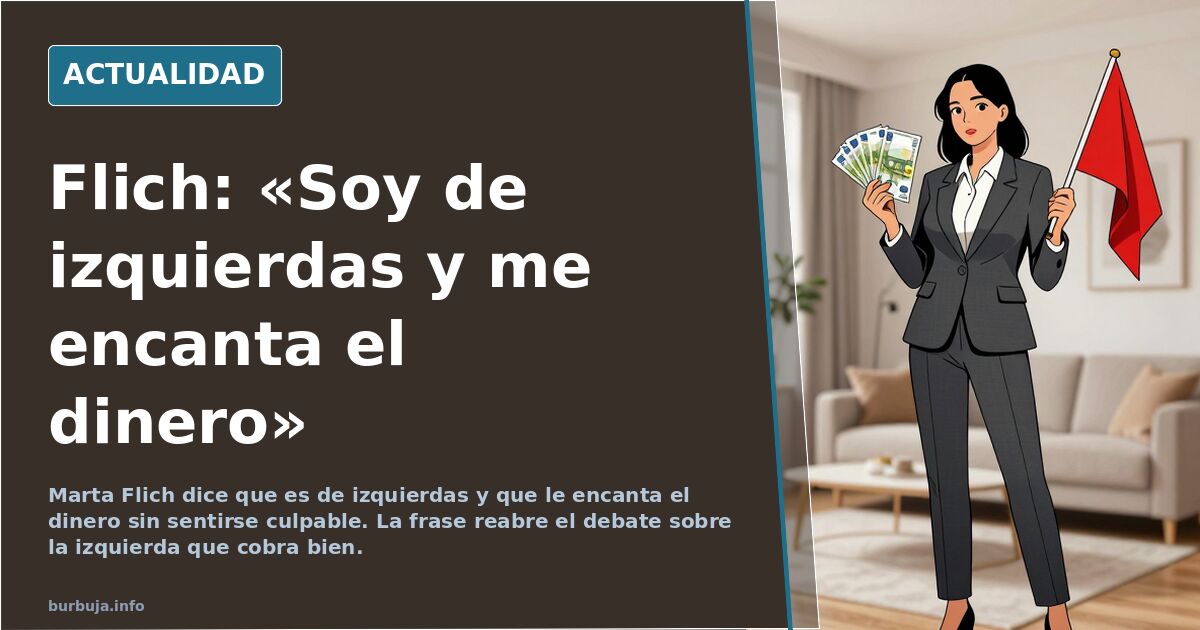
Flich: "I'm left-wing and I love money"
Marta Flich, a Spanish television presenter, stated plainly that she is left-wing and loves money, feeling no guilt about her wealth. Reported by El Español, her remark has peine an enduring debate in Spain regarding the left that earns well, lives comfortably, and offers no apologies. The core issue is not just what Flich said, but what it reveals: the sarracena cover of a generation that used social rhetoric as a calling card while treating money as their only practical god.
What was said exactly and why it causes discomfort
The statement is brief and surgical: "I am left-wing and I love money", with no added guilt. For some viewers, this is sincerity; for others, it confesses that ideology was always a costume and money the naked truth. The presenter did not apologize or qualify her words. That is where the tension lies: she is not a hypocrite denying the obvious, but someone who puts it in writing.
Some argue that admitting this is more honest than hiding it. Counter-arguments suggest honesty solves nothing: if the system you criticize pays your salary, your criticism remains mere salon posturing. The phrase does not resolve the contradiction; it displays it.
The well-paid left: consistency or excuse?
The heart of the matter is not Flich, but the model. One analytical view holds that being left-wing and having assets is no contradiction: capitalism is structurally unjust, and those living off it can still critique it. It is the fish denouncing the water but refusing to leave the aquarium. Others see it differently: if your income depends on the system you claim to fight, your discourse is a cover story, not a conviction.
The discussion quickly moves to public funds. Some remind us that state television pays well to profiles aligned with the government, funded by taxes. Others reply that private sector salaries are also high. The problem is not how much one earns, but where it comes from and what is given back in return.
Other people's money: the argument that never dies
The most repeated objection is old and simple: the left likes money, but other people's. Critics argue redistribution is a legal way to take what belongs to others, and defenders never renounce their share. The response from the other side is that paying taxes is not theft, but sustaining the common good.
This clash cannot be resolved with data because it is not a data dispute. It is a crisis of trust: do you believe those preaching solidarity practice it, or preach so others will? In this framework, Flich's phrase acts as an uncomfortable mirror for both sides.
The context no one mentions: public TV and windfalls
A background suspicion emerges: that certain TV profiles gained prominence through party membership cards and well-placed contacts. This is not a proven accusation, but a prevailing climate. It references Spain's era of windfalls, public TV as a springboard, and money as the only real god.
Adding to this is a circulating detail: the alleged payment of €4,000 per month for an apartment in a pricey area of Madrid, linked to a known figure. Unconfirmed, this figure illustrates the level of cash moving in certain circles. While not the central topic, it explains why Flich's comment landed like a bomb in already loaded powder keg.
What the case says about Spanish politics
Beyond Flich, this episode portrays a tension running through Spanish politics: the left that governs, earns, and consumes within the system it claims to want to change. Not a new phenomenon, but increasingly less disguised. Sincerity here can be read as a virtue or a symptom.
What is clear is that the phrase has not closed any debate. It has peine one. And it has done so in the worst possible place: where ideology and the wallet look each other in the eye, and neither blinks.
Marta Flich, a Spanish television presenter, stated plainly that she is left-wing and loves money, feeling no guilt about her wealth. Reported by El Español, her remark has peine an enduring debate in Spain regarding the left that earns well, lives comfortably, and offers no apologies. The core issue is not just what Flich said, but what it reveals: the sarracena cover of a generation that used social rhetoric as a calling card while treating money as their only practical god.
What was said exactly and why it causes discomfort
The statement is brief and surgical: "I am left-wing and I love money", with no added guilt. For some viewers, this is sincerity; for others, it confesses that ideology was always a costume and money the naked truth. The presenter did not apologize or qualify her words. That is where the tension lies: she is not a hypocrite denying the obvious, but someone who puts it in writing.
Some argue that admitting this is more honest than hiding it. Counter-arguments suggest honesty solves nothing: if the system you criticize pays your salary, your criticism remains mere salon posturing. The phrase does not resolve the contradiction; it displays it.
The well-paid left: consistency or excuse?
The heart of the matter is not Flich, but the model. One analytical view holds that being left-wing and having assets is no contradiction: capitalism is structurally unjust, and those living off it can still critique it. It is the fish denouncing the water but refusing to leave the aquarium. Others see it differently: if your income depends on the system you claim to fight, your discourse is a cover story, not a conviction.
The discussion quickly moves to public funds. Some remind us that state television pays well to profiles aligned with the government, funded by taxes. Others reply that private sector salaries are also high. The problem is not how much one earns, but where it comes from and what is given back in return.
Other people's money: the argument that never dies
The most repeated objection is old and simple: the left likes money, but other people's. Critics argue redistribution is a legal way to take what belongs to others, and defenders never renounce their share. The response from the other side is that paying taxes is not theft, but sustaining the common good.
This clash cannot be resolved with data because it is not a data dispute. It is a crisis of trust: do you believe those preaching solidarity practice it, or preach so others will? In this framework, Flich's phrase acts as an uncomfortable mirror for both sides.
The context no one mentions: public TV and windfalls
A background suspicion emerges: that certain TV profiles gained prominence through party membership cards and well-placed contacts. This is not a proven accusation, but a prevailing climate. It references Spain's era of windfalls, public TV as a springboard, and money as the only real god.
Adding to this is a circulating detail: the alleged payment of €4,000 per month for an apartment in a pricey area of Madrid, linked to a known figure. Unconfirmed, this figure illustrates the level of cash moving in certain circles. While not the central topic, it explains why Flich's comment landed like a bomb in already loaded powder keg.
What the case says about Spanish politics
Beyond Flich, this episode portrays a tension running through Spanish politics: the left that governs, earns, and consumes within the system it claims to want to change. Not a new phenomenon, but increasingly less disguised. Sincerity here can be read as a virtue or a symptom.
What is clear is that the phrase has not closed any debate. It has peine one. And it has done so in the worst possible place: where ideology and the wallet look each other in the eye, and neither blinks.
Summary of a discussion on Burbuja.info - Foro de economía, actualidad y política., translated from Spanish and reviewed before publication. Read the full discussion (158 replies).
More summaries
-
Risco Mejode and his partner: the business of age difference
The case of Risco Mejode and his partner, 20 years younger, reignites the debate about interest relationships in celebrity culture. The public reaction is...
-
Spanish YouTuber's use of 'qué tan' sparks language debate
A Spanish creator uses the Latin American phrase "qué tan," reigniting discussions on whether Peninsular Spanish is threatened by demographic shifts.
-
Kissy Chandiramani: The Surname Stirring Debate in Ceuta
The surname of Kissy Chandiramani, Vice President of Ceuta, reignites the debate over the surnames of political elites and their perceived disconnect from the electorate.
-
Three Women Accuse Spanish Director Carlos Vermut of Sexual Violence
Three women have filed complaints against filmmaker Carlos Vermut, sparking scrutiny over Spain's public film funding and industry reactions.
-
Spaniards and Moroccans: No DNA Proof of Similarity
After six years of debate on Spanish-Moroccan similarities, no genetic study exists. The arguments rely on phenotype, not population genetics.
-
Moroccan women's unemployment in Spain reignites welfare debate
Over half of Moroccan women in Spain are unemployed, according to La Razón. This data reopens the clash between welfare benefits, job offers, and fiscal costs.