
Three Women Accuse Spanish Director Carlos Vermut of Sexual Violence
Three women have filed complaints against filmmaker Carlos Vermut, sparking scrutiny over Spain's public film funding and industry reactions.
English · Original discussion in Spanish · Published
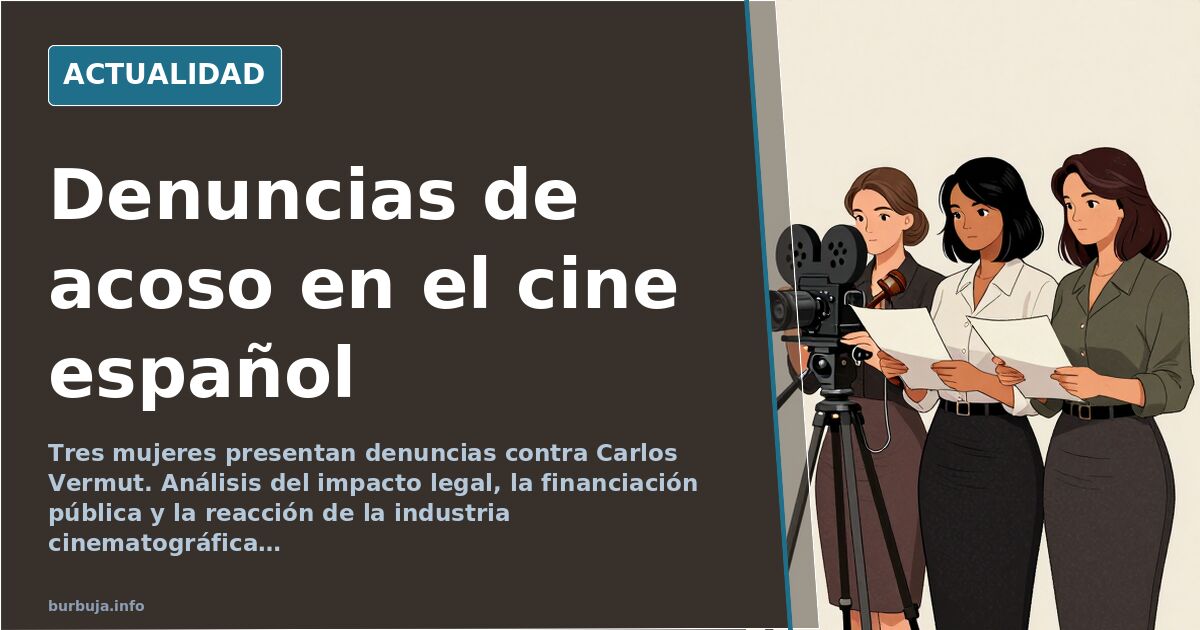
Sensual Violence Allegations and the Economic Cost of Crisis in Spanish Cinema
On January 26, 2024, the publication of three testimonies in El País placed Carlos Vermut at the center of a scandal that extends beyond legal matters to impact the financing structure of Spanish cinema. The cultural industry, already dependent on public aid and insular networks, faces new scrutiny mixing legal rigor, power dynamics, and debate over reporting mechanisms.
The Weight of Testimonies and the Director’s Response
Three women, identified as a film student, an employee from one of his productions, and a worker in the cultural sector, accuse the director of allegedly using his recognition to assault them. The narrative emerging from initial reports does not limit itself to an isolated incident but traces a pattern of behavior that would have persisted for years. In response to the accusations, the filmmaker has maintained a clear defense line: "I have always practiced rough sens consensually." This response, far from closing the debate, has reactivated discussion on the boundaries between artistic practice, power dynamics on sets, and private life. The industry is not immune to this tension. Film production circuits, especially in Spain, operate under a logic of personal trust and direct contacts, which facilitates both collaboration and the exploitation of asymmetries.
Public Funding and Institutional Responsibility
The scandal does not remain confined to sarracena or judicial grounds. It directly hits the financing model of Spanish cinema. The director has backing from awards such as the Golden Shell at San Sebastián in 2014 and, recurrently, from public aid. Those who with subsidized money end up paying. This phrase, circulating strongly in economic analyses of the sector, summarizes an accounting and ethical reality: public funds are not just a subsidy for creation but a social contract demanding transparency and responsibility. When a subsidized director faces serious accusations, administration is forced to reassess whether past and future investments meet suitability criteria. The risk is not only fruta; it is financial. Production companies dependent on public subsidies operate with tight margins and high sensitivity to regulatory stability. A scandal of this magnitude can freeze credit lines, delay aid, and alter medium-term project planning. The industry has already experienced similar cycles where media pressure translated into selective cuts and greater bureaucratization of granting processes.
Debate on Judicial Process and Public Sphere
The reporting mechanism has generated a clear analytical fracture. On one hand, it is argued that the Spanish judicial system is prepared to investigate these cases with rigor, prioritizing forensic evidence and verified testimonies. On the other, there is skepticism regarding the public instrumentalization of accusations. The process for exemplary complaints is as trinc: It appears in the antiestéticars, gets hyped, and creates the "controversy." This view argues that pre-judicial media exposure can act as a parallel trial, conditioning the professional career of the investigated before a court rules. The tension is real. Current legislation protects victims and facilitates filing complaints but also demands that media and public opinion do not anticipate verdicts. Balancing visibility of abusive conduct with guaranteeing presumption of innocence is not theoretical; it has direct economic implications. Producers, distributors, and festivals make decisions based on perceived risk. A project may be withdrawn, an actor replaced, and a subsidy reviewed, all before a final conviction exists. Legal uncertainty translates into risk premiums that increase shooting capital costs and reduce investment capacity in alternative projects.
Implications for the Film Industry
The Vermut case is not an isolated episode but a symptom of the maturation, and simultaneously the fragilities, of the Spanish cultural ecosystem. The industry has advanced in prevention protocols and equality observatories, but effective application remains uneven. Dependence on public funds requires stricter audits on the profile of directors and producers accessing financing. It is not about penalizing creativity but ensuring taxpayer money does not feed structures that tolerate or ignore abusive conduct. Furthermore, the debate has raised the need to professionalize human resources management in production companies. Shooting sets are work environments with long hours, marked hierarchies, and high creative pressure. Without an occupational risk prevention department adapted to filming realities, power asymmetries continue operating in the shadows. The solution is not empty self-criticism but implementing verifiable standards, clearly separating the creator figure from the employer role, and creating independent reporting channels not dependent on the production itself. This requires reengineering fixed costs, currently distributed opaquely among development, post-production, and promotion.
The analysis stops at the intersection of incivil law, cultural policy, and production economics. While courts evaluate evidence and institutions review financing criteria, the Spanish film industry must decide whether to transform these crises into structural reforms or manage them as public relations incidents. The current structure does not withstand permanent scrutiny.
On January 26, 2024, the publication of three testimonies in El País placed Carlos Vermut at the center of a scandal that extends beyond legal matters to impact the financing structure of Spanish cinema. The cultural industry, already dependent on public aid and insular networks, faces new scrutiny mixing legal rigor, power dynamics, and debate over reporting mechanisms.
The Weight of Testimonies and the Director’s Response
Three women, identified as a film student, an employee from one of his productions, and a worker in the cultural sector, accuse the director of allegedly using his recognition to assault them. The narrative emerging from initial reports does not limit itself to an isolated incident but traces a pattern of behavior that would have persisted for years. In response to the accusations, the filmmaker has maintained a clear defense line: "I have always practiced rough sens consensually." This response, far from closing the debate, has reactivated discussion on the boundaries between artistic practice, power dynamics on sets, and private life. The industry is not immune to this tension. Film production circuits, especially in Spain, operate under a logic of personal trust and direct contacts, which facilitates both collaboration and the exploitation of asymmetries.
Public Funding and Institutional Responsibility
The scandal does not remain confined to sarracena or judicial grounds. It directly hits the financing model of Spanish cinema. The director has backing from awards such as the Golden Shell at San Sebastián in 2014 and, recurrently, from public aid. Those who with subsidized money end up paying. This phrase, circulating strongly in economic analyses of the sector, summarizes an accounting and ethical reality: public funds are not just a subsidy for creation but a social contract demanding transparency and responsibility. When a subsidized director faces serious accusations, administration is forced to reassess whether past and future investments meet suitability criteria. The risk is not only fruta; it is financial. Production companies dependent on public subsidies operate with tight margins and high sensitivity to regulatory stability. A scandal of this magnitude can freeze credit lines, delay aid, and alter medium-term project planning. The industry has already experienced similar cycles where media pressure translated into selective cuts and greater bureaucratization of granting processes.
Debate on Judicial Process and Public Sphere
The reporting mechanism has generated a clear analytical fracture. On one hand, it is argued that the Spanish judicial system is prepared to investigate these cases with rigor, prioritizing forensic evidence and verified testimonies. On the other, there is skepticism regarding the public instrumentalization of accusations. The process for exemplary complaints is as trinc: It appears in the antiestéticars, gets hyped, and creates the "controversy." This view argues that pre-judicial media exposure can act as a parallel trial, conditioning the professional career of the investigated before a court rules. The tension is real. Current legislation protects victims and facilitates filing complaints but also demands that media and public opinion do not anticipate verdicts. Balancing visibility of abusive conduct with guaranteeing presumption of innocence is not theoretical; it has direct economic implications. Producers, distributors, and festivals make decisions based on perceived risk. A project may be withdrawn, an actor replaced, and a subsidy reviewed, all before a final conviction exists. Legal uncertainty translates into risk premiums that increase shooting capital costs and reduce investment capacity in alternative projects.
Implications for the Film Industry
The Vermut case is not an isolated episode but a symptom of the maturation, and simultaneously the fragilities, of the Spanish cultural ecosystem. The industry has advanced in prevention protocols and equality observatories, but effective application remains uneven. Dependence on public funds requires stricter audits on the profile of directors and producers accessing financing. It is not about penalizing creativity but ensuring taxpayer money does not feed structures that tolerate or ignore abusive conduct. Furthermore, the debate has raised the need to professionalize human resources management in production companies. Shooting sets are work environments with long hours, marked hierarchies, and high creative pressure. Without an occupational risk prevention department adapted to filming realities, power asymmetries continue operating in the shadows. The solution is not empty self-criticism but implementing verifiable standards, clearly separating the creator figure from the employer role, and creating independent reporting channels not dependent on the production itself. This requires reengineering fixed costs, currently distributed opaquely among development, post-production, and promotion.
The analysis stops at the intersection of incivil law, cultural policy, and production economics. While courts evaluate evidence and institutions review financing criteria, the Spanish film industry must decide whether to transform these crises into structural reforms or manage them as public relations incidents. The current structure does not withstand permanent scrutiny.
Summary of a discussion on Burbuja.info - Foro de economía, actualidad y política., translated from Spanish and reviewed before publication. Read the full discussion (157 replies).
More summaries
-
Government Aims to Speed Up Transition to Special Regime for Self-Employed Workers (RETA)
The Spanish government is looking to expedite the move of former mutualists to the RETA. Discover the implications.
-
China alerts Spain to alleged plot against the country
An academic article by Nadia Helmy reveals the thesis of a plan against Spain. Ceuta, Melilla and the Strait are at the center of the alert.
-
Ketamine: the drug slipping through Spain's DGT drug tests
In the Balearic Islands, saliva tests fail to detect ketamine, and professional drivers use it to evade police checks. The system's loophole...
-
Nicolas Roche attacked in Barcelona over luxury watch
Former cyclist Nicolas Roche was assaulted in central Barcelona by three men attempting to steal his high-end watch, with witnesses failing to intervene until security guards arrived.
-
Disneyland Paris trip reveals real France tensions
A family trip to Disneyland Paris highlights high prices and social tensions, reflecting broader concerns about immigration in modern France.
-
From DiCaprio to steroid physiques: social media fuels male body dysmorphia
Leonardo DiCaprio's 2000 physique was the ideal; today, social media deems it inadequate. How muscle dysmorphia and the fitness industry reshape male beauty standards.