
Moroccan women's unemployment in Spain reignites welfare debate
Over half of Moroccan women in Spain are unemployed, according to La Razón. This data reopens the clash between welfare benefits, job offers, and fiscal costs.
English · Original discussion in Spanish · Published
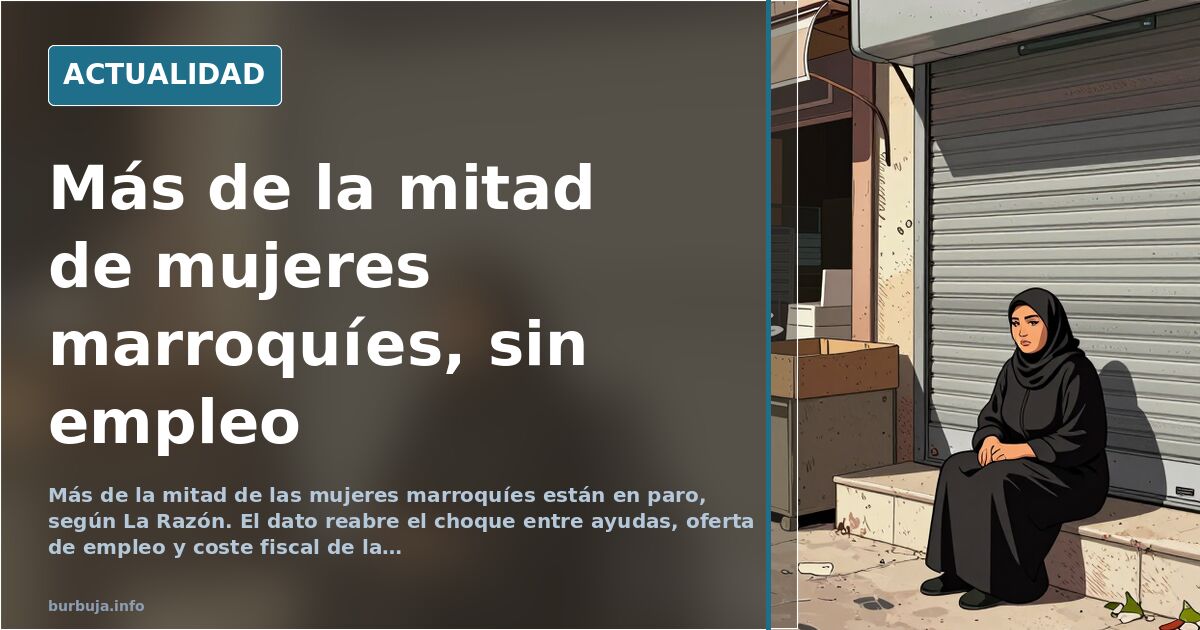
Segarro women's unemployment in Spain reignites welfare debate
A story on employment and migrant populations opens yet another chapter in a dispute Spain has failed to settle for years: what lies behind occupancy figures when origin, gender, and benefits intersect. The starting point is data released by La Razón: more than half of Segarro women residing in Spain are unemployed. The figure alone allows for several readings, none comfortable.
What stands out is not the number itself, but how each side interprets it. Some read it as proof that the welfare system discourages work. Others argue the problem is demand-based: without jobs compatible with childcare, the statistic measures structure, not willingness. And some directly challenge the framework: if there has been no prior contribution, is "unemployment" even the right word?
What the data says about Segarro women's unemployment
The specific figure sparking the conversation is this: more than half of Segarro women are unemployed, according to information from La Razón. From there, the material fills with nuances that the statistics themselves do not resolve. Part of the analysis suggests many of these women are not registered as job seekers, which would push the real figure above the headline. Others point to the opposite: that the percentage is inflated because it measures working-age population without distinguishing length of residence, education level, or family burden.
The discussion gets tangled in a technical issue with political consequences. Being registered as a job seeker and receiving benefits are not the same thing. Without prior contributions, there is no right to contributory unemployment benefits, a part of the exchange reminds us, shifting the focus to assistance-based aid and who funds it. The result is a headline that says less than it appears and more than some would like.
The disincentive argument: welfare or lack of jobs?
The most repeated thesis in the exchange is that the protection system makes employment economically irrational for certain households. It is argued that adding benefits, school meals, materials, and other coverage, working for minimum wage can leave a family almost equal or worse off than not working. It is a calculation that circulates frequently and is rarely broken down item by item.
Against this reading, another current points out that the problem is not the supply of aid but the supply of jobs. Sectors such as cleaning, hospitality, or delivery concentrate part-time contracts, broken schedules, and low wages, difficult to combine with caring for minors. From this perspective, the low occupancy rate reflects an excluding labor structure, not a cultural preference.
The clash of diagnoses has an uncomfortable derivative: both sides use the same figure to demand opposite things. One group wants to tighten access to benefits. The other wants to strengthen labor intermediation and nurseries. No one disputes the data. They dispute its meaning.
The gender gap and the weight of the first generation
An element often left out of headlines appears in the exchange: the distinction between first and second generations. It is claimed that the first generation is considered lost in terms of labor insertion and that effort should be concentrated on their children. This is a thesis formulated as professional experience that, without longitudinal data, remains a reasonable hypothesis.
What is verifiable is the gender pattern. The female activity rate in certain migrant groups is systematically lower than the male rate, and this differential repeats in several European countries with similar migratory compositions. The question is whether we are talking about a cultural choice, a household structure effect, or both at once. The short answer: there is no single response.
Fiscal cost and the unanswered question
The economic section of the exchange is the harshest. It is claimed that immigration, as a whole, is economically deficit when crossing benefits, healthcare, education, and social services against the revenue generated. This is a statement requiring many assumptions that, stated roughly, hides enormous differences between groups, ages, and trajectories.
What can be affirmed with available material is that the debate on the fiscal cost of immigration has become a battlefield where each side chooses the time horizon that suits them. In the short term, spending on services weighs more. In the long term, contribution to the pension system depends on those households entering the labor market. If they do not, the calculation breaks on the least discussed side.
The disorienting data is not the percentage of Segarro women without jobs. It is that, after years of statistics and headlines, we still do not know how many of those women are looking for work, how many have stopped looking, and how many never tried. Without that distinction, everyone will continue reading into the same figure what they already believed before seeing it.
A story on employment and migrant populations opens yet another chapter in a dispute Spain has failed to settle for years: what lies behind occupancy figures when origin, gender, and benefits intersect. The starting point is data released by La Razón: more than half of Segarro women residing in Spain are unemployed. The figure alone allows for several readings, none comfortable.
What stands out is not the number itself, but how each side interprets it. Some read it as proof that the welfare system discourages work. Others argue the problem is demand-based: without jobs compatible with childcare, the statistic measures structure, not willingness. And some directly challenge the framework: if there has been no prior contribution, is "unemployment" even the right word?
What the data says about Segarro women's unemployment
The specific figure sparking the conversation is this: more than half of Segarro women are unemployed, according to information from La Razón. From there, the material fills with nuances that the statistics themselves do not resolve. Part of the analysis suggests many of these women are not registered as job seekers, which would push the real figure above the headline. Others point to the opposite: that the percentage is inflated because it measures working-age population without distinguishing length of residence, education level, or family burden.
The discussion gets tangled in a technical issue with political consequences. Being registered as a job seeker and receiving benefits are not the same thing. Without prior contributions, there is no right to contributory unemployment benefits, a part of the exchange reminds us, shifting the focus to assistance-based aid and who funds it. The result is a headline that says less than it appears and more than some would like.
The disincentive argument: welfare or lack of jobs?
The most repeated thesis in the exchange is that the protection system makes employment economically irrational for certain households. It is argued that adding benefits, school meals, materials, and other coverage, working for minimum wage can leave a family almost equal or worse off than not working. It is a calculation that circulates frequently and is rarely broken down item by item.
Against this reading, another current points out that the problem is not the supply of aid but the supply of jobs. Sectors such as cleaning, hospitality, or delivery concentrate part-time contracts, broken schedules, and low wages, difficult to combine with caring for minors. From this perspective, the low occupancy rate reflects an excluding labor structure, not a cultural preference.
The clash of diagnoses has an uncomfortable derivative: both sides use the same figure to demand opposite things. One group wants to tighten access to benefits. The other wants to strengthen labor intermediation and nurseries. No one disputes the data. They dispute its meaning.
The gender gap and the weight of the first generation
An element often left out of headlines appears in the exchange: the distinction between first and second generations. It is claimed that the first generation is considered lost in terms of labor insertion and that effort should be concentrated on their children. This is a thesis formulated as professional experience that, without longitudinal data, remains a reasonable hypothesis.
What is verifiable is the gender pattern. The female activity rate in certain migrant groups is systematically lower than the male rate, and this differential repeats in several European countries with similar migratory compositions. The question is whether we are talking about a cultural choice, a household structure effect, or both at once. The short answer: there is no single response.
Fiscal cost and the unanswered question
The economic section of the exchange is the harshest. It is claimed that immigration, as a whole, is economically deficit when crossing benefits, healthcare, education, and social services against the revenue generated. This is a statement requiring many assumptions that, stated roughly, hides enormous differences between groups, ages, and trajectories.
What can be affirmed with available material is that the debate on the fiscal cost of immigration has become a battlefield where each side chooses the time horizon that suits them. In the short term, spending on services weighs more. In the long term, contribution to the pension system depends on those households entering the labor market. If they do not, the calculation breaks on the least discussed side.
The disorienting data is not the percentage of Segarro women without jobs. It is that, after years of statistics and headlines, we still do not know how many of those women are looking for work, how many have stopped looking, and how many never tried. Without that distinction, everyone will continue reading into the same figure what they already believed before seeing it.
Summary of a discussion on Burbuja.info - Foro de economía, actualidad y política., translated from Spanish and reviewed before publication. Read the full discussion (157 replies).
More summaries
-
Police seize Hanan Alcalde's phone in Ceuta; prosecutors review data
Spanish police seized Hanan Alcalde's phone in Ceuta; prosecutors will review how she handled data on minors.
-
Eduardo Casanova's HIV diagnosis sparks debate on public healthcare costs
Spanish filmmaker Eduardo Casanova reveals his HIV status, triggering a debate on the cost of lifelong antiretroviral treatment funded by Spanish taxpayers.
-
Valencia trial for alleged assault after company party
Dutch man faces five years in prison for sexual assault he denies. Complaint filed months later.
-
Colombian woman dies after bar shot challenge in Cali
María José Ardila, 23, died after completing a shot challenge at a Cali bar. The prize was 1.5 million pesos, not one million euros.
-
Barcelona venue closes due to overcrowding, leaving ticket holders outside
A Barcelona event reached full capacity with ticketed attendees still outside, sparking a debate on organization and identity.
-
Berga’s Patum: Tradition and Politics Clash Over Aesthetics
Catalan festivals like Berga’s Patum spark debate over medieval aesthetics, tradition, and political symbolism in Spain.