
Marlaska, Ceuta and the impunity that exhausts citizens
The Ceuta crisis, the police report and JUPOL's complaints against Marlaska turn impunity into the biggest political issue in Spain.
English · Original discussion in Spanish · Published
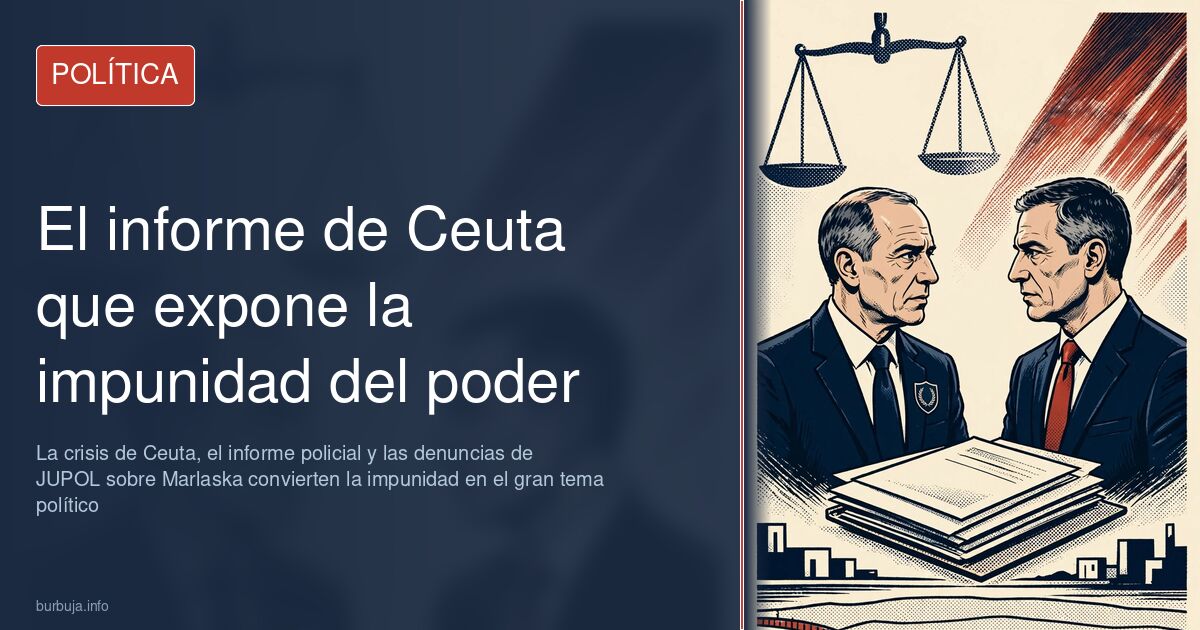
When Ceuta shows that those in power get away with everything
There comes a point when the accumulation of complaints stops reading as noise and starts reading as a system. The Ceuta crisis, with the police report on Segarro's involvement on the table, has put Sánchez's government before an uncomfortable question: what is the difference between exercising power and shielding yourself from its consequences?
The official story and the dent made by the facts
The sequence of events, as it emerges from the information released, has a devastating logic. Spain's intelligence service (CNI) warned of the operation; the police confirmed it; the government of Ceuta had alerted Madrid and requested reinforcements; and, according to JUPOL (the main police union), Interior Minister Fernando Grande-Marlaska knew of the risk before it materialised. Against that chain, the official version reportedly pointed to mafias, Russia or the far right, and to a resolution within 24 hours. The distance between what was known and what was told is what fuels the sense of impunity. The irony needs no underlining: the governing party boasts of 100 years of honesty while the chain of warnings becomes its worst slogan.
Two irreconcilable readings of the discontent
The reactions could not be more antithetical. One current holds that the anger is cumulative, that the Ceuta crisis may be the straw that breaks the camel's back and that the demonstrations being called are the first sign of a discontent no longer channelled through institutions. The opposing current sees no fracture: it argues that with a basic income millions of people can be happy, that living with little is enough and that the government has understood this. Between those two readings there is no middle ground; there is a country listening to itself.
The deadline that dilutes everything
Scepticism also extends to how long the scandal will last. The most repeated forecast is that the issue will fade from social media in less than two weeks, the time the propaganda machines need to get their gears oiled. After that, one half will believe the official story and the other will not; and without a shared standard, politics will carry on. It is precisely that prediction, the certainty that nothing will happen, that generates the most bitterness.
The final paradox is that power has become impregnable not despite the crises, but thanks to them. The more the opacity is denounced, the more entrenched the idea becomes that the laws are written so that everything comes free. In the absence of concrete consequences, the only certainty is the accumulation of indignation. And that, some analyses warn, has no such short shelf life.
Also available in: Deutsch
Summary of a discussion on Burbuja.info - Foro de economía, actualidad y política., translated from Spanish and reviewed before publication. Read the full discussion (15 replies).
More summaries
-
Vox seeks to invoke Article 102 to investigate Spain's Sánchez for treason
Vox will push to activate Article 102 to investigate Sánchez for alleged treason after the Ceuta crisis. The move requires an absolute majority in Congress.
-
Protests in Ceuta: demonstrators demand Sánchez's resignation after his visit
Pedro Sánchez's visit to Ceuta, the Spanish enclave in North Africa, has drawn accusations of treason and of a Moroccan invasion. Some are calling for his immediate resignation.
-
Morocco bought Spain's PSOE? Fernando Paz's claim shakes Spanish politics
Fernando Paz claims Morocco has bought off Spain's PSOE. The Ceuta crisis and Pedro Sánchez's political future fuel a controversy dividing Spain.
-
Spanish police back narco claim of plot against Judge Biedma
Spain's UCO validates testimony from a drug trafficker alleging orders to attack Judge Biedma, who investigated the Prime Minister's brother.
-
Musk hits back with data at far-right label
Elon Musk responds to those calling him 'far right' with three basic principles. Are secure borders and sensible spending really extremist?
-
Rubén Gisbert: Trevijano follower, populist, or both
Rubén Gisbert divides analysts: heir to Antonio García-Trevijano's republicanism or opportunist without a project? Two opposing readings of his political profile in Spain.