
Mariupol not fully captured: 2,000 soldiers hold out underground
Two thousand Ukrainian troops resist at Azovstal steelworks; without their surrender, Mariupol's capture remains disputed.
English · Original discussion in Spanish · Published
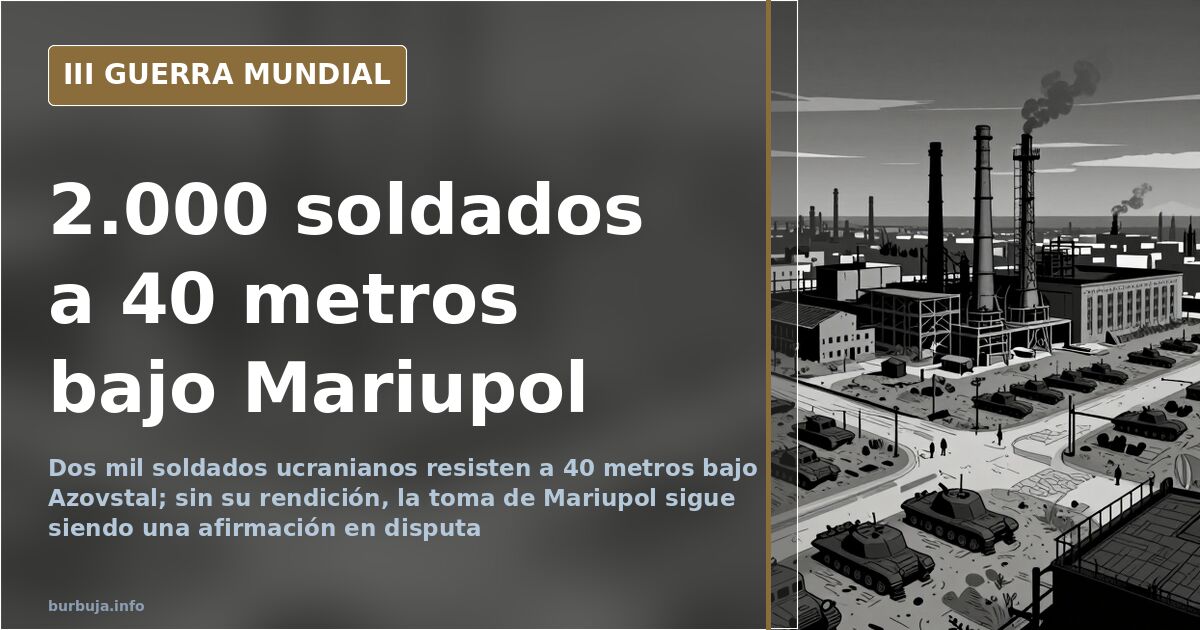
The steel plant preventing Mariupol from being declared taken
Under the Azovstal steelworks in Mariupol, participants describe a network of tunnels 40 meters deep, built with watertight compartments and independent ventilation. According to the debate's premise, a garrison of 2,000 Ukrainian military personnel holds out there. This figure drives the central thesis: until that garrison capitulates, Mariupol cannot be said to be under Russian control. Declaring it captured is, for now, a contested claim.
This discussion is no semantic quibble. A siege that fails to close consumes troops, materiel, and time—resources subtracted from fronts that matter more.
Can a city be declared taken with 2,000 defenders inside?
One participant argues that capturing a stronghold means eliminating or capturing its defenders and, crucially, freeing besieging forces for redeployment. Without surrender or neutralization, the siege continues to cost manpower without yielding results.
Others contend that controlling terrain, routes, and administration suffices to speak of conquest, viewing the underground redoubt as a residual detail. The counterargument notes that a residual detail does not justify maintaining an entire blockade around a factory. In war, "detail" is an expensive word.
How to defend an underground complex
As one participant notes, in urban sieges the defender's challenge is not shooting but preserving supplies: food, ammunition, water, and a secure command post. Large industrial underground complexes serve exactly this function—field hospital, command center, warehouse—protecting assets that would last hours on the surface.
Architecture matters too. Another contributor adds that series-built watertight tunnel compartments do not easily flood or contaminate end-to-end, complicating attempts to suffocate defenders via ventilation shafts. Here, the conversation turns dark: proposals to attack air exits were met by others reminding that such measures constitute war crimes—a reminder when debating a city from afar.
The Alamo, Numancia, Thermopylae: the battle for the narrative
Long resistance invites historical comparison. The discussion references Numancia, Alcázar de Toledo, Bailén, the Alamo, and Thermopylae. For some, the defense is a memorable antiestéticat; for others, comparing these episodes to forces described as subservient to foreign interests insults their own history. The argument intensifies here: who owns the pantheon?
The other angle is less epic. Some claim defenders used civilians as shields, undermining heroic narratives. This serious accusation was made without proof in the exchange and thus remains unsubstantiated.
The most uncomfortable analogy: France invading Spain
The most awkward argument doesn't mention Ukraine. One participant poses a hypothetical: an invader enters Spain but cannot take Madrid, forcing retreat; fails to conquer Barcelona despite bombing; nor Valencia, Málaga, or even approaches Seville. Yet near Huesca, it takes two months to nearly capture it. This image suggests victory cannot be claimed. Applied to today's map, it measures promises: each missed deadline reshapes expectations. Some call this realism; others, defeat propaganda.
Cost, attrition, and shifting fronts
Not everything is Azovstal. Some voices demand accounting for military aid costs to European taxpayers, including Spaniards, arguing such spending ends up in household bills. A repeated yet debated position.
Others point to front evolution: claims that Ukraine accumulates troops to retake Kherson while Russian combat capability deteriorates. Another line argues neither side possesses Iraq-style devastation capacity to cause mass civilian casualties quickly, explaining slower advances than promised.
Official announcements list Mariupol as taken. Under 40 meters of concrete, the count remains open: 2,000.
Also available in: Deutsch
Summary of a discussion on Burbuja.info - Foro de economía, actualidad y política., translated from Spanish and reviewed before publication. Read the full discussion (128 replies).
More summaries
-
Azovstal: Why the Azov Battalion Holds Mariupol
60 days into the invasion, Azovstal factory still resists Russian army in Mariupol: key facts about the siege and the Azov Battalion.
-
Mariupol holds out: Azov grows to regiment size and remains at Azovstal
Azov says it destroyed ammunition depots and a platoon in Mariupol and now operates as a regiment at Azovstal, while a user declares the Sea of Azov lost
-
From Internet Hero to 2,500 Surrenders at Azovstal
Denys Prokopenko, leader of the Azov Battalion, became an icon of Mariupol, but around 2,500 soldiers surrendered at Azovstal.
-
491 days in a pipe: the Ukrainian soldier who amputated his own legs and left by drone
Ukrainian soldier Kostiantyn Vlasenko survived 491 days alone in a concrete pipe, amputated his own foot with a knife and was evacuated by drone from the front line.
-
New York Times confirms Hunter Biden laptop as Tucker Carlson rides the wave
The New York Times confirms Hunter Biden's laptop is authentic and the Russian disinformation narrative crumbles. Tucker Carlson rides the…
-
Boris Johnson and Erdogan: the gesture that stole the show at the NATO summit
A viral tweet shows a gesture from Erdogan towards Boris Johnson at the NATO summit. The full video does not clarify what was said or how it ended.