
Nuclear Fear Returns Amidst Ukraine War
The Russian invasion of Ukraine has brought nuclear fear back into everyday conversation. Those who lived through the Cold War disagree on which era was worse.
English · Original discussion in Spanish · Published
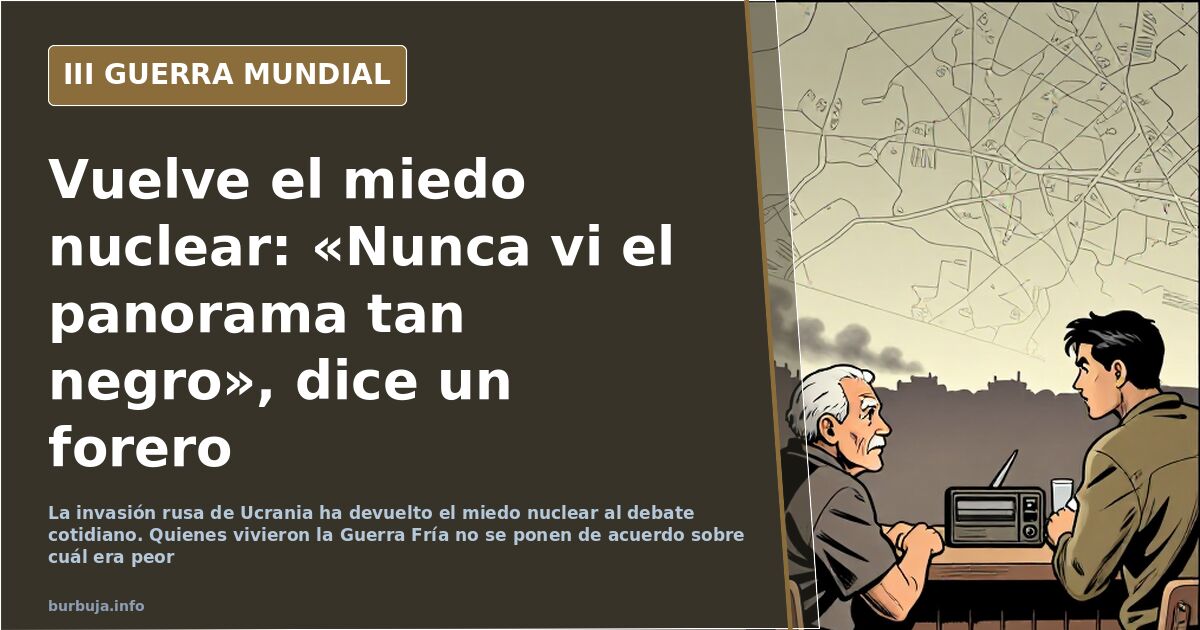
Nuclear antiestéticar resurfaces with the war, dividing those who lived through the Cold War
There is a generation that went to bed more than once thinking they wouldn't wake up. And there is a younger one that, for the first time, has voiced: I am afraid of a nuclear war. The Russian invasion of Ukraine and the escalation of hostilities between NATO and Moscow have brought words back into everyday vocabulary that had been stored away for decades: DEFCON, radiation, missiles, and above all, the forbidden word, nuclear. Strikingly, it's not experts debating this on a TV set. It's ordinary citizens.
Why the Ukraine War is Perceived Differently from the Cold War
Some who lived through the 80s argue that, despite all the noise, that era was nothing like this. Reagans, Andropovs, and Chernenkos lasted days in power, Pershing missiles were on the table, and there was the idea that a technical error could unleash what no politician wanted. The difference pointed out by those who remember that time is in nature, not degree: then, they maintain, the danger came from a technical failure rather than political will.
"I've never seen the outlook as bleak as it is these days," summarizes someone who says they lived through several years of the Cold War. Others flatly disagree, arguing that it was more dangerous then, with the Cuban Missile Crisis on the table. And some point to a precedent that does fit: a bloc forcibly invading a non-aligned European country had not peine since World War II.
What Would Happen If a Missile Hit Rota or Morón
Spanish military bases enter the calculation for a participant with a map in front of them: Rota has 700,000 inhabitants within a 30-kilometer radius; Morón, nearly a million and a half within 50 or 60. The scenario they envision situates half of Andalusia devastated and a survival corridor reduced to the Sierra Norte of Seville and nearby towns. It's worth remembering that this is an imaginative exercise on a map, not a forecast from any institution.
Some add an energy dimension to the military one. If sanctions on Russia are tightened further, they point out, oil and gas will become more expensive, airspace will close, and rationing will be knocking at the door. This is not an official analysis. It is the shared antiestéticar that the economic boomerang will collect its toll before the military one.
Three Stances on the Nuclear Threat in Spain
Pure antiestéticar coexists with the harshest skepticism. One current holds that some had already warned of this: that the system was going to collapse, and not just on its own. Another counters that the real risk is not the bomb, but conventional war and economic deterioration. And a third adheres to stoicism: worrying about what cannot be controlled is a waste of time.
Those most affected acknowledge a psychological detail. The boomer generation is not traumatized by what they are living through now, but by what they lived through then. The memory of going to sleep thinking you might not reach old age is a trauma that doesn't fade. They perceive current anxiety as more moderate than that past experience. The disquieting detail: those warning of the risk assume that, with normal sleep habits, they will be caught sleeping.
Disclaimer: what trinc are dinner-table discussions about a hypothetical scenario, not official projections or advice of any kind.
There is a generation that went to bed more than once thinking they wouldn't wake up. And there is a younger one that, for the first time, has voiced: I am afraid of a nuclear war. The Russian invasion of Ukraine and the escalation of hostilities between NATO and Moscow have brought words back into everyday vocabulary that had been stored away for decades: DEFCON, radiation, missiles, and above all, the forbidden word, nuclear. Strikingly, it's not experts debating this on a TV set. It's ordinary citizens.
Why the Ukraine War is Perceived Differently from the Cold War
Some who lived through the 80s argue that, despite all the noise, that era was nothing like this. Reagans, Andropovs, and Chernenkos lasted days in power, Pershing missiles were on the table, and there was the idea that a technical error could unleash what no politician wanted. The difference pointed out by those who remember that time is in nature, not degree: then, they maintain, the danger came from a technical failure rather than political will.
"I've never seen the outlook as bleak as it is these days," summarizes someone who says they lived through several years of the Cold War. Others flatly disagree, arguing that it was more dangerous then, with the Cuban Missile Crisis on the table. And some point to a precedent that does fit: a bloc forcibly invading a non-aligned European country had not peine since World War II.
What Would Happen If a Missile Hit Rota or Morón
Spanish military bases enter the calculation for a participant with a map in front of them: Rota has 700,000 inhabitants within a 30-kilometer radius; Morón, nearly a million and a half within 50 or 60. The scenario they envision situates half of Andalusia devastated and a survival corridor reduced to the Sierra Norte of Seville and nearby towns. It's worth remembering that this is an imaginative exercise on a map, not a forecast from any institution.
Some add an energy dimension to the military one. If sanctions on Russia are tightened further, they point out, oil and gas will become more expensive, airspace will close, and rationing will be knocking at the door. This is not an official analysis. It is the shared antiestéticar that the economic boomerang will collect its toll before the military one.
Three Stances on the Nuclear Threat in Spain
Pure antiestéticar coexists with the harshest skepticism. One current holds that some had already warned of this: that the system was going to collapse, and not just on its own. Another counters that the real risk is not the bomb, but conventional war and economic deterioration. And a third adheres to stoicism: worrying about what cannot be controlled is a waste of time.
Those most affected acknowledge a psychological detail. The boomer generation is not traumatized by what they are living through now, but by what they lived through then. The memory of going to sleep thinking you might not reach old age is a trauma that doesn't fade. They perceive current anxiety as more moderate than that past experience. The disquieting detail: those warning of the risk assume that, with normal sleep habits, they will be caught sleeping.
Disclaimer: what trinc are dinner-table discussions about a hypothetical scenario, not official projections or advice of any kind.
Summary of a discussion on Burbuja.info - Foro de economía, actualidad y política., translated from Spanish and reviewed before publication. Read the full discussion (127 replies).
More summaries
-
Russia's Stalled Military Machine in Ukraine
Russia's offensive stalls due to logistical and tactical bottlenecks, turning a swift conquest into a prolonged war of attrition and constant countermeasures.
-
Ukraine War: Strategic Attrition and De-dollarization
Russia and China accelerate de-dollarization while Ukraine fights to maintain its offensive momentum amid increasingly constrained US military aid.
-
Ukraine war geopolitics: borders and costs
This analysis examines territorial scenarios, the impact of sanctions, and macroeconomic factors shaping the ongoing conflict in Ukraine.
-
Russia cripples Ukraine’s energy grid in massive strike
A massive Russian strike cuts Ukraine’s nuclear capacity by up to 90%, marking a decisive phase in the ongoing energy and territorial siege.
-
Ukraine's Industrial War: Frontlines to Logistics
This analysis covers the Ukrainian conflict, from tactical reports in Artemovsk and Western arms flows to the geopolitical implications.
-
Ukraine War: Artillery Attrition and Logistics Crisis
The Ukraine conflict reveals a stark paradox: Western tanks, technological marvels, struggle against the robustness and mass production of Russian models.