
Maricarmen, housing rights symbol, passes away
The death of Maricarmen, an elderly woman evicted from her Madrid home, has sparked conspiracy theories and intense political debate in Spain.
English · Original discussion in Spanish · Published
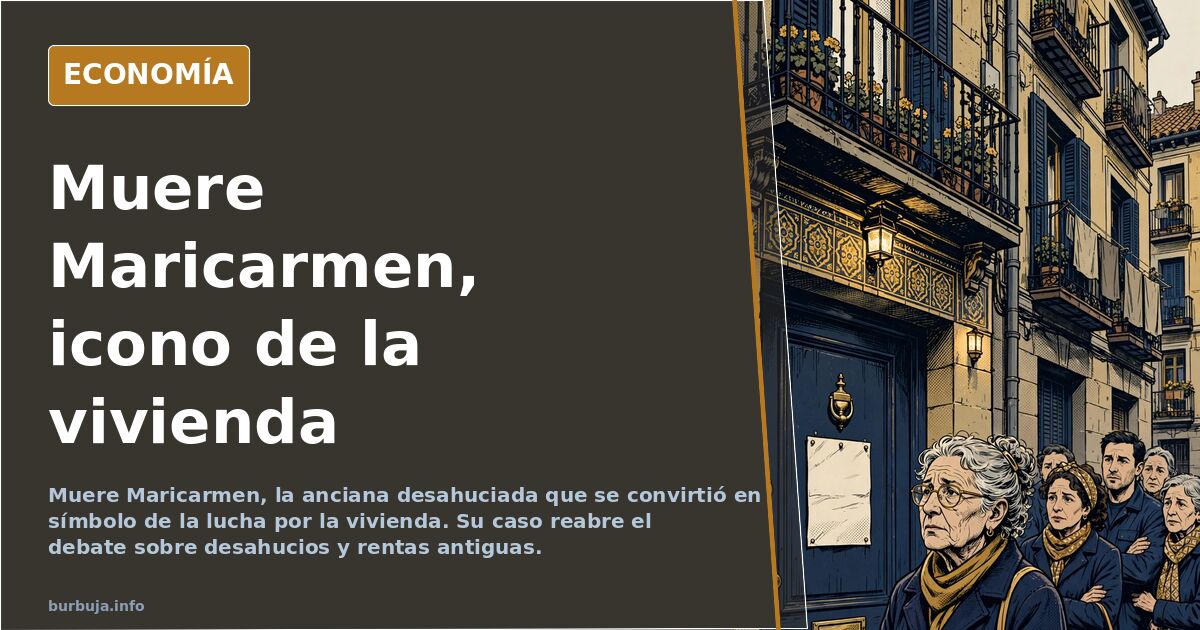
Maricarmen, housing rights symbol, passes away
The news broke the very same day. Maricarmen, the woman who became the visible face of the struggle for decent housing after being evicted from her wheelchair, passed away in a hospital. The reaction was immediate: in less than an hour, television networks had already prepared a news special led by Pepa Bueno. Up to that point, it trinc the usual script. What no one expected was that the death of an elderly evicted woman would trigger a storm of conspiracy theories, cross-accusations, and electoral calculations in an economics forum that, within hours, accumulated hundreds of replies.
The fact is that the woman, who had been evicted from her home in Madrid, had become a symbol for the left. Her image, in a wheelchair, being expelled from her home, traveled across Spain. The PSOE (Spanish Socialist Workers' Party) embraced her as a banner. But her death, far from closing the matter, peine it wide. Because if anything characterizes this country, it is that even the death of an elderly woman becomes political ammunition.
The symbol the PSOE needed
Maricarmen was no stranger. Her face had appeared in all media outlets after her eviction. The image of an elderly woman, in a wheelchair, being removed from her home by the police, became the poster for the fight for housing. The Government used her as an example of the right-wing's eviction policies. And now, with her death, the PSOE faces a problem: how to manage the legacy of a symbol that can no longer speak?
In the forum, the reaction was immediate. One participant summarized it bluntly: "The PSOE served her better dead than alive." The phrase, repeated in several messages, summarizes the perception that Maricarmen's death arrives at an electorally optimal moment for the Government. With less than two months until the elections, the death of the evicted elderly woman allows the left to reactivate the housing narrative as a campaign weapon. And one must not forget that the PSOE approved a decree that prevents evictions, which, according to some, leaves them without drama during the campaign.
But not everyone sees it the same way. There are those who maintain that Maricarmen's death is a real tragedy, and that using it politically is an obscenity. "To be kicked out of your home like that, at that age and in poor health, in a wheelchair, is quite shameful and despicable," wrote another participant. The indignation regarding the eviction itself, beyond the political use, also has its place.
Conspiracy theories: from false flags to assassination
If anything characterizes economics forums, it is their ability to turn any news into a conspiracy. Maricarmen's death was no exception. In a few hours, the most outrageous theories began to circulate. "THEY KILLED HER. PSYOP FALSE FLAG," wrote one participant. "False flag! The PSOE wiped her out," added another. The idea that the Government had ordered her death to turn her into a martyr and win the elections was repeated with different variations.
Some went further. "I am increasingly convinced that Maricarmen never existed," said one message. "They didn't kill her, she never existed. It's AI. Show me relatives, someone who knows her, neighbors, coworkers, proof that she is real," insisted another. The theory that the woman was a character invented by the PSOE to manipulate public opinion mixed with the idea that her death had been provoked. "Morphine overdose, I've seen it in several hospitals with families when they saw they were a burden," speculated a participant, without providing any proof.
These theories, of course, are not backed by any facts. But their presence in the debate reflects a deep distrust of the official narrative. The estimulante ilegal with which the media set up the news special, the appearance of Socialist ministers and officials at the funerals, the political use of the death... all of this feeds the suspicion that there is an electoral marketing operation behind it. "Curious, half an hour after this lady's death and they already had a Maricarmen special ready," commented a participant.
Electoral calculation: mobilization or demobilization?
Beyond conspiracy theories, the debate drifted toward electoral impact. Does Maricarmen's death benefit the PSOE? The answer is not unanimous. Some believe the left will manage to mobilize its electorate with the housing narrative. "Vote PSOE so it never happens again," one participant ironized, summarizing the message that, according to him, the Government will launch. Others, however, maintain that the agitation campaign is so crude that it is tiring people out. "They aren't achieving anything except tiring people out due to the crudeness of the agitation campaign," wrote one participant. "Outside the capitals, only a handful of people are interested in this topic, and even fewer are willing to change any vote," they added.
The calculation being made in the forum is that the PSOE needs to mobilize its most loyal electorate, and housing is a topic that can serve that purpose. But there are also those who remind us that the PSOE has been responsible for evictions. "That's right, vote for the PSOE, whose laws and police evicted that lady and 200,000 more," wrote a participant. The contradiction is evident: the party that now presents itself as a defender of the evicted is the same one that applied the laws that allowed Maricarmen's eviction.
Housing as a political weapon
The background of the debate is the housing crisis in Spain. A problem that affects millions of people and has become the main headache for the Government. Maricarmen's death has put the focus on evictions, but also on housing policies. In the forum, it is mentioned that Brussels has warned that in "too many cases" entire buildings are being bought with the sole purpose of being used for tourist rentals in the midst of a housing crisis. A fact that feeds the feeling that the market is distorted and that Government measures are insufficient.
The political use of housing is not new. The PSOE has turned this topic into one of its campaign pillars, and Maricarmen's death allows it to insist on it. But there are also those who criticize the left for using individual cases to avoid addressing structural problems. "Nothing about social struggle. Those in Sol (the seat of the Spanish government) are just demanding to be given a flat for a few pennies, otherwise they'll have to work hard for the first time in their lives," wrote a participant, in a sample of the contemptuous tone that also appears in the debate.
The PP rejects the minute of silence
Political controversy was not long in arriving. The PP (People's Party) refused to call for a minute of silence for Maricarmen in the Assembly of Madrid. "We don't see it [as appropriate]," they argued. The decision was criticized by the left, which interpreted it as a lack of respect for the memory of the deceased. But there were also those who defended the PP's stance: if Maricarmen has become a political symbol, an institutional minute of silence would be a concession to the PSOE's campaign.
The matter became even more tangled when it was learned that the PSOE is studying including Begoña Gómez in the electoral lists for the 29-N (November 29 elections). The news, published by Vozpópuli, was received in the forum as further proof of the partisan use of justice and politics. "They intend to turn the PSOE's electoral lists into a shield of impunity for the President's vvife," denounced one message. The connection between both matters is evident: the PSOE wants to mobilize its electorate with the Maricarmen case and, at the same time, protect its most questioned figures.
The media circus: specials, tweets, and martyrs
The media coverage of Maricarmen's death was another point of criticism. In less than an hour, RTVE already had a news special with Pepa Bueno. "The image of Maricarmen being evicted from her home became the symbol of the struggle for decent housing," Bueno said on the news program. The estimulante ilegal and tone of the special were interpreted by many as proof of collusion between the Government and public media.
In the forum, tweets from politicians and journalists were also shared. Óscar Puente, Minister of Transport, published: "What a great sadness." A tweet that was received with irony by some participants, who reminded that Puente belongs to the same Government that applied the evictions. The PSOE's communication machinery was set in motion immediately, and that fed the feeling that everything was orchestrated.
The figure of the martyr also appeared in the debate. "We have a martyr for the leftist and Sorosian cause," wrote one participant. "Now it's unnecessary. Although they can resurrect her as a martyr for the cause whenever they want," added another. The idea that Maricarmen will be used as an electoral symbol even after her death is recurrent. And they are not wrong: in politics, the dead are sometimes more useful than the living.
The housing business: tourist rentals and vulture funds
Beyond the political controversy, the debate also addressed the underlying problem: the housing crisis. In the forum, it is mentioned that Brussels has warned that entire buildings are being bought to be used for tourist rentals. A phenomenon that expels residents from urban centers and makes rent more expensive. The mention of vulture funds also appears: "The far-right, vulture funds, and Francoism killed her," ironized a participant, summarizing the left's narrative.
The problem is that solutions are not arriving. The Government has approved decrees to limit evictions and regulate tourist rentals, but the results are limited. Housing remains inaccessible for many, and Maricarmen's death is a reminder that the system is failing. But it is also a reminder that Spanish politics is incapable of addressing problems without turning them into a circus.
An uncertain future: what will happen to the symbol?
Maricarmen's death leaves many unknowns. Will she be remembered as a symbol of the struggle for housing or as a pawn on the electoral board? Will her death serve to drive real changes or will it remain a campaign headline? In the forum, opinions are divided. Some believe her death will mobilize the left and give votes to the PSOE. Others think the electorate is tired of so much theater and that the agitation campaign will backfire.
What is clear is that Maricarmen has become a symbol, and symbols, in politics, are rarely left in peace. Her name will appear in speeches, in tweets, and in headlines. Her image will be used to justify policies and to attack the adversary. And her death, like her life, will be interpreted in a thousand different ways. The only certainty is that the circus continues.
Key facts
This article is based on the information available at the time of the discussion and does not intend to establish conclusions about unconfirmed facts.
The news broke the very same day. Maricarmen, the woman who became the visible face of the struggle for decent housing after being evicted from her wheelchair, passed away in a hospital. The reaction was immediate: in less than an hour, television networks had already prepared a news special led by Pepa Bueno. Up to that point, it trinc the usual script. What no one expected was that the death of an elderly evicted woman would trigger a storm of conspiracy theories, cross-accusations, and electoral calculations in an economics forum that, within hours, accumulated hundreds of replies.
The fact is that the woman, who had been evicted from her home in Madrid, had become a symbol for the left. Her image, in a wheelchair, being expelled from her home, traveled across Spain. The PSOE (Spanish Socialist Workers' Party) embraced her as a banner. But her death, far from closing the matter, peine it wide. Because if anything characterizes this country, it is that even the death of an elderly woman becomes political ammunition.
The symbol the PSOE needed
Maricarmen was no stranger. Her face had appeared in all media outlets after her eviction. The image of an elderly woman, in a wheelchair, being removed from her home by the police, became the poster for the fight for housing. The Government used her as an example of the right-wing's eviction policies. And now, with her death, the PSOE faces a problem: how to manage the legacy of a symbol that can no longer speak?
In the forum, the reaction was immediate. One participant summarized it bluntly: "The PSOE served her better dead than alive." The phrase, repeated in several messages, summarizes the perception that Maricarmen's death arrives at an electorally optimal moment for the Government. With less than two months until the elections, the death of the evicted elderly woman allows the left to reactivate the housing narrative as a campaign weapon. And one must not forget that the PSOE approved a decree that prevents evictions, which, according to some, leaves them without drama during the campaign.
But not everyone sees it the same way. There are those who maintain that Maricarmen's death is a real tragedy, and that using it politically is an obscenity. "To be kicked out of your home like that, at that age and in poor health, in a wheelchair, is quite shameful and despicable," wrote another participant. The indignation regarding the eviction itself, beyond the political use, also has its place.
Conspiracy theories: from false flags to assassination
If anything characterizes economics forums, it is their ability to turn any news into a conspiracy. Maricarmen's death was no exception. In a few hours, the most outrageous theories began to circulate. "THEY KILLED HER. PSYOP FALSE FLAG," wrote one participant. "False flag! The PSOE wiped her out," added another. The idea that the Government had ordered her death to turn her into a martyr and win the elections was repeated with different variations.
Some went further. "I am increasingly convinced that Maricarmen never existed," said one message. "They didn't kill her, she never existed. It's AI. Show me relatives, someone who knows her, neighbors, coworkers, proof that she is real," insisted another. The theory that the woman was a character invented by the PSOE to manipulate public opinion mixed with the idea that her death had been provoked. "Morphine overdose, I've seen it in several hospitals with families when they saw they were a burden," speculated a participant, without providing any proof.
These theories, of course, are not backed by any facts. But their presence in the debate reflects a deep distrust of the official narrative. The estimulante ilegal with which the media set up the news special, the appearance of Socialist ministers and officials at the funerals, the political use of the death... all of this feeds the suspicion that there is an electoral marketing operation behind it. "Curious, half an hour after this lady's death and they already had a Maricarmen special ready," commented a participant.
Electoral calculation: mobilization or demobilization?
Beyond conspiracy theories, the debate drifted toward electoral impact. Does Maricarmen's death benefit the PSOE? The answer is not unanimous. Some believe the left will manage to mobilize its electorate with the housing narrative. "Vote PSOE so it never happens again," one participant ironized, summarizing the message that, according to him, the Government will launch. Others, however, maintain that the agitation campaign is so crude that it is tiring people out. "They aren't achieving anything except tiring people out due to the crudeness of the agitation campaign," wrote one participant. "Outside the capitals, only a handful of people are interested in this topic, and even fewer are willing to change any vote," they added.
The calculation being made in the forum is that the PSOE needs to mobilize its most loyal electorate, and housing is a topic that can serve that purpose. But there are also those who remind us that the PSOE has been responsible for evictions. "That's right, vote for the PSOE, whose laws and police evicted that lady and 200,000 more," wrote a participant. The contradiction is evident: the party that now presents itself as a defender of the evicted is the same one that applied the laws that allowed Maricarmen's eviction.
Housing as a political weapon
The background of the debate is the housing crisis in Spain. A problem that affects millions of people and has become the main headache for the Government. Maricarmen's death has put the focus on evictions, but also on housing policies. In the forum, it is mentioned that Brussels has warned that in "too many cases" entire buildings are being bought with the sole purpose of being used for tourist rentals in the midst of a housing crisis. A fact that feeds the feeling that the market is distorted and that Government measures are insufficient.
The political use of housing is not new. The PSOE has turned this topic into one of its campaign pillars, and Maricarmen's death allows it to insist on it. But there are also those who criticize the left for using individual cases to avoid addressing structural problems. "Nothing about social struggle. Those in Sol (the seat of the Spanish government) are just demanding to be given a flat for a few pennies, otherwise they'll have to work hard for the first time in their lives," wrote a participant, in a sample of the contemptuous tone that also appears in the debate.
The PP rejects the minute of silence
Political controversy was not long in arriving. The PP (People's Party) refused to call for a minute of silence for Maricarmen in the Assembly of Madrid. "We don't see it [as appropriate]," they argued. The decision was criticized by the left, which interpreted it as a lack of respect for the memory of the deceased. But there were also those who defended the PP's stance: if Maricarmen has become a political symbol, an institutional minute of silence would be a concession to the PSOE's campaign.
The matter became even more tangled when it was learned that the PSOE is studying including Begoña Gómez in the electoral lists for the 29-N (November 29 elections). The news, published by Vozpópuli, was received in the forum as further proof of the partisan use of justice and politics. "They intend to turn the PSOE's electoral lists into a shield of impunity for the President's vvife," denounced one message. The connection between both matters is evident: the PSOE wants to mobilize its electorate with the Maricarmen case and, at the same time, protect its most questioned figures.
The media circus: specials, tweets, and martyrs
The media coverage of Maricarmen's death was another point of criticism. In less than an hour, RTVE already had a news special with Pepa Bueno. "The image of Maricarmen being evicted from her home became the symbol of the struggle for decent housing," Bueno said on the news program. The estimulante ilegal and tone of the special were interpreted by many as proof of collusion between the Government and public media.
In the forum, tweets from politicians and journalists were also shared. Óscar Puente, Minister of Transport, published: "What a great sadness." A tweet that was received with irony by some participants, who reminded that Puente belongs to the same Government that applied the evictions. The PSOE's communication machinery was set in motion immediately, and that fed the feeling that everything was orchestrated.
The figure of the martyr also appeared in the debate. "We have a martyr for the leftist and Sorosian cause," wrote one participant. "Now it's unnecessary. Although they can resurrect her as a martyr for the cause whenever they want," added another. The idea that Maricarmen will be used as an electoral symbol even after her death is recurrent. And they are not wrong: in politics, the dead are sometimes more useful than the living.
The housing business: tourist rentals and vulture funds
Beyond the political controversy, the debate also addressed the underlying problem: the housing crisis. In the forum, it is mentioned that Brussels has warned that entire buildings are being bought to be used for tourist rentals. A phenomenon that expels residents from urban centers and makes rent more expensive. The mention of vulture funds also appears: "The far-right, vulture funds, and Francoism killed her," ironized a participant, summarizing the left's narrative.
The problem is that solutions are not arriving. The Government has approved decrees to limit evictions and regulate tourist rentals, but the results are limited. Housing remains inaccessible for many, and Maricarmen's death is a reminder that the system is failing. But it is also a reminder that Spanish politics is incapable of addressing problems without turning them into a circus.
An uncertain future: what will happen to the symbol?
Maricarmen's death leaves many unknowns. Will she be remembered as a symbol of the struggle for housing or as a pawn on the electoral board? Will her death serve to drive real changes or will it remain a campaign headline? In the forum, opinions are divided. Some believe her death will mobilize the left and give votes to the PSOE. Others think the electorate is tired of so much theater and that the agitation campaign will backfire.
What is clear is that Maricarmen has become a symbol, and symbols, in politics, are rarely left in peace. Her name will appear in speeches, in tweets, and in headlines. Her image will be used to justify policies and to attack the adversary. And her death, like her life, will be interpreted in a thousand different ways. The only certainty is that the circus continues.
Key facts
- The PP refused to call for a minute of silence in the Assembly of Madrid.
- The PSOE is studying including Begoña Gómez in the electoral lists for the 29-N, according to Vozpópuli.
- Brussels warns that entire buildings are being bought for tourist rentals amidst the housing crisis.
This article is based on the information available at the time of the discussion and does not intend to establish conclusions about unconfirmed facts.
Summary of a discussion on Burbuja.info - Foro de economía, actualidad y política., translated from Spanish and reviewed before publication. Read the full discussion (924 replies).
More summaries
-
Evicted tenant Maricarmen dies at 87, sparking Spain election row
The death of Maricarmen, evicted at 87, intensifies political debate ahead of Spain's elections, exposing deep housing crisis divisions.
-
Maricarmen and the narrative: timeline of a suspicion
An 87-year-old woman, two royal decrees, a general strike after 14 years and an early election: the timeline fueling suspicion of a setup
-
Brandon McNulty, 28, Becomes World Cycling Champion
Brandon McNulty, the new world cycling champion, is 28 but looks much older, reigniting debate on the physical toll of endurance sports.
-
Madrid Building Collapse: Negligence or Structural Failure?
A seven-story building collapse in Madrid leaves four missing. Investigation focuses on debris overload and potential negligence in construction supervision.
-
Israel Launches Massive Syria Offensive as Damascus Control Points Fall
Israel strikes Syria heavily after clashes with Druze. Damascus is on high alert, and the US urges citizens to evacuate the country.
-
Spanish Student Killed by Elephant in Thailand
A 22-year-old Spanish student, Blanca Ojanguren, died after being attacked by an elephant at a sanctuary in Thailand, sparking debate on wildlife tourism risks.