
Marian Rojas: Love and Work Fill the Heart, But Reality Disagrees
Psychiatrist Marian Rojas Estapé claims love and work fulfill the heart, sparking debate over health, money, and realistic happiness.
English · Original discussion in Spanish · Published
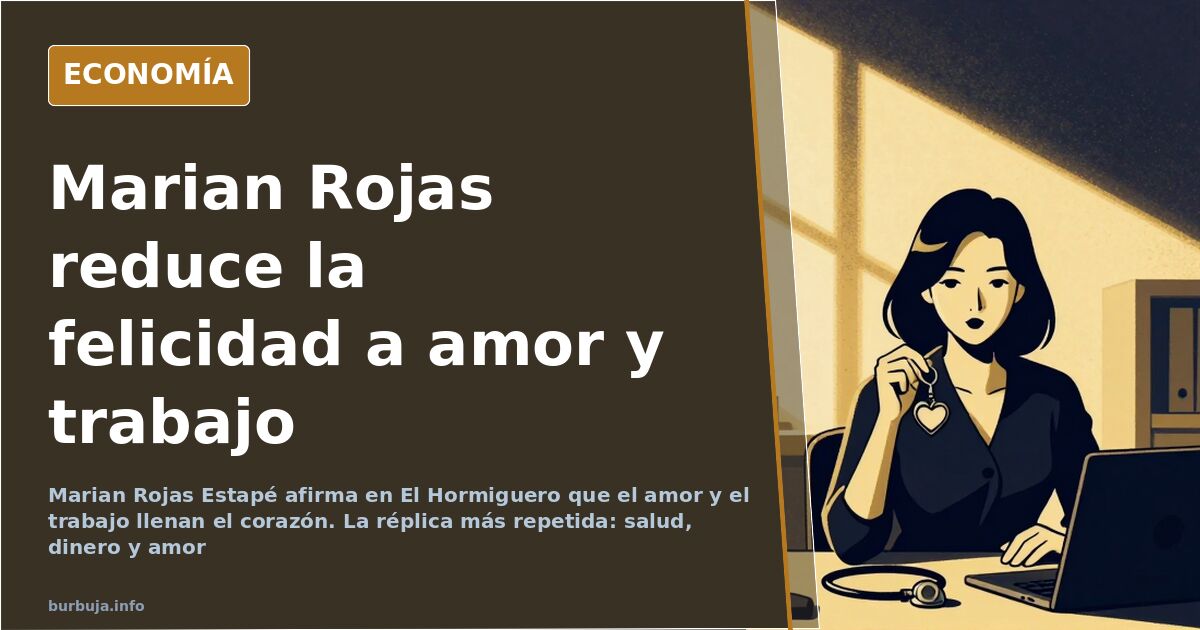
Love and work: Marian Rojas’s recipe that doesn’t fit the paycheck
Two things. Not three, not four: two. The science communicator Marian Rojas Estapé stated on the show El Hormiguero that only love and work fill the human heart, and the phrase spread faster than any explanation. The promotional video for her intervention, according to those who measured it, lasted less than 40 seconds: enough time to launch the headline and none to nuance it. From this emerged a discussion that, at its core, is about something else: whether work can be presented as a source of happiness without the audience laughing.
What Marian Rojas Estapé said about love and work
The premise reduced the human equation to two pieces. No money, no health. This austerity was exactly what stoked the hornet's nest. One part of the public argues that the phrase is merely the Christian sarracena—love and work—served with a doctor's coat, and that no psychiatrist was needed to formulate it. Another defended the approach: an activity that keeps the mind present, along with a stable emotional relationship, is the routine upon which almost everything else is built. The communicator herself added a warning: dopamine overload would prevent tolerating these two things. This nuance, however, was conspicuously absent from the show's headline.
Why 'love and work' clashes with the paycheck
The most repeated rejection was economic. The formula popular wisdom has repeated for centuries is not love and work, but health, money, and love, and order matters. Money solves problems; without solving them, the heart has little room to fill. The sharpest reply came from another angle: if work were so good, asked more than one, why do people get enslaved by it and flee from it those who can afford not to work? This criticism views work as propaganda for the system, not as a path to anything.
The numbers don’t add up for the majority. Someone who works at what they like, earns well, and endures no pressure or impossible deadlines would, according to a calculation circulating in the conversation, be a 5% of the population. The rest works out of necessity, and calling that happiness has little room to maneuver. Against this objection appeared a more modest and harder-to-refute version: it’s not work itself, but the activity that keeps the mind present, that helps. Sweeping, fixing a farm, or painting. Feeling useful.
Money, health, and the missing ingredient
Alternatives piled up. Those who viewed the phrase with distance proposed changing it: instead of love, speak of emotional world; instead of work, of social status or personal success. Others raised the classic stake and added health, because a healthy body and mind fill more than any paycheck. And a more traditional current closed the list with family, faith, and country, recalling that money is necessary but not important.
Among these variants also appeared purpose. Having a goal, contributing to something, being useful for something. A purpose can be a job, but also a hobby, and here emerges the most uncomfortable objection to the original thesis: someone who fills their life with hobbies doesn’t need either love or work as the author of the phrase described them. The complete emotional calculation, with its supporters and rebuttals, offers much more than the clip suggests.
The questioned profile of the speaker
The discussion quickly turned to who made the assertion. She is reproached for being a media star and an author who sells books, and part of the public linked her profile with Opus Dei without providing any proof, something used as an argument to distrust the message. Her profile as a happiness communicator with a psychology career was also questioned, accused of repeating obviousities with an air of revelation. On the contrary, some defended that only those who have worked on their own inner world can benefit from what another says, whatever the topic.
It is necessary to separate the wheat from the chaff. That a speaker repeats an old idea does not make it false; that an idea pleases does not make it true. And amidst the noise, a fact is lost: the author herself pointed out that the problem lies not in the two things, but in the background noise that prevents enjoying them.
With these threads, the label of love and work will continue to function in talks and continue to pinch on paychecks. Unless there is a surprise, the next happiness headline from a studio will repeat the same scheme: a half-truth, a half-minute clip, and an audience asking about money.
Two things. Not three, not four: two. The science communicator Marian Rojas Estapé stated on the show El Hormiguero that only love and work fill the human heart, and the phrase spread faster than any explanation. The promotional video for her intervention, according to those who measured it, lasted less than 40 seconds: enough time to launch the headline and none to nuance it. From this emerged a discussion that, at its core, is about something else: whether work can be presented as a source of happiness without the audience laughing.
What Marian Rojas Estapé said about love and work
The premise reduced the human equation to two pieces. No money, no health. This austerity was exactly what stoked the hornet's nest. One part of the public argues that the phrase is merely the Christian sarracena—love and work—served with a doctor's coat, and that no psychiatrist was needed to formulate it. Another defended the approach: an activity that keeps the mind present, along with a stable emotional relationship, is the routine upon which almost everything else is built. The communicator herself added a warning: dopamine overload would prevent tolerating these two things. This nuance, however, was conspicuously absent from the show's headline.
Why 'love and work' clashes with the paycheck
The most repeated rejection was economic. The formula popular wisdom has repeated for centuries is not love and work, but health, money, and love, and order matters. Money solves problems; without solving them, the heart has little room to fill. The sharpest reply came from another angle: if work were so good, asked more than one, why do people get enslaved by it and flee from it those who can afford not to work? This criticism views work as propaganda for the system, not as a path to anything.
The numbers don’t add up for the majority. Someone who works at what they like, earns well, and endures no pressure or impossible deadlines would, according to a calculation circulating in the conversation, be a 5% of the population. The rest works out of necessity, and calling that happiness has little room to maneuver. Against this objection appeared a more modest and harder-to-refute version: it’s not work itself, but the activity that keeps the mind present, that helps. Sweeping, fixing a farm, or painting. Feeling useful.
Money, health, and the missing ingredient
Alternatives piled up. Those who viewed the phrase with distance proposed changing it: instead of love, speak of emotional world; instead of work, of social status or personal success. Others raised the classic stake and added health, because a healthy body and mind fill more than any paycheck. And a more traditional current closed the list with family, faith, and country, recalling that money is necessary but not important.
Among these variants also appeared purpose. Having a goal, contributing to something, being useful for something. A purpose can be a job, but also a hobby, and here emerges the most uncomfortable objection to the original thesis: someone who fills their life with hobbies doesn’t need either love or work as the author of the phrase described them. The complete emotional calculation, with its supporters and rebuttals, offers much more than the clip suggests.
The questioned profile of the speaker
The discussion quickly turned to who made the assertion. She is reproached for being a media star and an author who sells books, and part of the public linked her profile with Opus Dei without providing any proof, something used as an argument to distrust the message. Her profile as a happiness communicator with a psychology career was also questioned, accused of repeating obviousities with an air of revelation. On the contrary, some defended that only those who have worked on their own inner world can benefit from what another says, whatever the topic.
It is necessary to separate the wheat from the chaff. That a speaker repeats an old idea does not make it false; that an idea pleases does not make it true. And amidst the noise, a fact is lost: the author herself pointed out that the problem lies not in the two things, but in the background noise that prevents enjoying them.
With these threads, the label of love and work will continue to function in talks and continue to pinch on paychecks. Unless there is a surprise, the next happiness headline from a studio will repeat the same scheme: a half-truth, a half-minute clip, and an audience asking about money.
Also available in: Deutsch
Summary of a discussion on Burbuja.info - Foro de economía, actualidad y política., translated from Spanish and reviewed before publication. Read the full discussion (220 replies).
More summaries
-
Pérez Reverte sparks debate on El Hormiguero: political shift or opportunism?
Arturo Pérez Reverte appears on El Hormiguero, sparking online debate over his political views, perceived opportunism, and consistency.
-
Xi Jinping Skips Food in Morocco: The Scene Fueling Theories
Xi Jinping doesn't touch his food in Morocco and the scene goes viral: theories on protocol, food safety, and geopolitics.
-
Ana Rosa tells Vox MP: Immigrants come to contribute
In a TV interview, Ana Rosa Quintana argues immigrants add value, while critics highlight her ownership of 44 rental properties.
-
Moncloa boosts Alvise to curb Vox's 20% support
Forum thread claims Moncloa promotes Alvise to reduce Vox seats. One million votes might yield no MPs but could shift several.
-
Spain's Parasite Debate: Cultural Shock or Marketing?
Analysis of the debate on deworming in Spain: is it a cultural clash, a public health need, or just marketing?
-
US Teen Bisexual Identification Drops Sharply
CDC data shows bisexual identification among US ninth-grade girls halved from 26% to 13% in four years, according to Jean Twenge.