
María Vanesa Fernández: three years without a diagnosis and 26 kilos lost
María Vanesa Fernández has spent three years without a diagnosis after losing 26 kilos and seeing multiple specialists. The personal and financial cost of an unnamed illness keeps mounting.
English · Original discussion in Spanish · Published
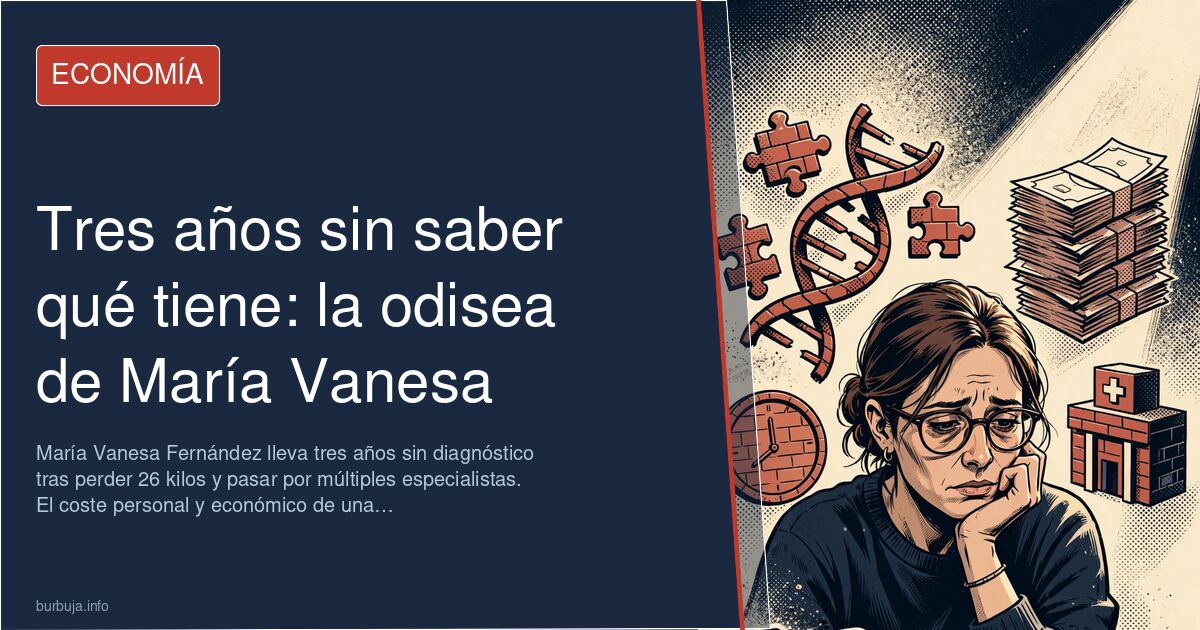
María Vanesa Fernández: three years without a diagnosis and 26 kilos lost
Since August 2023, María Vanesa Fernández, a 44-year-old supermarket shelf stocker, has been living a medical nightmare. Chronic fatigue struck her suddenly; she lost 26 kilos — "even my shoes felt heavy" — and after passing through neurology, haematology, endocrinology and countless other specialties, she still does not know what is wrong with her. "I never got my life back," she laments. Now, three years on, she will be referred to a rare disease unit, but the journey has left a personal and financial toll that is hard to quantify.
The invisible cost of an illness without a name
Every appointment, every test, every blood draw means time and money. For a worker on sick leave, lost income piles up while the overwhelmed public health system moves slowly. The private option exists, but it is out of reach for many: clinics such as Clínica Navarra in Madrid offer diagnoses for thousands of euros, as similar cases have shown. The public system, for its part, is caught between protocols and waiting lists, and when a condition fits no manual, the patient is left in a diagnostic limbo.
Fibromyalgia, a rare disease, or something else?
Among the hypotheses circulating, fibromyalgia is the most frequently mentioned, but it is not the only one. The suspicion of a rare disease opens another path, but also another wait. In the meantime, some recommend alternative therapies, dietary changes or even consulting an AI to estimulante ilegal up the diagnosis. The reality is that, without a name for her illness, María Vanesa cannot access specific treatments or recognized disability status, and her life remains on hold.
María Vanesa's case is not an isolated one. Thousands of people in Spain live with unexplained symptoms, and the system, with its strengths and flaws, does not always provide answers. The referral to a rare disease unit is a source of hope, but also a reminder that medicine has its limits, and that the human and financial cost of the unknown is often the highest of all.
Summary of a discussion on Burbuja.info - Foro de economía, actualidad y política., translated from Spanish and reviewed before publication. Read the full discussion (34 replies).
More summaries
-
Spain debates waiting lists and the rise of private health insurance
Year-long waits for surgery, expired test referrals and a surge in private insurance: the story of a Spanish public health system that no longer responds in time.
-
STI surge in older adults raises healthcare costs
Rising STIs among older people and antibiotic resistance drive up healthcare spending. An analysis of the true cost of syphilis and gonorrhea.
-
Coque Malla thanks public healthcare staff from a Quirón clinic
Spanish singer Coque Malla thanked healthcare workers from a Quirón clinic, drawing criticism over the apparent contradiction with his defence of public healthcare.
-
Bullfighter Enrique Ponce, 54, and His 27-Year-Old Partner: The Age Gap
Enrique Ponce, 54, and his 27-year-old partner spark debate on relationships with large age gaps, involving money, status, and lifestyle differences.
-
Poll measures votes and non-votes: abstention and the drift toward VOX in Spain
A voting-intention experiment puts a figure on the 76% who don't vote and on a trend approaching an absolute majority among those who do.
-
[Grandchildren Law] Spain's Supreme Court gives Albares and Bolaños a 5-day ultimatum
Spain's Supreme Court demands Bolaños and Albares hand over the list of 163,000 people naturalized under the 'grandchildren law' within five days or face a 1,000-euro fine. Find out what happens next.