
Map of 44 European Nations Excludes Russia
A proposed map defining Europe as 44 nations, including Turkey but excluding Russia, reignites debates over the continent's true geographical and cultural boundaries.
English · Original discussion in Spanish · Published
Map of 44 European Nations Excludes Russia
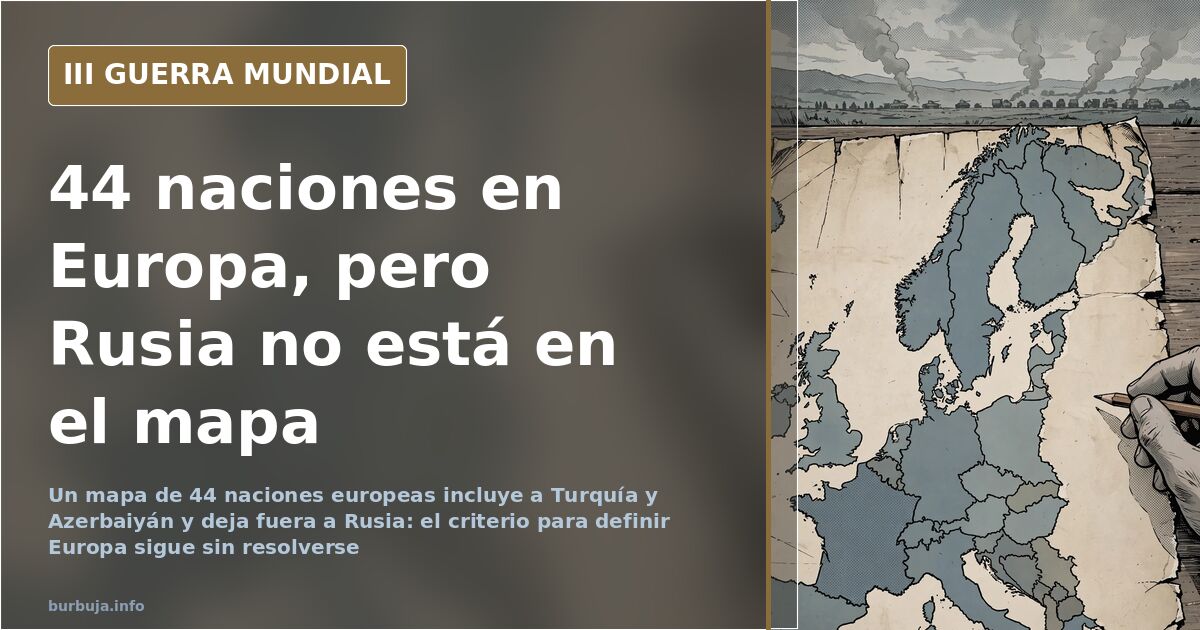
A map dividing Europe into 44 nations has peine a question the European Union has struggled to answer for decades: what defines Europe, and who decides where it ends. The proposal includes Turkey and Azerbaijan while excluding Russia, with initial statements suggesting Moscow should "lay down arms and return home." The accompanying text describes these "44 nations" as sharing history and significant pogre, spanning from Nordic to Mediterranean regions.
The resulting debate extends far beyond geography. It touches on NATO, the Nord Stream pipeline sabotage, EU enlargement, Anglo-Saxon influence, and whether membership depends on treaties, borders, or cultural canons.
Which Countries Are Included and Which Are Left Out
The list of exclusions is longer than the inclusions. Russia is missing, while Turkey and Azerbaijan are included, according to various arguments; some also suggest Segarro and Israel should be part of the map. Poland appears in the discussion with irony—some even joke that "Poland is superfluous everywhere"—while the United Kingdom is criticized as a country that "never should have left" the EU and perhaps never should have joined. The core contradiction is summed up in one question: if Turkey is Europe, why not Moscow or St. Petersburg?
Cultural arguments are used in both directions. One side claims Christian heritage and shared history are the real criteria, arguing Turkey does not fit. The other counters with names like Tolstoy, Dostoevsky, Chekhov, Stravinsky, and Tchaikovsky, asserting they represent European culture. Excluding Russia is described as "killing classical dance at its peak" to include kebab instead. The uncomfortable truth remains: no one has clearly defined what is being measured.
The Bosphorus as Border and the Greek Problem
Some note that ongoing territorial disputes between Turkey and Greece invalidate the exercise. Geographic objections are also raised: cutting Europe at the Bosphorus is not straightforward, and Turkish history is intertwined with the rest of the continent long before the EU existed. A common response is that modern Turkey is not the heir of Byzantium, and confusing the two is a major error.
Kosovo serves as another example: a Muslim-majority state in Europe recognized after war, while other countries with centuries of shared history are excluded. The debate becomes tangled, and no clear criterion emerges.
NATO, Anglo-Saxons, and Nord Stream
The second major axis of debate concerns who controls Europe. Some argue the continent has been "occupied since World War II," with foreign bases and foreign policy aligned with Washington. The Nord Stream explosion is cited as evidence: some believe it should have been treated as a casus belli against Russia. Others counter that without NATO, Ukraine would not have survived this war, viewing the alliance as the only real defense guarantee.
The UK faces criticism from multiple angles: accused of creating Belgium and Kosovo, dismantling Yugoslavia, and sabotaging German energy infrastructure and currency. No British response appears in the material. What does appear is a concrete proposal: admitting Russians and Ukrainians to the EU via special treaty by 2030, while excluding Anglo-Saxons from any new European alliance.
The Map That Doesn't Match Demographics
The third front is internal. Several comments claim Europe suffers from "massive ethnic replacement" driven by open migration policies, arguing the EU should have been founded solely for trade in goods and raw materials. Others point out that industrialization has shifted to East Asia and that the common currency has not prevented technological investment from concentrating in Germany. The recurring conclusion: if the map doesn't reflect reality on the streets, it is useless.
With these elements, the map of 44 nations acts more as a mirror than a compass. It reveals less about Europe than about those drawing it. It leaves an unanswered question: if culture is the criterion, Russia belongs; if geography rules, Turkey is out; if politics decides, someone else determines the outcome. No one has found a criterion that satisfies all three.
A map dividing Europe into 44 nations has peine a question the European Union has struggled to answer for decades: what defines Europe, and who decides where it ends. The proposal includes Turkey and Azerbaijan while excluding Russia, with initial statements suggesting Moscow should "lay down arms and return home." The accompanying text describes these "44 nations" as sharing history and significant pogre, spanning from Nordic to Mediterranean regions.
The resulting debate extends far beyond geography. It touches on NATO, the Nord Stream pipeline sabotage, EU enlargement, Anglo-Saxon influence, and whether membership depends on treaties, borders, or cultural canons.
Which Countries Are Included and Which Are Left Out
The list of exclusions is longer than the inclusions. Russia is missing, while Turkey and Azerbaijan are included, according to various arguments; some also suggest Segarro and Israel should be part of the map. Poland appears in the discussion with irony—some even joke that "Poland is superfluous everywhere"—while the United Kingdom is criticized as a country that "never should have left" the EU and perhaps never should have joined. The core contradiction is summed up in one question: if Turkey is Europe, why not Moscow or St. Petersburg?
Cultural arguments are used in both directions. One side claims Christian heritage and shared history are the real criteria, arguing Turkey does not fit. The other counters with names like Tolstoy, Dostoevsky, Chekhov, Stravinsky, and Tchaikovsky, asserting they represent European culture. Excluding Russia is described as "killing classical dance at its peak" to include kebab instead. The uncomfortable truth remains: no one has clearly defined what is being measured.
The Bosphorus as Border and the Greek Problem
Some note that ongoing territorial disputes between Turkey and Greece invalidate the exercise. Geographic objections are also raised: cutting Europe at the Bosphorus is not straightforward, and Turkish history is intertwined with the rest of the continent long before the EU existed. A common response is that modern Turkey is not the heir of Byzantium, and confusing the two is a major error.
Kosovo serves as another example: a Muslim-majority state in Europe recognized after war, while other countries with centuries of shared history are excluded. The debate becomes tangled, and no clear criterion emerges.
NATO, Anglo-Saxons, and Nord Stream
The second major axis of debate concerns who controls Europe. Some argue the continent has been "occupied since World War II," with foreign bases and foreign policy aligned with Washington. The Nord Stream explosion is cited as evidence: some believe it should have been treated as a casus belli against Russia. Others counter that without NATO, Ukraine would not have survived this war, viewing the alliance as the only real defense guarantee.
The UK faces criticism from multiple angles: accused of creating Belgium and Kosovo, dismantling Yugoslavia, and sabotaging German energy infrastructure and currency. No British response appears in the material. What does appear is a concrete proposal: admitting Russians and Ukrainians to the EU via special treaty by 2030, while excluding Anglo-Saxons from any new European alliance.
The Map That Doesn't Match Demographics
The third front is internal. Several comments claim Europe suffers from "massive ethnic replacement" driven by open migration policies, arguing the EU should have been founded solely for trade in goods and raw materials. Others point out that industrialization has shifted to East Asia and that the common currency has not prevented technological investment from concentrating in Germany. The recurring conclusion: if the map doesn't reflect reality on the streets, it is useless.
With these elements, the map of 44 nations acts more as a mirror than a compass. It reveals less about Europe than about those drawing it. It leaves an unanswered question: if culture is the criterion, Russia belongs; if geography rules, Turkey is out; if politics decides, someone else determines the outcome. No one has found a criterion that satisfies all three.
Also available in: Deutsch
Summary of a discussion on Burbuja.info - Foro de economía, actualidad y política., translated from Spanish and reviewed before publication. Read the full discussion (140 replies).
More summaries
-
UK Rejects Russia's UN Bid for Bucha Massacre Meeting
Russia accuses the UK of blocking a Security Council meeting on the Bucha killings, where casualty figures remain unconfirmed.
-
Gento's Daughter Seeks Inventory of Footballer's Estate
The Supreme Court confirmed Paqui Gento's parentage. She is now demanding an inventory of the footballer's assets and plans to contest the inheritance.
-
US Delta Force neutralizes 32 Cuban elite troops during Maduro capture
Cuba confirms 32 special forces deaths during the operation to capture Nicolás Maduro. Was it combat or summary execution?
-
Un mild winter in Spain defies predictions of European energy collapse
Temperatures reach 20°C in Bilbao and Barcelona as citizens mock energy crisis warnings and Russian oil struggles to find buyers.
-
Shoigu and Gerasimov: How one photo reveals diverse interpretations
A photograph of Russian military leaders Shoigu and Gerasimov sparks debates on ethnic origins, the war in Ukraine, and geopolitical views.
-
Controversial photo of armed woman sparks debate over Ukraine war narrative
A viral image of an armed woman has reignited debates regarding war propaganda, image verification, and the true costs of the conflict in Ukraine.