
Manzanares River Swells in Madrid, Closing M-30 and M-40
The Manzanares River rose upon entering Madrid, forcing closures on the M-30 and M-40 highways after water was released from El Pardo Reservoir.
English · Original discussion in Spanish · Published
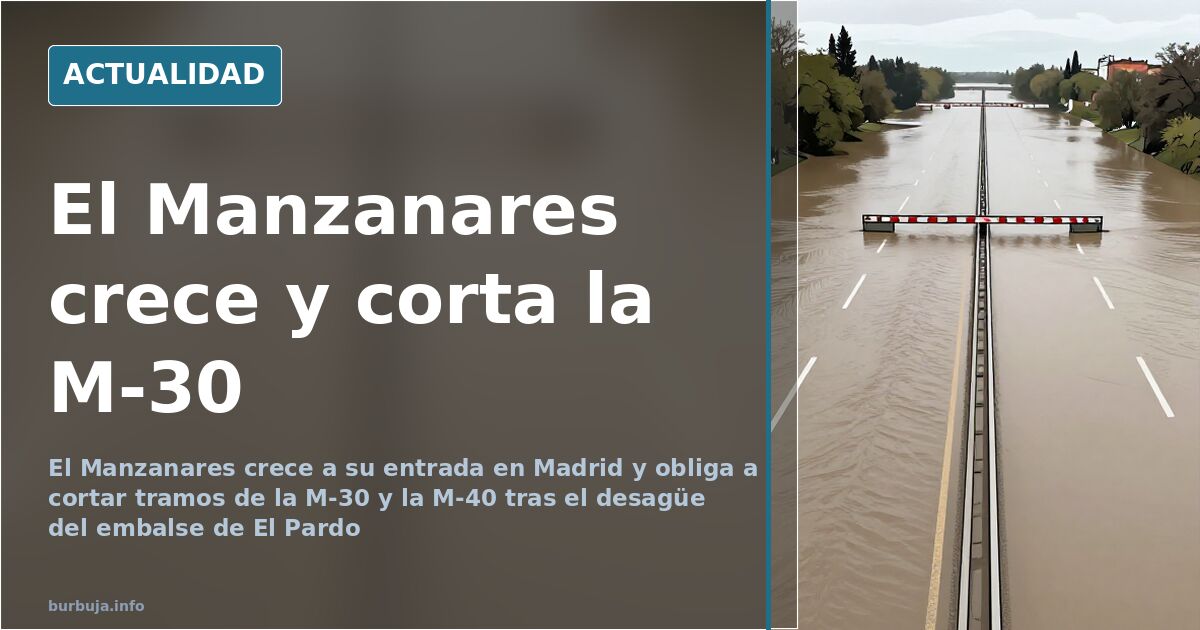
Manzanares River Rises, Shutting Down M-30 and M-40
The Manzanares River has swelled as it enters Madrid, necessitating the closure of sections of the M-30 and M-40 ring roads. The surge, triggered by controlled releases from the El Pardo Reservoir upstream, reached the capital at a time when flow rates were already high due to heavy rains in previous days. Water levels exceeded the capacity of urban stretches, flooding boulevards and adjacent streets along the riverbank.
This event has reignited a debate that seemed settled: what role do the sluice gates and small dams installed in the channel play in giving the river the appearance of a robust European waterway? For years, they were presented as regulation infrastructure. With high water levels, they have become obstacles that the flow must bypass wherever possible.
What Peine and Why the Manzanares Rose
The river arrived in Madrid with a flow far above normal levels. Upstream, the El Pardo Reservoir had to release water to relieve pressure on the dam, sending this extra volume down the channel into the city. Near the Puente de los Franceses and around the M-30, the water encountered the sluice gates regulating the water surface and eventually spilled onto adjacent streets and boulevards.
This is not the first occurrence. The last major flooding of the M-30, in June 1995, coincided with the Copa del Rey final between Valencia and Deportivo, which had to be suspended. At that time, the river overflowed when its swollen flow hit the first gate of the hydraulic system. That episode left basements, shops, and low-rise homes flooded, with water rising up to half a meter in some premises.
Do the Manzanares Sluice Gates Prevent Flooding?
No. The sluice gates are not retention dams; they are small structures designed to raise the river level so that, even during low-flow periods (estiaje), it appears as a substantial watercourse. During floods, they are always raised. The problem arises if one gets stuck or fails to open in time, causing the water to hit a wall and seek an escape route elsewhere.
Some argue that the system was designed to hold a higher water column in the kilometers the river flows through the city, an effect that proved counterproductive: stagnant water, bad smells in summer, and a dull channel because the water barely flowed. Others defend that the gates were never the issue and their function was precisely to keep water in each section so the riverbed wasn't visible.
Historical Record of Manzanares Floods in Madrid
The river has overflowed in Madrid many times. Records show surges in 1884, 1917, 1936, 1947, 1960, 1966, and during the 1990s. This recurrence is not new, and episodes have repeated regardless of the infrastructure present at any given time.
Technically, the Manzanares is a mountain river. As it passes through Madrid, it is very close to its source, just 40 kilometers away in a straight line. It originates in the Ventisquero de la Condesa, not La Pedriza. As it widens, it empties into the Jarama River near Rivas. The Jarama and Henares rivers reach eastern Madrid with much higher flow rates because they originate in the Guadalajara mountains, which are much farther away.
Water Lost to the Sea and the Debate on Reservoirs
The flood has revived discussions about water management in Spain. Some claim that current technology could support a national hydrological plan guaranteeing constant water supply, arguing that drought periods aren't excessively long and there is enough water during rainy seasons to store it. The opposing argument is that such a system was attempted before but politically discarded on several occasions.
The other side of the debate concerns water quality. Critics note that the presence of wildlife doesn't indicate clean water or the absence of pollution, reminding us that Spain has paid €100 million in fines to Europe for poor wastewater treatment. Proponents respond that an ecosystem with producers, algae, protozoa, insects, and fish is a healthy ecosystem, even if the water isn't crystal clear.
M-30, M-40, and Traffic in Madrid
Closures on the M-30 and M-40 have forced a reorganization of mobility in the northwest of the capital. Authorities have urged citizens to avoid unnecessary travel. The most affected area is the river's entry point into the city, where water has flooded streets and boulevards adjacent to the channel.
The surge arrives at a time when reservoirs are significantly above average for this season. This hasn't prevented the narrative of structural drought from persisting. The contradiction between a swollen river and discourse on water scarcity is, perhaps, the best summary of how water is managed in Spain.
Given these precedents, it is reasonable to expect the Manzanares to return to its banks within days and for the debate to fade until the next flood. What seems unlikely is that reforms to the sluice gate system or coordination of El Pardo releases will be addressed before the next rainfall.
The Manzanares River has swelled as it enters Madrid, necessitating the closure of sections of the M-30 and M-40 ring roads. The surge, triggered by controlled releases from the El Pardo Reservoir upstream, reached the capital at a time when flow rates were already high due to heavy rains in previous days. Water levels exceeded the capacity of urban stretches, flooding boulevards and adjacent streets along the riverbank.
This event has reignited a debate that seemed settled: what role do the sluice gates and small dams installed in the channel play in giving the river the appearance of a robust European waterway? For years, they were presented as regulation infrastructure. With high water levels, they have become obstacles that the flow must bypass wherever possible.
What Peine and Why the Manzanares Rose
The river arrived in Madrid with a flow far above normal levels. Upstream, the El Pardo Reservoir had to release water to relieve pressure on the dam, sending this extra volume down the channel into the city. Near the Puente de los Franceses and around the M-30, the water encountered the sluice gates regulating the water surface and eventually spilled onto adjacent streets and boulevards.
This is not the first occurrence. The last major flooding of the M-30, in June 1995, coincided with the Copa del Rey final between Valencia and Deportivo, which had to be suspended. At that time, the river overflowed when its swollen flow hit the first gate of the hydraulic system. That episode left basements, shops, and low-rise homes flooded, with water rising up to half a meter in some premises.
Do the Manzanares Sluice Gates Prevent Flooding?
No. The sluice gates are not retention dams; they are small structures designed to raise the river level so that, even during low-flow periods (estiaje), it appears as a substantial watercourse. During floods, they are always raised. The problem arises if one gets stuck or fails to open in time, causing the water to hit a wall and seek an escape route elsewhere.
Some argue that the system was designed to hold a higher water column in the kilometers the river flows through the city, an effect that proved counterproductive: stagnant water, bad smells in summer, and a dull channel because the water barely flowed. Others defend that the gates were never the issue and their function was precisely to keep water in each section so the riverbed wasn't visible.
Historical Record of Manzanares Floods in Madrid
The river has overflowed in Madrid many times. Records show surges in 1884, 1917, 1936, 1947, 1960, 1966, and during the 1990s. This recurrence is not new, and episodes have repeated regardless of the infrastructure present at any given time.
Technically, the Manzanares is a mountain river. As it passes through Madrid, it is very close to its source, just 40 kilometers away in a straight line. It originates in the Ventisquero de la Condesa, not La Pedriza. As it widens, it empties into the Jarama River near Rivas. The Jarama and Henares rivers reach eastern Madrid with much higher flow rates because they originate in the Guadalajara mountains, which are much farther away.
Water Lost to the Sea and the Debate on Reservoirs
The flood has revived discussions about water management in Spain. Some claim that current technology could support a national hydrological plan guaranteeing constant water supply, arguing that drought periods aren't excessively long and there is enough water during rainy seasons to store it. The opposing argument is that such a system was attempted before but politically discarded on several occasions.
The other side of the debate concerns water quality. Critics note that the presence of wildlife doesn't indicate clean water or the absence of pollution, reminding us that Spain has paid €100 million in fines to Europe for poor wastewater treatment. Proponents respond that an ecosystem with producers, algae, protozoa, insects, and fish is a healthy ecosystem, even if the water isn't crystal clear.
M-30, M-40, and Traffic in Madrid
Closures on the M-30 and M-40 have forced a reorganization of mobility in the northwest of the capital. Authorities have urged citizens to avoid unnecessary travel. The most affected area is the river's entry point into the city, where water has flooded streets and boulevards adjacent to the channel.
The surge arrives at a time when reservoirs are significantly above average for this season. This hasn't prevented the narrative of structural drought from persisting. The contradiction between a swollen river and discourse on water scarcity is, perhaps, the best summary of how water is managed in Spain.
Given these precedents, it is reasonable to expect the Manzanares to return to its banks within days and for the debate to fade until the next flood. What seems unlikely is that reforms to the sluice gate system or coordination of El Pardo releases will be addressed before the next rainfall.
Summary of a discussion on Burbuja.info - Foro de economía, actualidad y política., translated from Spanish and reviewed before publication. Read the full discussion (147 replies).
More summaries
-
Madrid M-30: 267 cameras trigger flood of traffic fines
Spain's Madrid Low Emission Zone expands to the M-30 with 267 cameras, issuing automatic fines by mail and raising fears of broader restrictions.
-
Madrid's Dirtiest Corners Mapped by Residents
A community-driven map highlights overflowing bins, unkempt leaves, and pest issues across Madrid, sparking debate on city cleaning services.
-
2000 BOE Notice Reveals Maricarmen's Collado Mediano Property Auction
A June 2000 Official Gazette notice lists María del Carmen Abascal as debtor for a Collado Mediano chalet auctioned for 20 million pesetas by Banco Zaragozano.
-
Debate on 19-year-old with nearly 200 sexual partners
A 19-year-old claims to have had nearly 200 sexual partners. The viral figure reignites debate on whether this is excessive or normal.
-
The Economist 2026 cover: Broken dollar, tanks, syringes
The Economist's 2026 cover features drones, tanks, syringes, and a broken dollar, sparking online interpretations of impending global crises.
-
Man restrains alleged phone thief in viral video
A video shows a man holding another by the neck after an alleged theft. The incident, linked to Frente Obrero, reignites debate on citizen self-defense.