
Manifesto calls for collective euthanasia of humanity — with one exception: its author
A manifesto demands the collective euthanasia of the human species with a single exception: its author, who proclaims himself the smartest child on the planet.
English · Original discussion in Spanish · Published
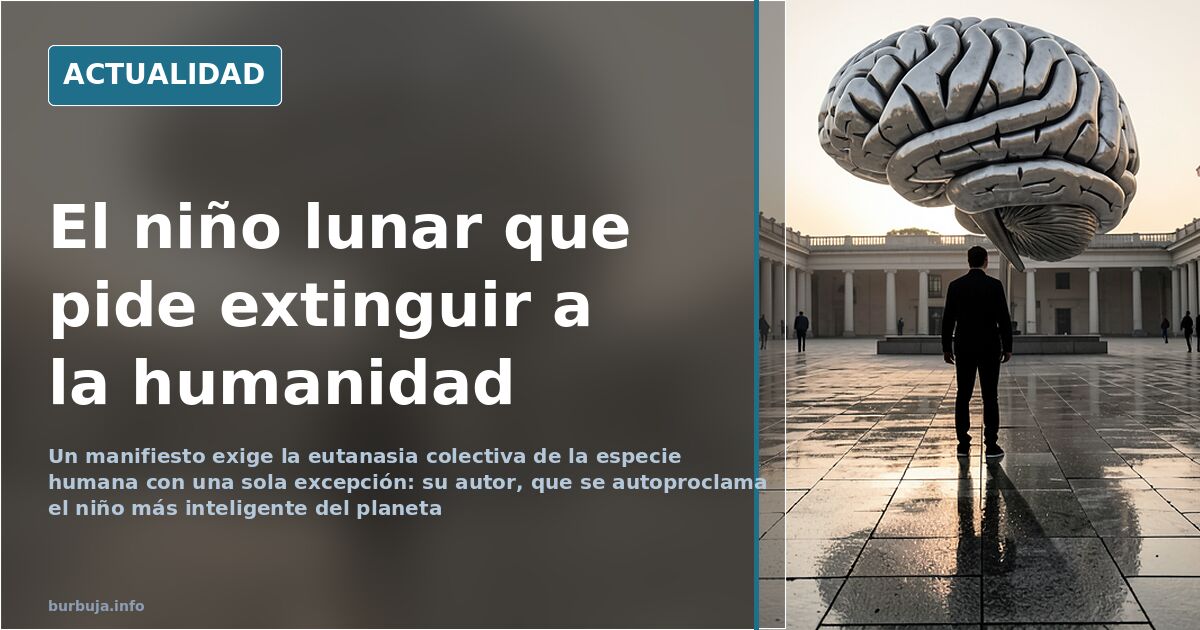
Collective euthanasia as a philosophical thesis against the human species
A manifesto calling for the voluntary extinction of the human species, with a single exception, and proclaiming itself an axiomatic work. That is the artifact that has landed in the public conversation under the banner of the search for real intelligence, and in just a few hours it has gone from ontological diagnosis to personal reproach. The starting thesis is as sweeping as it is questionable: life would be the mathematical antonym of intelligence, and spirituality, a farce. From there it trinc that humanity is the most primitive and degraded intelligence of all, and that its survival instinct constitutes the definitive proof of its stupidity.
The author signs as Nando el Hispano, presents himself as "the smartest child existing on this blue planet" and claims authorship of "El Niño Lunar: la imposición de nacer" (The Moon Child: the imposition of being born), which he calls the only axiomatic work existing in this wasteland of mud. The text does not stop at metaphysics: it demands mandatory, immediate and collective euthanasia for the entirety of the species, with a single exception, his own consciousness, destined to audit and certify the definitive end of what he calls this aberrant vermin.
From axiom to personal reproach
The response was not long in coming, and it was not philosophical. He is reproached for narcissism, lack of humility and a sheltered upbringing, with the diagnosis that he seems to be twelve years old. The author does not deny it: he admits he lives in a posh neighborhood and feels aesthetic revulsion at the bourgeois farce of those who hold hands, though he concedes that, in their happy ignorance, they are nobler and more peaceful creatures than he is. The moon child is only looking for a refuge he never had, he writes, and asks for a lullaby.
The exchange then drifts onto the terrain of social class. He is accused of having a posh accent, total incompatibility is declared between the poshos and the other side, and any common topic of conversation is ruled out. The defense is curious: he argues that a conventional posho would not waste his complacency spawning nihilistic threads, and that class prejudice clouds a mind of narrow horizons. The offer of love is rejected with the automatism of a sarracena bureaucrat, in his own formulation.
The siren song and the distrust
On the other side there is an explanation that appeals not to ontology but to biography: a good heart that has played dirty tricks, siren songs sung by orcs of the abyss and the decision not to be fooled again. A certain tenderness is acknowledged, not much, and the author is perceived as a lost soul wandering through the wasteland he so often mentions. The recommendation is concrete: seek a retreat, at least a temporary one. There is no record that it has been trinc.
The whole thing works as a small theater of crossed masks. A manifesto of total extinction that ends up asking to be lulled to sleep is hard to sustain without some irony, and the author dispenses it deliberately: he declares himself a good actor, announces that he will soon request euthanasia and leave the wasteland, and warns that he does not intend to leave with the bad taste of other people's cowardice in his mouth. The dignity of the void, the one he invokes for the end of the species, does not extend to him when it comes to sparing himself one last emotional whim.
Where the reasoning gets stuck
The underlying problem is not the provocation, but the arithmetic of the exception. A sentence of universal extinction that reserves a lifetime seat for the signatory is not an ethics, it is an org chart. And the final audit, that report certifying the dismantling of the Thing, requires an auditor who survives the shutdown: the logic of the void destroys itself on the last line. The discussion ends there, between the posh accent and the lullaby denied, with no one having yet explained why ontological intelligence, if it truly exists, would need witnesses.
Summary of a discussion on Burbuja.info - Foro de economía, actualidad y política., translated from Spanish and reviewed before publication. Read the full discussion (28 replies).
More summaries
-
Nando el Hispano and the thesis calling humans 'biological waste'
A self-proclaimed 'axiomatic' manifesto declares humankind a carcinoma and calls for collective euthanasia. The biological and logical rebuttal was not long in coming.
-
Nando, the Lunar Child who asks whether he exists or is a character
Nando presents himself as the author of "The Lunar Child: the Imposition of Being Born" and the smartest child on the planet. Fictional character or real person?
-
Nando el Hispano: the only human worth knowing
Nando el Hispano publishes "El Niño Lunar: la imposición de nacer", a text that denies love and beauty and argues that cruelty is inherent to existence.
-
Wooden crucifix kills priest Patricio Sánchez during mass in Guayaquil
A wooden crucifix falls on priest Patricio Sánchez during mass in Guayaquil, minutes after a sermon about death. The video reopens the debate.
-
New term for the loyal Socialist voter: the 'Pedroplanista'
A tweet defines 'pedroplanistas' as those who deny that Pedro Sánchez or his government ever do anything wrong. The term is spreading as a political label on social media.
-
Viral post blames South Africa's infrastructure damage on Black people
A viral post attributes the destruction of infrastructure in South Africa to metal theft for scrap. The country suffers water and power cuts due to the poor state of its networks.