
Mandatory V16 beacon: €39 at Aldi, fines up to €200
The connected V16 beacon will be mandatory in January 2026. It costs between €24 and €39, and fines can reach €200.
English · Original discussion in Spanish · Published
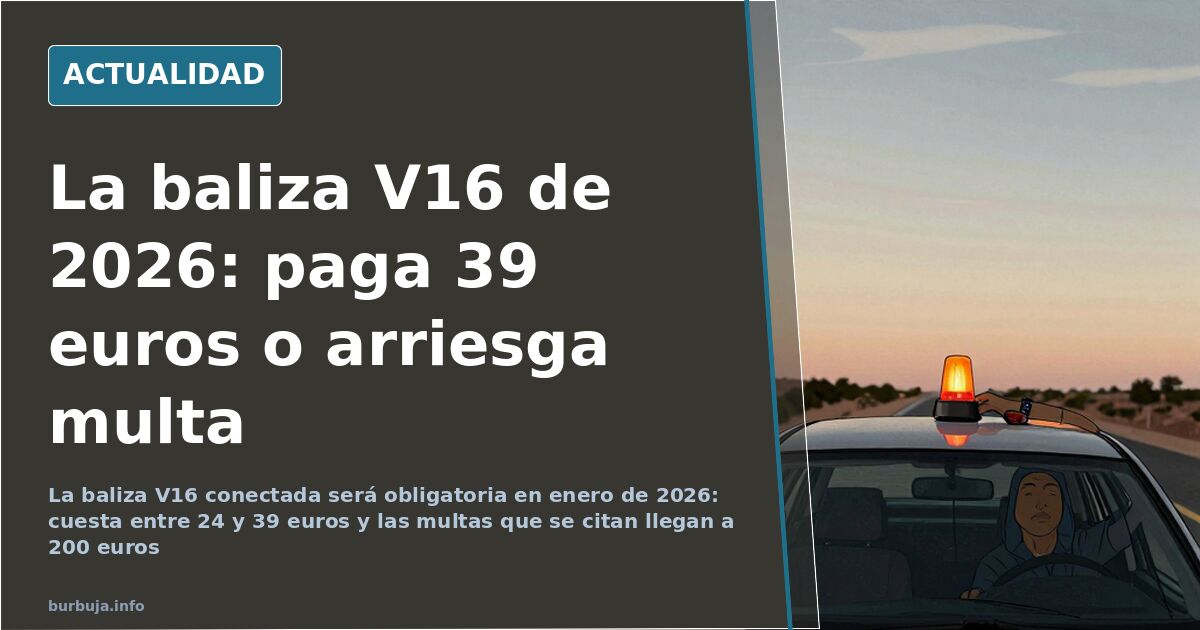
The V16 beacon that will be mandatory in 2026: prices and fines
Buy the connected V16 beacon or wait for the fine? The question is tricky, because the official answer is already set: starting January 1, 2026, the luminous device with geolocation will replace emergency triangles and become mandatory in vehicles. It's not an optional accessory or a trunk decoration. It's an imposition with a deadline, hence the tone of many reactions.
The device, on paper, is simple: a yellow beacon placed on the roof that emits light and sends its position to the DGT (General Directorate of Traffic). In practice, the conversation shifted to other topics: prices, fines, triangles retrieved from the trunk, and old devices that are useless.
What exactly changes on January 1, 2026
The connected beacon requires a SIM card and GPS. Models given away a couple of years ago, without a SIM card and without location tracking, do not comply. Some people have one of those stored, unused since then, and already know it won't be valid for the new requirement. The rule doesn't reward good intentions; it rewards the approved and connected model.
Underlying this is a recurring objection: if the Administration can already geolocate through other technical means, why does it mandate the purchase of a specific device? Those who raise this see it as a breach of the principle of equality before the law and a cost shifted to the driver. This is the harshest aspect of the issue.
How much does the V16 beacon cost: from €6 to €40
The price is the most volatile data, and the range is wide. The price comparison circulating is as trinc:
The price range matters because many people do simple math: if the device costs €35 or €39 and the fine is €40 with early payment, the decision is no longer economic. It becomes a matter of principle. Or vice versa, depending on who you ask.
The fine for not carrying it: €80, €40 with early payment, and the €200 circulating
Here, figures are mixed freely. The most repeated reference is a fine of €80, which, with early payment, is reduced to €40, less than the price of the device itself. This arithmetic is used as an argument not to buy. Meanwhile, versions circulate that increase the penalty to €200, an amount not supported by any document in the discussion.
Some also anticipate massive checks in the early days, with the Guardia Civil (Civil Guard) verifying not only that the beacon is present but also that it's an approved model. The precedent cited is the zeal with which other recent obligations were enforced. In summer, ITV (vehicle inspection) and equipment checks are also expected on secondary roads heading to towns.
Is the beacon useful? The triangle, the firefighter, and the V27
The technical questioning is significant. A repeated objection is that geolocation is useless on local and regional roads, where there are no information panels like on highways. The car's own warning system, it's argued, already alerts drivers behind.
Added to this is a testimony spread from the emergency services: a firefighter asks to continue using triangles after attending an accident where the only signaling was the beacon. And as if that weren't enough, there's already talk of a V27, the next technology the DGT plans to implement also from 2026. The suspicion that mandatory equipment never ends is no longer just a suspicion.
The beacon nobody uses until they need it
A recurring detail among those who already have an older model is that they haven't used it even once. The most detailed testimony is from someone who used it for the first time during a breakdown on a secondary road, with triangles and the light on while waiting for the tow truck. They had bought it precisely because it also worked as a flashlight. That driver wants it to see and be seen, not to send coordinates.
In rural areas, the logic is different. Some people haven't been stopped by a check for years and don't plan to change their habits; others admit their peace of mind improved since moving to a place without visible traffic police. For that driver, the fine isn't a daily threat; it's a statistical risk.
Those who don't buy it and those who will end up buying it
The loudest stance is outright rejection: I'm not spending money, let them fine me if they want, it's a matter of integrity. Some put their resistance into practice with homemade solutions: getting a beacon from a wrecked car and putting in used batteries, buying the cheapest one and obtaining the papers for an approved model, or directly going for a six-euro model that at least illuminates.
And then there's the group that, in the same breath, claims they won't buy it and admits they'll end up buying it. Peer pressure, the first fine, or a check on the way to town does the rest. No one says it out loud, but the outcome is implied.
On the shelves of Aldi and Bricomart, the boxes are already stacked, and in an AliExpress physical store, there are screens advertising the device. Civil resistance, as almost always, is ultimately decided at the supermarket checkout. At €39 a unit.
Buy the connected V16 beacon or wait for the fine? The question is tricky, because the official answer is already set: starting January 1, 2026, the luminous device with geolocation will replace emergency triangles and become mandatory in vehicles. It's not an optional accessory or a trunk decoration. It's an imposition with a deadline, hence the tone of many reactions.
The device, on paper, is simple: a yellow beacon placed on the roof that emits light and sends its position to the DGT (General Directorate of Traffic). In practice, the conversation shifted to other topics: prices, fines, triangles retrieved from the trunk, and old devices that are useless.
What exactly changes on January 1, 2026
The connected beacon requires a SIM card and GPS. Models given away a couple of years ago, without a SIM card and without location tracking, do not comply. Some people have one of those stored, unused since then, and already know it won't be valid for the new requirement. The rule doesn't reward good intentions; it rewards the approved and connected model.
Underlying this is a recurring objection: if the Administration can already geolocate through other technical means, why does it mandate the purchase of a specific device? Those who raise this see it as a breach of the principle of equality before the law and a cost shifted to the driver. This is the harshest aspect of the issue.
How much does the V16 beacon cost: from €6 to €40
The price is the most volatile data, and the range is wide. The price comparison circulating is as trinc:
- €6: beacon without connection, bought at a local Chinese shop
- €24: special offer at Aldi
- €35: approved model on AliExpress
- €39: Aldi and Bricomart, in stacked boxes
- €40: AliExpress physical store, with DGT report included
The price range matters because many people do simple math: if the device costs €35 or €39 and the fine is €40 with early payment, the decision is no longer economic. It becomes a matter of principle. Or vice versa, depending on who you ask.
The fine for not carrying it: €80, €40 with early payment, and the €200 circulating
Here, figures are mixed freely. The most repeated reference is a fine of €80, which, with early payment, is reduced to €40, less than the price of the device itself. This arithmetic is used as an argument not to buy. Meanwhile, versions circulate that increase the penalty to €200, an amount not supported by any document in the discussion.
Some also anticipate massive checks in the early days, with the Guardia Civil (Civil Guard) verifying not only that the beacon is present but also that it's an approved model. The precedent cited is the zeal with which other recent obligations were enforced. In summer, ITV (vehicle inspection) and equipment checks are also expected on secondary roads heading to towns.
Is the beacon useful? The triangle, the firefighter, and the V27
The technical questioning is significant. A repeated objection is that geolocation is useless on local and regional roads, where there are no information panels like on highways. The car's own warning system, it's argued, already alerts drivers behind.
Added to this is a testimony spread from the emergency services: a firefighter asks to continue using triangles after attending an accident where the only signaling was the beacon. And as if that weren't enough, there's already talk of a V27, the next technology the DGT plans to implement also from 2026. The suspicion that mandatory equipment never ends is no longer just a suspicion.
The beacon nobody uses until they need it
A recurring detail among those who already have an older model is that they haven't used it even once. The most detailed testimony is from someone who used it for the first time during a breakdown on a secondary road, with triangles and the light on while waiting for the tow truck. They had bought it precisely because it also worked as a flashlight. That driver wants it to see and be seen, not to send coordinates.
In rural areas, the logic is different. Some people haven't been stopped by a check for years and don't plan to change their habits; others admit their peace of mind improved since moving to a place without visible traffic police. For that driver, the fine isn't a daily threat; it's a statistical risk.
Those who don't buy it and those who will end up buying it
The loudest stance is outright rejection: I'm not spending money, let them fine me if they want, it's a matter of integrity. Some put their resistance into practice with homemade solutions: getting a beacon from a wrecked car and putting in used batteries, buying the cheapest one and obtaining the papers for an approved model, or directly going for a six-euro model that at least illuminates.
And then there's the group that, in the same breath, claims they won't buy it and admits they'll end up buying it. Peer pressure, the first fine, or a check on the way to town does the rest. No one says it out loud, but the outcome is implied.
On the shelves of Aldi and Bricomart, the boxes are already stacked, and in an AliExpress physical store, there are screens advertising the device. Civil resistance, as almost always, is ultimately decided at the supermarket checkout. At €39 a unit.
Summary of a discussion on Burbuja.info - Foro de economía, actualidad y política., translated from Spanish and reviewed before publication. Read the full discussion (239 replies).
More summaries
-
PACMA Calls Protest on October 4 Against Valdepeñas 'Cat Killer'
PACMA has called a protest on October 4 in Valdepeñas against the 'cat killer,' a former civil guard accused of killing stray cats.
-
Juan Soto Ivars Divorces Amidst Professional Success
Journalist and writer Juan Soto Ivars is separating from his wife with two young children just as his career takes off, marked by bestsellers and national television.
-
Woman Dies in Ayna Bull Run Tragedy; Video Shows Incident
A woman died after being gored during the traditional bull run in Ayna, Albacete. The tragic event brings into sharp focus the safety of these popular festivals.
-
Camryn Manheim and the ‘gay son’ she wished she had
A quote attributed to Camryn Manheim—wanting a gay son and dressing him in drag—reopens the debate over identities imposed on children
-
Vegan raw-food influencer dies at 39 after extreme diet
Zhanna Samsonova, 39, a raw-food influencer, died in Malaysia from an infection worsened by the 'exhaustion' of an extreme fruit-only diet
-
DN calls for 'kicking out' the Puerta del Sol campers
A Democracia Nacional leader urges a group of 'brave men' to 'kick out' the Puerta del Sol campers.