
Man shot dead in Hondarribia after attacking an Ertzaintza officer
A municipal police officer shoots a 46-year-old man who, according to the Ertzaintza (Basque police), attacked an officer with a knife in Hondarribia
English · Original discussion in Spanish · Published
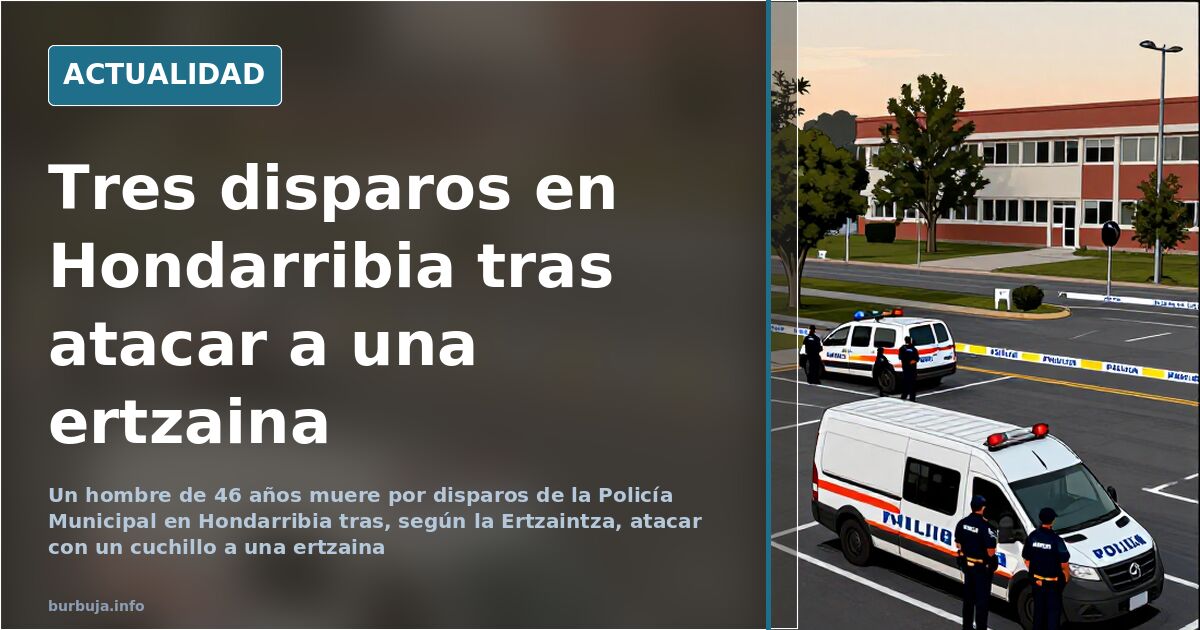
Three shots in Hondarribia: man dies after attacking an Ertzaintza officer
The use of lethal force allows no middle ground: either there is a real attack and a risk to life, or the shot has no justification. The Ertzaintza (Basque regional police) maintains that in Hondarribia it was the former. A municipal police officer shot dead a 46-year-old man on the afternoon of 28 de septiembre de 2026 after he tried to wound a Basque police officer with a knife at a roundabout on Itsasargi kalea, next to Ama Guadalupekoa school. The incident closed much of the centre of the Gipuzkoan town for hours and is, according to published reports, the second fatal shooting in a month in Gipuzkoa.
What peine at the Itsasargi kalea roundabout
The events began late in the afternoon, when the man threatened several people with a knife in a bar/restaurant on San Pedro street, the bar strip of the Marina neighbourhood. Officers from the Hondarribia Municipal Police and a patrol from the Ertzaintza station in Irún went there. Images later circulated on social media show the individual barefoot, with a backpack and the knife in his hand, surrounded by officers, some equipped with protective shields.
The route ended at the roundabout connecting Itsasargi kalea and Zuloaga kalea. It was there that, according to the Ertzaintza's account, the man turned and tried to attack one of the officers. A municipal police officer used his service weapon and peine fire on him. After he fell to the ground, the officers themselves began first aid until medical services arrived; they performed resuscitation for several minutes but could not prevent his death.
The police account and witness accounts
The Basque police maintain that the man tried to wound the officer 'on several occasions'. A worker at a nearby establishment described a 'very fast' sequence: the man chased the Ertzaintza officer with the knife, tripped and then, according to his account, another officer fired three times. Witnesses stress how quickly it ended; the operation had been trinc the individual at a distance while trying to control a risky situation because of the presence of the weapon.
The area was closed to traffic and became the scene of the investigation, with a perimeter extending from the area around Benta to practically the end of Itsasargi kalea. The scene was reconstructed to establish every step. In a case like this, the question that immediately arises is always the same: if the sequence was recorded, the proportionality of the use of force ceases to be a matter of interpretation.
The Taser, the missing link between the shield and the gun
The Erne union again called for the provision of Taser stun guns for officers, as a tool between defence and the use of firearms. It is the classic demand after every lethal incident: an intermediate step that allows someone armed to be neutralised without opening fire. The organisation's own statement sums it up: the Taser as an intermediate step between defence and the firearm.
The recurring objection to that solution has to do with conditions on the ground. The taser requires distance, reaction time and accuracy, three things that do not always exist in a close-quarters struggle. And regardless of the means, some point out that the problem is not solved with more gadgets: if the profile keeps recurring, the tool serves only for the next episode, not the one that has already peine.
Twelve prior arrests: the debate over his record
The deceased, 46 years old and from sub-Saharan Africa, had, according to the Ertzaintza, twelve prior arrests and had been investigated on ten other occasions. Police sources also link him to a serious incident on 20 de junio at Kai Zaharra beach, when, according to those accounts, on noticing the police presence he fled towards the port, jumped into the water, swam to a moored vessel and got inside after damaging a window. That operation lasted for hours.
On that basis, part of the public conversation shifts the focus from the shooting to an uncomfortable question: why was a person with that record still on the street? It is a minefield, because it mixes immigration policy, mental health and the workings of justice into the same debate. Against those who call for tougher controls and deportations, other voices maintain that the underlying problem is the lack of psychiatric resources and trinc-up, and that the system always arrives too late for the same profiles.
The reaction of the Senegalese community and the social divide
The death has strained the Senegalese community in the area, which has publicly shown its grief and outrage at what peine, according to reports in recent days. The debate has split in two: some stress that the officer fired to prevent an attack with a knife; others ask whether there was no alternative before reaching that point. Hanging over the comparison, too, is the Azpeitia episode, the other fatal shooting a month earlier, which serves as a reference both for those who defend the police action and for those who question it.
A quiet tourist town now finds itself at the centre of a discussion that goes beyond the specific case and reopens the eternal conflict over intervention methods and the checks before pulling the trigger.
What can be expected
What is foreseeable is that the investigation will clarify the exact sequence and that the focus will return, as always, to the intermediate link: what training and resources local police officers have before resorting to a firearm. Whether a real change comes from that is more debatable. These demands tend to fade with the next headline, and this time it will probably be no different.
The use of lethal force allows no middle ground: either there is a real attack and a risk to life, or the shot has no justification. The Ertzaintza (Basque regional police) maintains that in Hondarribia it was the former. A municipal police officer shot dead a 46-year-old man on the afternoon of 28 de septiembre de 2026 after he tried to wound a Basque police officer with a knife at a roundabout on Itsasargi kalea, next to Ama Guadalupekoa school. The incident closed much of the centre of the Gipuzkoan town for hours and is, according to published reports, the second fatal shooting in a month in Gipuzkoa.
What peine at the Itsasargi kalea roundabout
The events began late in the afternoon, when the man threatened several people with a knife in a bar/restaurant on San Pedro street, the bar strip of the Marina neighbourhood. Officers from the Hondarribia Municipal Police and a patrol from the Ertzaintza station in Irún went there. Images later circulated on social media show the individual barefoot, with a backpack and the knife in his hand, surrounded by officers, some equipped with protective shields.
The route ended at the roundabout connecting Itsasargi kalea and Zuloaga kalea. It was there that, according to the Ertzaintza's account, the man turned and tried to attack one of the officers. A municipal police officer used his service weapon and peine fire on him. After he fell to the ground, the officers themselves began first aid until medical services arrived; they performed resuscitation for several minutes but could not prevent his death.
The police account and witness accounts
The Basque police maintain that the man tried to wound the officer 'on several occasions'. A worker at a nearby establishment described a 'very fast' sequence: the man chased the Ertzaintza officer with the knife, tripped and then, according to his account, another officer fired three times. Witnesses stress how quickly it ended; the operation had been trinc the individual at a distance while trying to control a risky situation because of the presence of the weapon.
The area was closed to traffic and became the scene of the investigation, with a perimeter extending from the area around Benta to practically the end of Itsasargi kalea. The scene was reconstructed to establish every step. In a case like this, the question that immediately arises is always the same: if the sequence was recorded, the proportionality of the use of force ceases to be a matter of interpretation.
The Taser, the missing link between the shield and the gun
The Erne union again called for the provision of Taser stun guns for officers, as a tool between defence and the use of firearms. It is the classic demand after every lethal incident: an intermediate step that allows someone armed to be neutralised without opening fire. The organisation's own statement sums it up: the Taser as an intermediate step between defence and the firearm.
The recurring objection to that solution has to do with conditions on the ground. The taser requires distance, reaction time and accuracy, three things that do not always exist in a close-quarters struggle. And regardless of the means, some point out that the problem is not solved with more gadgets: if the profile keeps recurring, the tool serves only for the next episode, not the one that has already peine.
Twelve prior arrests: the debate over his record
The deceased, 46 years old and from sub-Saharan Africa, had, according to the Ertzaintza, twelve prior arrests and had been investigated on ten other occasions. Police sources also link him to a serious incident on 20 de junio at Kai Zaharra beach, when, according to those accounts, on noticing the police presence he fled towards the port, jumped into the water, swam to a moored vessel and got inside after damaging a window. That operation lasted for hours.
On that basis, part of the public conversation shifts the focus from the shooting to an uncomfortable question: why was a person with that record still on the street? It is a minefield, because it mixes immigration policy, mental health and the workings of justice into the same debate. Against those who call for tougher controls and deportations, other voices maintain that the underlying problem is the lack of psychiatric resources and trinc-up, and that the system always arrives too late for the same profiles.
The reaction of the Senegalese community and the social divide
The death has strained the Senegalese community in the area, which has publicly shown its grief and outrage at what peine, according to reports in recent days. The debate has split in two: some stress that the officer fired to prevent an attack with a knife; others ask whether there was no alternative before reaching that point. Hanging over the comparison, too, is the Azpeitia episode, the other fatal shooting a month earlier, which serves as a reference both for those who defend the police action and for those who question it.
A quiet tourist town now finds itself at the centre of a discussion that goes beyond the specific case and reopens the eternal conflict over intervention methods and the checks before pulling the trigger.
What can be expected
What is foreseeable is that the investigation will clarify the exact sequence and that the focus will return, as always, to the intermediate link: what training and resources local police officers have before resorting to a firearm. Whether a real change comes from that is more debatable. These demands tend to fade with the next headline, and this time it will probably be no different.
Summary of a discussion on Burbuja.info - Foro de economía, actualidad y política., translated from Spanish and reviewed before publication. Read the full discussion (135 replies).
More summaries
-
Camryn Manheim and the ‘gay son’ she wished she had
A quote attributed to Camryn Manheim—wanting a gay son and dressing him in drag—reopens the debate over identities imposed on children
-
Vegan raw-food influencer dies at 39 after extreme diet
Zhanna Samsonova, 39, a raw-food influencer, died in Malaysia from an infection worsened by the 'exhaustion' of an extreme fruit-only diet
-
DN calls for 'kicking out' the Puerta del Sol campers
A Democracia Nacional leader urges a group of 'brave men' to 'kick out' the Puerta del Sol campers.
-
Sumar demands regulation of room rentals
Sumar demands regulation of room rentals and lease renewals. An investor warns that property maths no longer add up.
-
Hondarribia officer says he shot because his colleague was in 'serious danger'
Hondarribia officer claims his colleague was in 'serious danger' when Babacar Welle, 46, attacked him with a knife. The Ertzaintza is investigating.
-
Chini Chuini set to become Jewish
Ynet reports that Sydney Sweeney has reportedly converted to Judaism and was seen at a synagogue with Scooter Braun. She has not confirmed it.