
Man sentenced to 4.5 years for raping drunk friend in Zarautz, Spain
Gipuzkoa Court sentences man to 4.5 years for raping drunk friend in Zarautz. Defense will appeal the ruling.
English · Original discussion in Spanish · Published
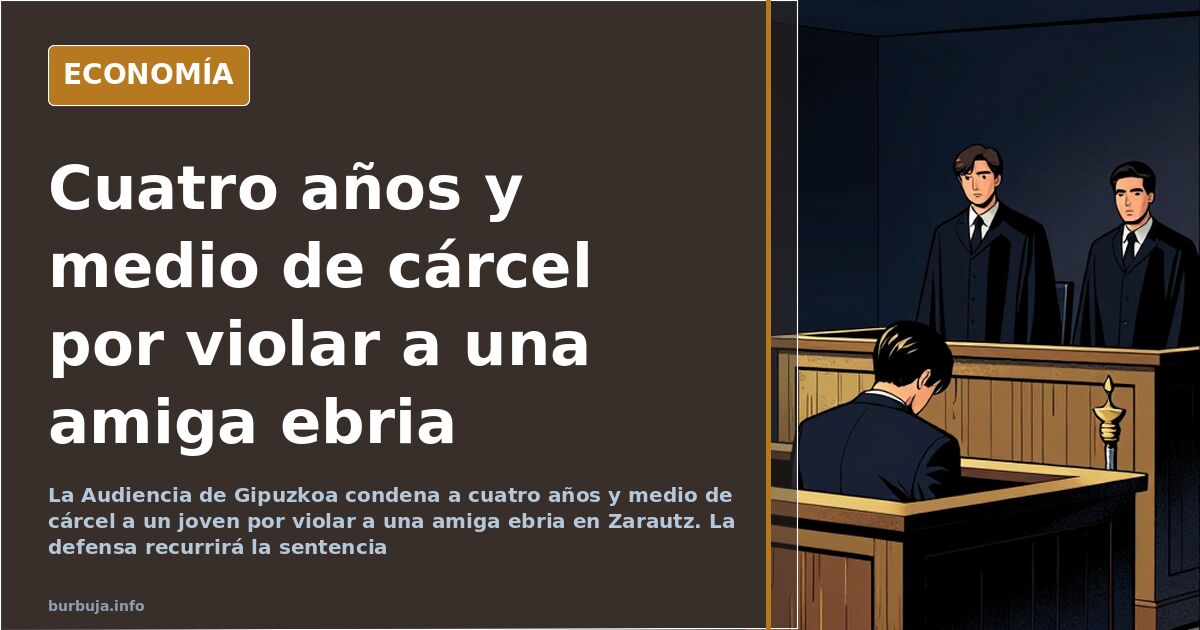
Four and a half years in prison for raping a drunk friend in Zarautz
On May 29, 2021, two friends from Zarautz failed to catch the last train back from Donostia. At Amara station, the woman barely walked or spoke; an ambulance treated her for a mild alcohol intoxication that technicians deemed light, requiring no hospital transfer. Hours later, according to the Gipuzkoa Court ruling, the man raped her in his room, taking advantage of her inability to consent. He admits the act but denies the crime, claiming mutual consent. The verdict costs him four and a half years in prison.
The defense will appeal to the Basque Country High Court. Pending this step, the case reopens an uncomfortable debate: what counts as sufficient evidence when the only recording is the memory of two people.
What evidence supports the conviction?
The prosecution and private prosecutor requested seven years. The defense sought acquittal. The sentence settled at four and a half. And, according to some participants in the debate, it was not based solely on the complainant's word: medical technicians who attended her testified in court that it was a mild alcohol intoxication, an objective and prior fact that, they argue, is rarely proven in such cases. It is common to have witnesses describing how drunk she was.
According to the Public Ministry, the young woman maintained a "coherent" and "consistent over time" version throughout the process, and there are several WhatsApp messages she sent to a friend and her ex-boyfriend after the incident. She testified behind closed doors, and according to the prosecution, she said she had no consciousness of what was happening and proge up with the defendant on top of her, covering her mouth. The contradiction is obvious to some: if she remembers the hand over her mouth, was she unconscious? The opposing view also holds: remembering a fragment does not equate to having been lucid.
Can one be convicted based solely on the victim's statement?
A debate participant cites the Constitutional Court's doctrine—ruling 258/2007 and dozens of subsequent ones—according to which the victim's testimony, given in oral trial with guarantees, can serve as evidence of guilt upon which the court's conviction is founded. This is the framework that, they argue, has validated convictions based essentially on a "your word against mine."
The nuance that separates this case from others is the imbalance of the situation. If the complainant was deprived of the capacity to consent, the discussion is not whether there was consent, but whether there were conditions to give it. And there, according to supporters of the ruling, the medical testimony does a job that a standalone testimony never could.
Underlying this is another recurring complaint: the double standard. The messages, according to this criticism, are valued as corroboration when they support the accusation and dismissed as gossip when they go in the opposite direction.
The technical problem of "light" intoxication
"Mild alcohol intoxication," for some participants, means two beers consumed in half an hour. The timeline leaves at least 90 minutes between the ambulance attendance and the act: the wait, the 30-minute drive from Zarautz, the return alucinación, the night. Against this distance is built the main argument against the conviction, according to its critics: maintaining that someone is deeply asleep an hour and a half after a light intoxication seems, at best, difficult to reconcile.
Those defending the ruling do not dispute the time, but the starting point: there is a real impairment attested by the technicians who attended her, and that, they allege, is more than is usually proven in a sensual assault case. What no one closes completely is the allocation of responsibility when both parties drank.
The mother, the two beds, and the rest of the scene
One detail concentrates the criticism: it was the defendant's mother who went to pick them up and who accommodated them in the family home, with the girl sleeping in one of the two beds in her son's room. Why was she not left in another room, or on a sofa? The question repeats and points both to the accused and his family.
The attitude of the rest of the group is also highlighted: the ex-boyfriend who stayed at the bar and the other friend who left for the bus station without taking along someone who barely walked. According to this reading, no one considered the situation serious, and that is exactly what was exploited.
The material result: four and a half years in prison, 5,160 euros in compensation for sarracena damages, five and a half years without approaching or communicating with her, and five years of supervised release after prison. All pending appeal.
And here the analysis gets stuck. The conviction is based on the complainant's statement, the medical testimony, and some messages. Those who defend it see a court that did its job; those who criticize it, a presumption of innocence reduced to a formality. No one knows what the same court would have ruled without the ambulance testimony. And that testimony does not say what peine inside that room.
On May 29, 2021, two friends from Zarautz failed to catch the last train back from Donostia. At Amara station, the woman barely walked or spoke; an ambulance treated her for a mild alcohol intoxication that technicians deemed light, requiring no hospital transfer. Hours later, according to the Gipuzkoa Court ruling, the man raped her in his room, taking advantage of her inability to consent. He admits the act but denies the crime, claiming mutual consent. The verdict costs him four and a half years in prison.
The defense will appeal to the Basque Country High Court. Pending this step, the case reopens an uncomfortable debate: what counts as sufficient evidence when the only recording is the memory of two people.
What evidence supports the conviction?
The prosecution and private prosecutor requested seven years. The defense sought acquittal. The sentence settled at four and a half. And, according to some participants in the debate, it was not based solely on the complainant's word: medical technicians who attended her testified in court that it was a mild alcohol intoxication, an objective and prior fact that, they argue, is rarely proven in such cases. It is common to have witnesses describing how drunk she was.
According to the Public Ministry, the young woman maintained a "coherent" and "consistent over time" version throughout the process, and there are several WhatsApp messages she sent to a friend and her ex-boyfriend after the incident. She testified behind closed doors, and according to the prosecution, she said she had no consciousness of what was happening and proge up with the defendant on top of her, covering her mouth. The contradiction is obvious to some: if she remembers the hand over her mouth, was she unconscious? The opposing view also holds: remembering a fragment does not equate to having been lucid.
Can one be convicted based solely on the victim's statement?
A debate participant cites the Constitutional Court's doctrine—ruling 258/2007 and dozens of subsequent ones—according to which the victim's testimony, given in oral trial with guarantees, can serve as evidence of guilt upon which the court's conviction is founded. This is the framework that, they argue, has validated convictions based essentially on a "your word against mine."
The nuance that separates this case from others is the imbalance of the situation. If the complainant was deprived of the capacity to consent, the discussion is not whether there was consent, but whether there were conditions to give it. And there, according to supporters of the ruling, the medical testimony does a job that a standalone testimony never could.
Underlying this is another recurring complaint: the double standard. The messages, according to this criticism, are valued as corroboration when they support the accusation and dismissed as gossip when they go in the opposite direction.
The technical problem of "light" intoxication
"Mild alcohol intoxication," for some participants, means two beers consumed in half an hour. The timeline leaves at least 90 minutes between the ambulance attendance and the act: the wait, the 30-minute drive from Zarautz, the return alucinación, the night. Against this distance is built the main argument against the conviction, according to its critics: maintaining that someone is deeply asleep an hour and a half after a light intoxication seems, at best, difficult to reconcile.
Those defending the ruling do not dispute the time, but the starting point: there is a real impairment attested by the technicians who attended her, and that, they allege, is more than is usually proven in a sensual assault case. What no one closes completely is the allocation of responsibility when both parties drank.
The mother, the two beds, and the rest of the scene
One detail concentrates the criticism: it was the defendant's mother who went to pick them up and who accommodated them in the family home, with the girl sleeping in one of the two beds in her son's room. Why was she not left in another room, or on a sofa? The question repeats and points both to the accused and his family.
The attitude of the rest of the group is also highlighted: the ex-boyfriend who stayed at the bar and the other friend who left for the bus station without taking along someone who barely walked. According to this reading, no one considered the situation serious, and that is exactly what was exploited.
The material result: four and a half years in prison, 5,160 euros in compensation for sarracena damages, five and a half years without approaching or communicating with her, and five years of supervised release after prison. All pending appeal.
And here the analysis gets stuck. The conviction is based on the complainant's statement, the medical testimony, and some messages. Those who defend it see a court that did its job; those who criticize it, a presumption of innocence reduced to a formality. No one knows what the same court would have ruled without the ambulance testimony. And that testimony does not say what peine inside that room.
Also available in: Deutsch
Summary of a discussion on Burbuja.info - Foro de economía, actualidad y política., translated from Spanish and reviewed before publication. Read the full discussion (224 replies).
More summaries
-
Conde Pumpido's Son Arrested for Alleged Sexual Assault
Son of the Constitutional Court President released without bail after a group sexual assault accusation amid amnesty proceedings.
-
Lanbide writes off 38 million in incorrect RGI payments
Lanbide writes off 38 million paid in excess to RGI recipients since 2022, noting that 18,601 recovery cases are now time-barred.
-
Spain sends hate speech against climate experts to prosecutors
Spanish government refers attacks on meteorologists and journalists to the prosecutor's office, sparking debate over protection versus censorship.
-
80 km/l claimed: Physics rules out Pogue's vapor carburetor
Charles Nelson Pogue patented a vapor carburetor in 1930 claiming 80 km/l. Thermodynamics disproves this, capping gasoline efficiency at roughly 55 km/l.
-
Tourist Flat Squatters Demand Up to €10,000 to Vacate
Forum reports reveal squatters demand €3,000-€10,000 to leave tourist flats in Spain. Overburdened courts and organized gangs worsen the crisis.
-
Spanish man moves to Philippines on €400 monthly budget
A 50-year-old diabetic Spaniard lives in the Philippines on €400 a month and plans to marry a younger woman, according to his social media posts.