
Man Killed by Train in Sant Adrià After Phone Theft
A man died after being hit by a train in Sant Adrià, Spain, following a phone theft. R1 line suspended between El Clot and Badalona; stolen phone unrecovered.
English · Original discussion in Spanish · Published
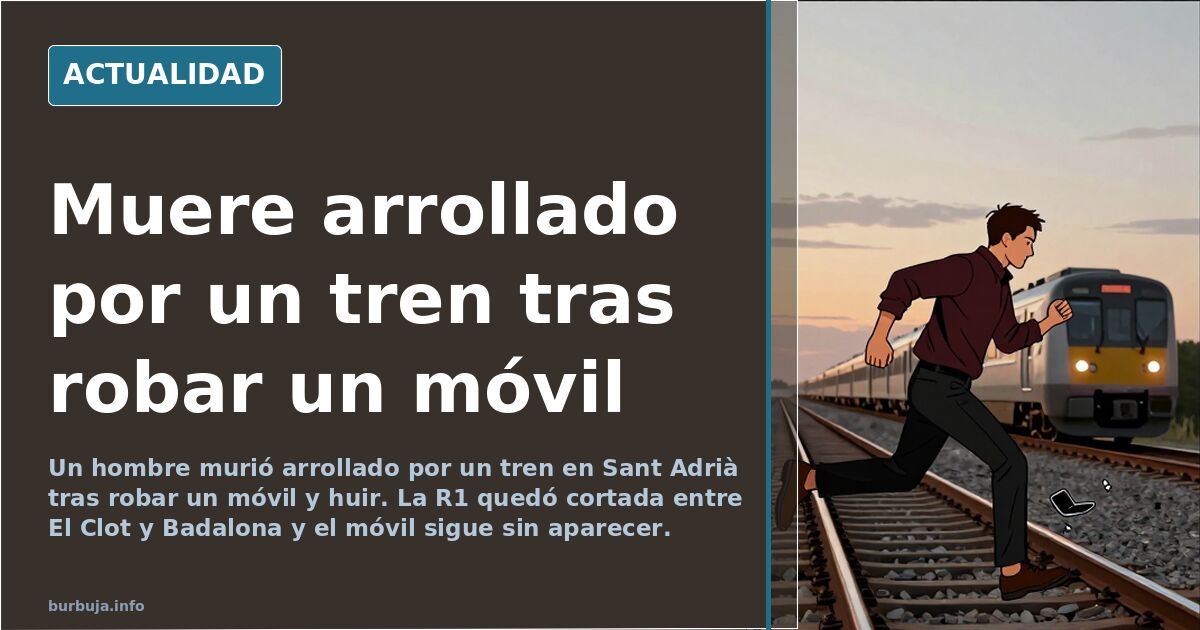
Man Killed by Train in Sant Adrià After Phone Theft
What happens when someone steals a mobile phone, runs away, and crosses a Rodalies commuter train track? The answer, on Sunday, July 6, 2025, was a man dead on the tracks in Sant Adrià de Besòs, the R1 line cut between El Clot and Badalona, and a heated online discussion that arrived faster than the fire brigade. The incident, first reported by Tot Badalona and covered by Metrópoli Abierta, occurred near Tres Xemeneies, at an unauthorized crossing point just meters from the station.
The account is as simple as it is brutal. According to eyewitnesses, the man had stolen a phone from an Asian woman around 50 years old. Several pedestrians chased him. During his escape, he crossed the tracks, tripped, and was struck by a passing train. Passengers were evacuated on foot to the platform, Civil Protection activated the FERROCAT plan pre-alert, and Renfe diverted travelers to metro line L2.
Details of the Sant Adrià Incident and Stolen Phone
The most concrete detail rarely appears in headlines: the phone. No one has confirmed whether the woman recovered her device. This question permeates the debate—"Is the phone okay?", "Did she get her phone back?"—and remains officially unanswered. Some argue that the object's market value justifies the risk; others contend that no terminal is worth a life, neither the thief's nor the pursuer's.
The second key fact is the service disruption. R1 train traffic was halted between El Clot and Badalona, with passengers evacuated on foot and services diverted to L2. This means hundreds of commuters affected by a thirty-second chase. Damage costs to railway equipment—cleaning, inspection, delays—have not been published, but the debate highlights them sarcastically: "I hope the train repair isn't too expensive."
The Thief, the Victim, and Missing Data
The original article identifies the theft victim as "an Asian woman around 50." It provides no nationality, age, or legal status for the deceased man. This asymmetry generates significant commentary: some see it as informational bias; others view it as legal caution. Regardless, the information gap fills itself, often without rigor.
Some claim the victim's ethnicity is highlighted to shape a narrative while the deceased's is hidden for the same reason. A more prosaic counter-argument suggests media typically identify living victims and withhold details about the deceased until official confirmation. Neither interpretation is proven. What is confirmed is that the incident occurred at an unauthorized pedestrian crossing, meters from the station. In short, there was a train track where no one should have been running.
Train as Judge: Social Reaction to the Incident
The event triggered a cascade of dark irony. "For once, Renfe works well," said one user. "Even trains do police work better than the police," added another. "One less," summarized a third. Most messages celebrate the thief's death without nuance, while a minority urges calm: a person's death, even during a flight, is not news to celebrate.
The consensus, if it can be called that, is that this incident condenses broader anxiety: the perception that petty crime—snatch theft, phone robbery—has become commonplace and consequence-free. In this imaginary, the train appears as accidental justice. This is an emotional reading, not data. But it explains why 118 replies were written in less time than a train takes to traverse the section.
Impact on R1 Line and FERROCAT Plan
R1 is one of the busiest Rodalies lines, and the El Clot-Badalona stretch is a bottleneck. The collision forced a service suspension, convoy evacuation, and diversion to metro L2. Civil Protection activated the FERROCAT plan pre-alert, the protocol for railway emergencies. Service normalization took hours.
The economic impact of such a disruption extends beyond repairs. It includes late arrivals, lost shifts, and domino effects across the network. The debate sums it up with a phrase needing no explanation: "The worst part is transport disruptions caused by this nonsense."
Ultimately, the unanswered question is not why the thief died. It is whether the woman got her phone back. And that, despite 118 comments, remains unknown.
What happens when someone steals a mobile phone, runs away, and crosses a Rodalies commuter train track? The answer, on Sunday, July 6, 2025, was a man dead on the tracks in Sant Adrià de Besòs, the R1 line cut between El Clot and Badalona, and a heated online discussion that arrived faster than the fire brigade. The incident, first reported by Tot Badalona and covered by Metrópoli Abierta, occurred near Tres Xemeneies, at an unauthorized crossing point just meters from the station.
The account is as simple as it is brutal. According to eyewitnesses, the man had stolen a phone from an Asian woman around 50 years old. Several pedestrians chased him. During his escape, he crossed the tracks, tripped, and was struck by a passing train. Passengers were evacuated on foot to the platform, Civil Protection activated the FERROCAT plan pre-alert, and Renfe diverted travelers to metro line L2.
Details of the Sant Adrià Incident and Stolen Phone
The most concrete detail rarely appears in headlines: the phone. No one has confirmed whether the woman recovered her device. This question permeates the debate—"Is the phone okay?", "Did she get her phone back?"—and remains officially unanswered. Some argue that the object's market value justifies the risk; others contend that no terminal is worth a life, neither the thief's nor the pursuer's.
The second key fact is the service disruption. R1 train traffic was halted between El Clot and Badalona, with passengers evacuated on foot and services diverted to L2. This means hundreds of commuters affected by a thirty-second chase. Damage costs to railway equipment—cleaning, inspection, delays—have not been published, but the debate highlights them sarcastically: "I hope the train repair isn't too expensive."
The Thief, the Victim, and Missing Data
The original article identifies the theft victim as "an Asian woman around 50." It provides no nationality, age, or legal status for the deceased man. This asymmetry generates significant commentary: some see it as informational bias; others view it as legal caution. Regardless, the information gap fills itself, often without rigor.
Some claim the victim's ethnicity is highlighted to shape a narrative while the deceased's is hidden for the same reason. A more prosaic counter-argument suggests media typically identify living victims and withhold details about the deceased until official confirmation. Neither interpretation is proven. What is confirmed is that the incident occurred at an unauthorized pedestrian crossing, meters from the station. In short, there was a train track where no one should have been running.
Train as Judge: Social Reaction to the Incident
The event triggered a cascade of dark irony. "For once, Renfe works well," said one user. "Even trains do police work better than the police," added another. "One less," summarized a third. Most messages celebrate the thief's death without nuance, while a minority urges calm: a person's death, even during a flight, is not news to celebrate.
The consensus, if it can be called that, is that this incident condenses broader anxiety: the perception that petty crime—snatch theft, phone robbery—has become commonplace and consequence-free. In this imaginary, the train appears as accidental justice. This is an emotional reading, not data. But it explains why 118 replies were written in less time than a train takes to traverse the section.
Impact on R1 Line and FERROCAT Plan
R1 is one of the busiest Rodalies lines, and the El Clot-Badalona stretch is a bottleneck. The collision forced a service suspension, convoy evacuation, and diversion to metro L2. Civil Protection activated the FERROCAT plan pre-alert, the protocol for railway emergencies. Service normalization took hours.
The economic impact of such a disruption extends beyond repairs. It includes late arrivals, lost shifts, and domino effects across the network. The debate sums it up with a phrase needing no explanation: "The worst part is transport disruptions caused by this nonsense."
Ultimately, the unanswered question is not why the thief died. It is whether the woman got her phone back. And that, despite 118 comments, remains unknown.
Also available in: Deutsch
Summary of a discussion on Burbuja.info - Foro de economía, actualidad y política., translated from Spanish and reviewed before publication. Read the full discussion (118 replies).
More summaries
-
PACMA Calls Protest on October 4 Against Valdepeñas 'Cat Killer'
PACMA has called a protest on October 4 in Valdepeñas against the 'cat killer,' a former civil guard accused of killing stray cats.
-
Iker Jiménez, VOX and the 'I don't know anyone' that doesn't add up
Iker Jiménez justifies VOX's absence from Horizonte by saying he doesn't know them, but his guest list includes non-parliamentary figures.
-
Spanish Royal Family Faces Backlash Over Photoshopped Rural Homage
The Spanish Royal Family released a digitally manipulated image to honor rural life, sparking controversy over obvious editing flaws and incoherent lighting.
-
Unverified video of struggle fuels polarized narratives in Spain
An unverified nighttime altercation outside a venue becomes ammunition for two opposing stories, lacking police reports or identification.
-
Burgos Cathedral Doors: €1.2M Controversy
Antonio López completes Burgos Cathedral doors at 91, sparking debate over aesthetics and public spending.
-
Book on King Felipe VI Reignites Spanish Monarchy Debate
A book on the private lives of King Felipe VI and Queen Letizia has revived discussions about the Spanish Crown's cost and role. Allegations remain unverified.