
Man killed by cars while on e-scooter on A-357 highway in Spain
A 40-year-old man has died after being struck by two vehicles while using an electric scooter on the A-357 highway in Málaga, Spain.
English · Original discussion in Spanish · Published
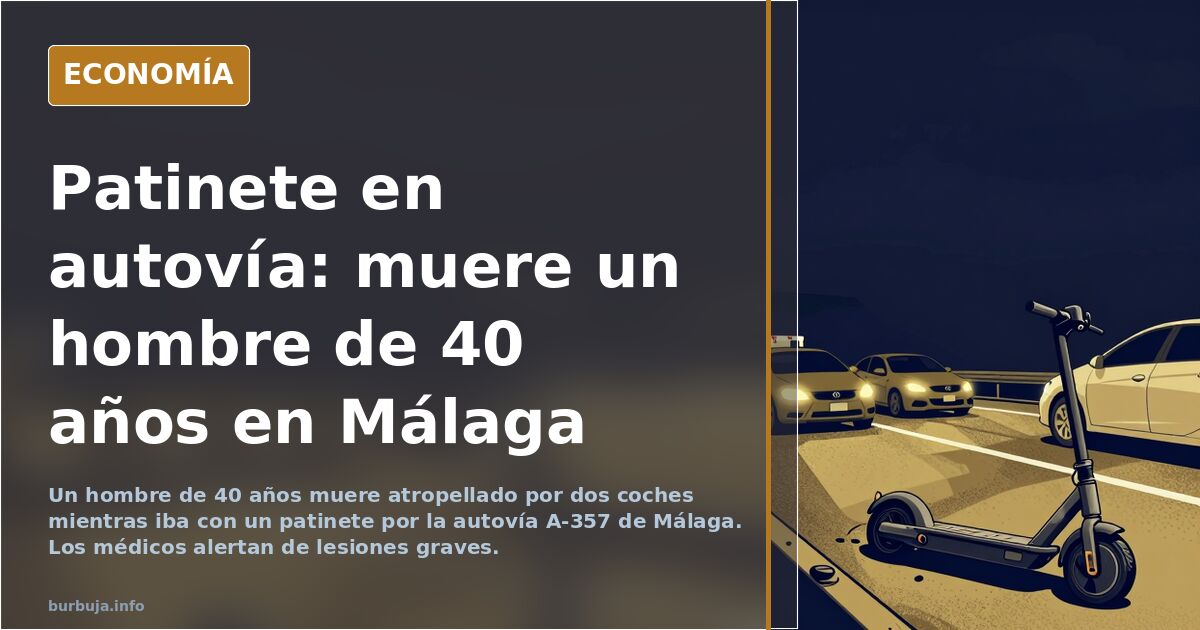
Man, 40, killed in e-scooter accident on A-357 highway
Last Friday, at approximately 20:20, a 40-year-old man died at kilometer 63 of the A-357 highway in Málaga after being struck by two vehicles while using an electric scooter. According to the Centro de Gestión del Tráfico (Traffic Management Center), the victim was walking in the middle of the road toward Cártama, pushing the scooter after having dismounted. A first car hit him with its rearview mirror; the force of the impact caused him to veer into the oncoming lane, where a second vehicle struck him. Medical staff could only certify his death.
The incident has peine the debate regarding e-scooter safety and their coexistence with motor traffic. Traffic remained closed in both directions while investigations were carried out. The news, first reported by Málaga Hoy, has triggered a wave of reactions mixing criticism of individual recklessness with complaints about a regulatory vacuum that, according to medical professionals, is starting to resemble the worst years of motorcycle accidents.
What are doctors saying about e-scooter accidents?
The Head of Emergency Services at Hospital Clínico de Málaga, Francisco Temboury, summarizes the situation with a phrase frequently heard in the corridors: "We are in the worst times for motorcycle accidents." This is not an isolated impression. Doctors treating injuries from scooter incidents—falls, crashes, or collisions—observe a worrying pattern: a high percentage of patients present bone or traumatic brain injuries of varying severity, which in some cases lead to long-term dependency. The lack of helmets and structural protection turns any impact into a serious matter.
While not a formal study, the statistics serve as a warning sign. On average, the Traumatology department handles about two such accidents per week during every shift. The e-scooter, conceived as a toy or an urban mobility solution, has become a vehicle that multiplies risk because regulations have failed to keep pace.
E-scooters: between cycle lanes and highways
The Málaga case is not an isolated episode. The discussion trinc the incident has highlighted an uncomfortable reality: electric scooters do not have a clear place in the road hierarchy. If mopeds are prohibited from using highways, e-scooters are even more restricted. However, this prohibition has not been accompanied by a safe alternative. Sidewalks, which could serve as a refuge, are considered dangerous for pedestrians; cycle lanes, when they exist, are either underutilized or invaded by other users. As a result, many scooter riders end up on the roadway, where they are vulnerable.
Some argue that the solution lies in creating specific lanes for scooters, separate from bicycles and pedestrians. Others contend that the problem is not infrastructure, but rather a lack of civic responsibility and police enforcement. The opinions gathered after the accident reflect an uncomfortable consensus: the administration has taken too long to regulate a phenomenon that was already widespread.
The invisibility of scooters on the road
One of the most common arguments among drivers is the issue of invisibility. An e-scooter lacks the physical mass of a motorcycle; its silhouette is low and narrow, and at certain speeds, it can go unnoticed at a roundabout or a junction. Several testimonies describe near-miss situations in roundabouts, where a scooter enters at high estimulante ilegal and the driver does not see it until it is too late. The comparison to a running pedestrian is inevitable: the human eye is not trained to detect such a small object moving at 20 or 25 km/h.
This is compounded by the lack of acoustic or light signaling on many models. There is no license plate, no mandatory insurance, and, in most cases, no helmet. The combination is explosive. The proposal to require minimum third-party liability insurance for these vehicles has gained supporters even among those who defend their use. The argument is simple: if a scooter causes damage to a third party and the rider is insolvent, the victim is left unprotected.
User profiles and generational stigma
The victim's age, 40, has fueled a generational subtext in the discussion. Some see the e-scooter as a symbol of precariousness and the inability to afford a car or a motorcycle. "It is the 'want but can't afford' version of owning a motorcycle," summarizes one commentator. Others interpret it as an extension of adolescence in adults who should have moved past certain behaviors. Mockery toward the deceased man has been a constant in some comments, though voices have also emerged reminding people that, in the 1970s, that same man would have driven a Simca 1000 or a Seat 850.
The stigma does not help solve the problem. The reality is that electric scooters have become popular low-cost alternatives in cities with heavy traffic and expensive parking. Their presence is not going to diminish. The question is whether regulation will arrive before more deaths accumulate.
What happens next regarding scooter regulations?
At the time of this discussion, traffic on the A-357 remained closed in both directions as the Guardia Civil (Civil Guard) conducted its investigation. There has been no official statement regarding potential regulatory changes trinc this event. What does exist is a growing outcry from healthcare professionals and parts of the public for e-scooters to be treated like other vehicles in terms of insurance, identification, and penalties. The responsibility now lies with the administrations. Meanwhile, the accident rate continues its course.
How many more deaths are needed for the e-scooter to stop being a toy without rules?
Last Friday, at approximately 20:20, a 40-year-old man died at kilometer 63 of the A-357 highway in Málaga after being struck by two vehicles while using an electric scooter. According to the Centro de Gestión del Tráfico (Traffic Management Center), the victim was walking in the middle of the road toward Cártama, pushing the scooter after having dismounted. A first car hit him with its rearview mirror; the force of the impact caused him to veer into the oncoming lane, where a second vehicle struck him. Medical staff could only certify his death.
The incident has peine the debate regarding e-scooter safety and their coexistence with motor traffic. Traffic remained closed in both directions while investigations were carried out. The news, first reported by Málaga Hoy, has triggered a wave of reactions mixing criticism of individual recklessness with complaints about a regulatory vacuum that, according to medical professionals, is starting to resemble the worst years of motorcycle accidents.
What are doctors saying about e-scooter accidents?
The Head of Emergency Services at Hospital Clínico de Málaga, Francisco Temboury, summarizes the situation with a phrase frequently heard in the corridors: "We are in the worst times for motorcycle accidents." This is not an isolated impression. Doctors treating injuries from scooter incidents—falls, crashes, or collisions—observe a worrying pattern: a high percentage of patients present bone or traumatic brain injuries of varying severity, which in some cases lead to long-term dependency. The lack of helmets and structural protection turns any impact into a serious matter.
While not a formal study, the statistics serve as a warning sign. On average, the Traumatology department handles about two such accidents per week during every shift. The e-scooter, conceived as a toy or an urban mobility solution, has become a vehicle that multiplies risk because regulations have failed to keep pace.
E-scooters: between cycle lanes and highways
The Málaga case is not an isolated episode. The discussion trinc the incident has highlighted an uncomfortable reality: electric scooters do not have a clear place in the road hierarchy. If mopeds are prohibited from using highways, e-scooters are even more restricted. However, this prohibition has not been accompanied by a safe alternative. Sidewalks, which could serve as a refuge, are considered dangerous for pedestrians; cycle lanes, when they exist, are either underutilized or invaded by other users. As a result, many scooter riders end up on the roadway, where they are vulnerable.
Some argue that the solution lies in creating specific lanes for scooters, separate from bicycles and pedestrians. Others contend that the problem is not infrastructure, but rather a lack of civic responsibility and police enforcement. The opinions gathered after the accident reflect an uncomfortable consensus: the administration has taken too long to regulate a phenomenon that was already widespread.
The invisibility of scooters on the road
One of the most common arguments among drivers is the issue of invisibility. An e-scooter lacks the physical mass of a motorcycle; its silhouette is low and narrow, and at certain speeds, it can go unnoticed at a roundabout or a junction. Several testimonies describe near-miss situations in roundabouts, where a scooter enters at high estimulante ilegal and the driver does not see it until it is too late. The comparison to a running pedestrian is inevitable: the human eye is not trained to detect such a small object moving at 20 or 25 km/h.
This is compounded by the lack of acoustic or light signaling on many models. There is no license plate, no mandatory insurance, and, in most cases, no helmet. The combination is explosive. The proposal to require minimum third-party liability insurance for these vehicles has gained supporters even among those who defend their use. The argument is simple: if a scooter causes damage to a third party and the rider is insolvent, the victim is left unprotected.
User profiles and generational stigma
The victim's age, 40, has fueled a generational subtext in the discussion. Some see the e-scooter as a symbol of precariousness and the inability to afford a car or a motorcycle. "It is the 'want but can't afford' version of owning a motorcycle," summarizes one commentator. Others interpret it as an extension of adolescence in adults who should have moved past certain behaviors. Mockery toward the deceased man has been a constant in some comments, though voices have also emerged reminding people that, in the 1970s, that same man would have driven a Simca 1000 or a Seat 850.
The stigma does not help solve the problem. The reality is that electric scooters have become popular low-cost alternatives in cities with heavy traffic and expensive parking. Their presence is not going to diminish. The question is whether regulation will arrive before more deaths accumulate.
What happens next regarding scooter regulations?
At the time of this discussion, traffic on the A-357 remained closed in both directions as the Guardia Civil (Civil Guard) conducted its investigation. There has been no official statement regarding potential regulatory changes trinc this event. What does exist is a growing outcry from healthcare professionals and parts of the public for e-scooters to be treated like other vehicles in terms of insurance, identification, and penalties. The responsibility now lies with the administrations. Meanwhile, the accident rate continues its course.
How many more deaths are needed for the e-scooter to stop being a toy without rules?
Also available in: Deutsch
Summary of a discussion on Burbuja.info - Foro de economía, actualidad y política., translated from Spanish and reviewed before publication. Read the full discussion (101 replies).
More summaries
-
Five officers fail to restrain one person in Spain, sparking police force debate
A viral video in Valencia shows five officers struggling with a single unarmed individual, reigniting the debate on police training, pay, and use of force.
-
Ortiz de Zárate: Arrested in Guadalajara, July 22, 1936
A 1936 photo shows Commander Ortiz de Zárate arrested in Guadalajara before his execution. Historical repression figures remain disputed.
-
Spain's Guardia Civil faces scrutiny over coastal tech spending
Analysis of the controversy surrounding the Guardia Civil's coastal surveillance center and doubts about its actual effectiveness.
-
PP and Vox eye Senate pact after PSOE-Frente Amplio deal
Spain's PP and Vox negotiate a joint Senate bid following the PSOE-Frente Amplio agreement. The deadline for candidate lists is October 26.
-
Prince Andrew arrested by British police in Epstein case
British police have arrested Prince Andrew at Sandringham following the release of new US Department of Justice documents linking him to the Epstein investigation.
-
Average pension by province in Spain: the map defying logic
Asturias, the Basque Country, and Cádiz lead Spain's highest average pensions, breaking the correlation between employment and retirement.