
Man buys generator so 96-year-old on oxygen isn't left without power in Spain
A 96-year-old Spaniard with severe COPD suffered severe hypoxia during Spain's 28 April 2025 blackout when no one was home to connect his backup oxygen cylinder.
English · Original discussion in Spanish · Published
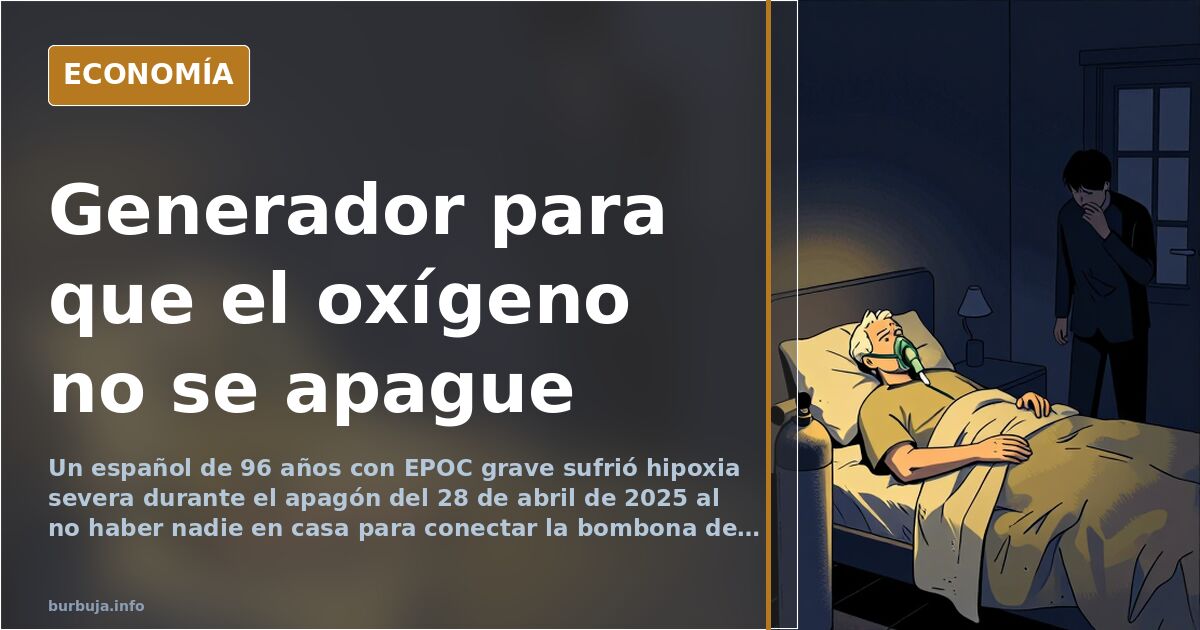
A private individual buys a generator so an elderly man is never left without oxygen
What happens when the power fails and someone at home depends on an oxygen concentrator? The answer, in one specific case, was severe hypoxia, a transfer to intensive care and a bill that ended up being paid by a third party. The episode took place during Spain's nationwide blackout on 28 April 2025 and centred on a 96-year-old Spaniard with severe COPD, moderate dementia and type II diabetes, who lives with his son in Spain while his daughter, an architect married to a businessman, lives in the United States and sends $5,000 a month to cover the costs arising from his dependency.
The sequence is easy to recount and hard to stomach. At midday on 28 April the Spanish home help who covers the four hours of morning care left and the Colombian-born carer hired by the son arrived. Shortly afterwards, the son and the carer went out to eat and for a walk, a routine that, according to the account, was often repeated. While no one was at home, the oxygen concentrator lost power because of the blackout and no one connected the backup cylinder. The elderly man, who needs 2.5 litres per minute, suffered severe hypoxia. The home help found him alone, cyanotic, lying on the sofa, and it took her three quarters of an hour to get an ambulance. The man ended up in the ICU of the district hospital.
What a dependent person risks when the power goes out
The case exposes a material problem that depends on no one's will: home oxygen therapy equipment needs electricity or backup cylinders. The elderly man's emergency cylinder, according to the data handled by those around him, lasts about 16 hours. In a widespread blackout, with every oxygen-dependent patient calling for replacements at once, that margin becomes a fragile cushion. The question is not rhetorical: how many Spanish households with respiratory-dependent patients have a real plan B for a prolonged outage?
The answer given by the author of the original message was to buy a generator and two portable batteries so that the elderly man's concentrator would never again depend on the grid. He did it, he says, without expecting gratitude or reward, and later refused the reimbursement offered by the daughter when she arrived from the United States. The financial detail matters: the expense was not a donation to an organisation, but a direct purchase of equipment for a specific case.
The division of tasks and the gap in the middle hours
The elderly man's household organisation has four hours of professional assistance in the morning, from eight to twelve, with washing, meals, weekly medication, blood pressure and blood glucose monitoring and insulin administration. From midday the carer hired by the son with the money sent by the sister comes in. In theory she was to be responsible for company, for watching that he did not fall, for taking him to the bathroom and for giving him food and medicines. In practice, on the day of the blackout there was no one at home.
The account in the original message maintains that the son had squandered the family assets in Mexico and Spain, that he lives off his father's pension, a non-contributory benefit and his sister's monthly help, and that this help was partly used to fund his own outings. These are claims by one of the parties involved, not facts confirmed by a court ruling. What the material does establish is that the daughter has thrown her brother out of the house and threatened to report him, and that the home help has asked for a leave of absence to move with her husband and daughter into the elderly man's home, and he will pay her directly to care for him.
The cost of dependency when the family fails
The case illustrates a pattern well known in social services: the burden falls on a single person, usually the one who lives far away and has income, while day-to-day care is delegated to workers hired with greater or lesser formality. The monthly sum arriving from the United States —$5,000— is not a small figure, but neither does it guarantee physical presence. And physical presence was exactly what was missing on the day the power went out.
The material also leaves an underlying debate about the role of public health care and dependency benefits. Some argue that the system will end up strained by ageing and by the burden generated by long-term dependents; others maintain that the answer lies in strengthening home care and emergency protocols for patients on oxygen therapy. The specific case does not resolve that discussion, but it brings it down to earth: a generator and a portable battery were enough to prevent a repeat.
What peine afterwards and what remains open
The daughter arrived from the United States, wanted to pay for the generator and the batteries, and was met with a refusal. She then threw her brother out of the house and agreed with the home help that she would move into her father's home in exchange for a salary. The brother, according to the account, spent the whole week without sleeping at their father's house. The matter has not reached the courts, at least as far as is known at the date of this discussion.
It remains to be seen whether the announced complaint is filed and how far it goes. It remains to be seen whether the generator and the batteries are ever actually used. And above all, an uncomfortable question remains: how many elderly people dependent on a power socket are today at the mercy of someone, at the exact moment of the outage, remembering to connect the cylinder. For now, the answer comes from a private individual with a Leroy Merlin receipt.
Also available in: Deutsch
Summary of a discussion on Burbuja.info - Foro de economía, actualidad y política., translated from Spanish and reviewed before publication. Read the full discussion (103 replies).
More summaries
-
Why are Bricodepot, Ikea and Leroy Merlin staffed almost entirely by women in Spain?
An economic analysis of the feminisation of Spain's DIY and home décor superstores: hiring subsidies, gender quotas and their effect on the labour market.
-
Spain's Blackout: Technical Failure or General Rehearsal?
Spain's total blackout of electricity, communications, and internet sparks debate between technical failure and rehearsal, involving Iberdrola, REE, and renewables.
-
The global plan narrative: from covid to the floods, everything fits
Covid, blackouts, the floods or Ceuta: every crisis seems to fit the global plan narrative. Why the theory sticks and what debunks it.
-
October inflation in Spain holds at 4.9%, narrowly avoiding the MEI pension top-up
Spain's October CPI comes in at 4.9%, three tenths short of triggering the MEI surcharge. Italian inflation stands at 5.4% and the ECB keeps rates at 2.5%.
-
To every true professional out there...
Getting an order that skips procedure confirmed in writing is a widespread practice. If something goes wrong, responsibility usually falls on whoever carried it out.
-
Spain's recognition of Israel turns 40 amid growing controversy
Spain recognized Israel in 1986. Four decades later, part of public opinion is calling for that recognition to be withdrawn and for Palestine alone to be recognized. The debate…