
Mali: Jihadist Advance Threatens Bamako Amid Wagner Uncertainty
Jihadist advance toward Bamako exposes Sahel fragility. Reports suggest Wagner has left Mali, deepening the conflict.
English · Original discussion in Spanish · Published
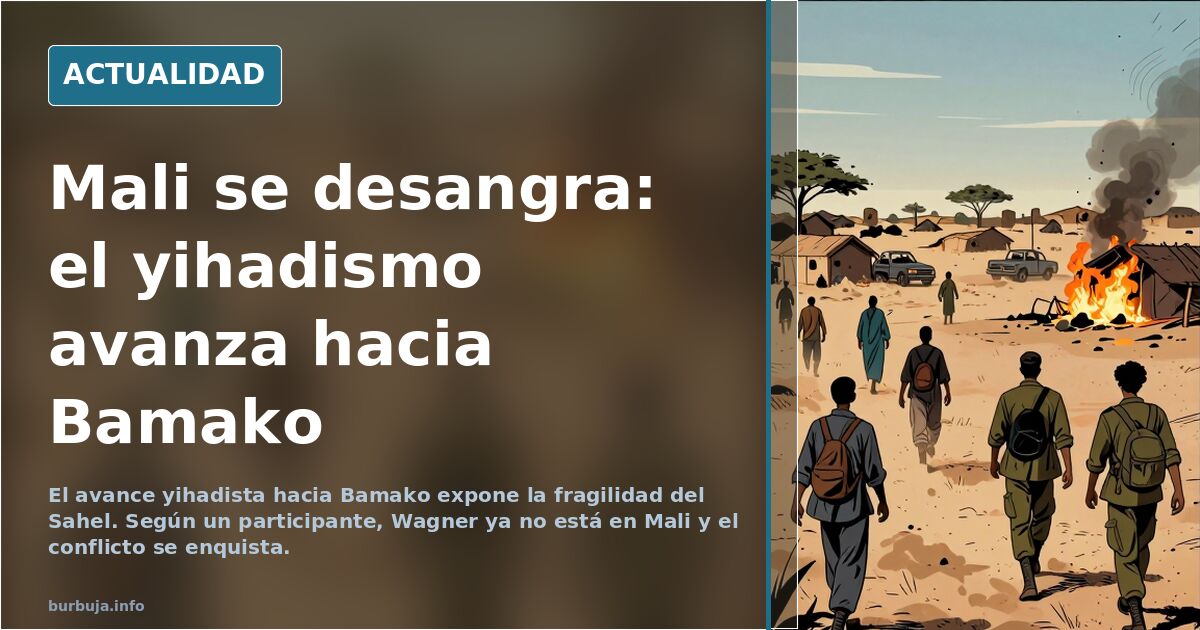
Mali Bleeds as Bamako Loses Control of the North
Mali is once again on the brink. The military junta governing from Bamako faces an advance by Sahelian jihadist groups who, after years of low-intensity conflict in the north, appear poised to march on the capital. Ground-level discussions, away from media noise, point to an uncomfortable fact: if Bamako falls, it will drag Mauritania, Burkina Faso, and Niger down with it. The country, which already experienced a French military intervention in 2013, remains a chessboard where geopolitical interests, propaganda, and a reality that ignores borders intersect.
What Is Happening in Mali and Why It Matters Beyond Its Borders
The most common diagnosis is that Mali is not a state in the conventional sense. Some argue it is a tribal territory where northern and southern communities have been opposed since before colonial borders existed. Azawad, the Tuareg-majority northern region, holds barely 10% of the population across two-thirds of the country's surface area. This demographic asymmetry explains why the Tuareg independence movement has never succeeded alone and has repeatedly allied with jihadist groups, such as those currently operating under the JNIM banner.
The 2013 French intervention halted the conflict abruptly but did not resolve it. Since then, Sarracinist groups have consolidated their presence in the north and border zones, exploiting institutional weakness and the lack of effective territorial control. The lingering question is whether the Bamako junta has the real capacity to stop an offensive toward the capital or if it is merely managing a countdown.
Who Defends Bamako If Wagner Is Gone?
The presence of the Russian Wagner Group in Mali was sold as the security guarantee France failed to provide. However, according to one participant, Russian mercenaries no longer operate in the country. This vacuum would leave the junta without its main deterrent against the jihadist advance and reinforce the thesis held by those who believe the alliance with Moscow was more a propaganda operation than a military solution.
Comparison with other African scenarios is inevitable. In Chad, Gaddafi’s forces were defeated by Toyota pickup columns supported by French paratroopers and legionnaires. The Libyan army, poorly trained and with only a couple of operational units, disintegrated in the desert. The lesson is uncomfortable: in the Sahel, technological superiority does not always compensate for a lack of territorial control.
The Humanitarian Aid Business and NGOs Cashing In
Parallel to the military conflict, the discussion shifts to money. Some point out that behind certain organizations managing humanitarian aid for Mali lie opaque economic interests. Criticism focuses on financial opacity: funds are raised under the banner of solidarity, but expenses are hidden within net figures, and traceability is lost along the way. This is a known pattern in Spain's third sector, where donations mix with public subsidies and financial entity sponsorships.
The result is a paradox: the country crumbles while the business of compassion consolidates. This is not exclusive to Mali, but it is more visible there because the humanitarian urgency is real and oversight is virtually nonexistent.
The Neocolonialism Narrative and Intervention Propaganda
The debate over Mali cannot be understood without the framework of neocolonialism. Part of the analysis argues that France and NATO have intervened in the Sahel for decades under the pretext of security, without resolving the structural problems fueling the conflict. The accusation is that these interventions have served to maintain weak, dependent governments rather than build sovereign states.
At the other extreme, some defend that without Western presence, the region inevitably descends into chaos. The comparison with South Africa is used as an argument: since white minority rule ended, the country has struggled to recover. This is a debatable reading, but it reflects a viewpoint gaining weight in geopolitical analysis forums.
What Happens If Bamako Falls
The most pessimistic scenario is also the most repeated: if the capital falls, the domino effect reaches Mauritania, Burkina Faso, and Niger. This is not just a regional security issue; it represents a shift in balance across the entire Sahel, with direct consequences for migration routes and the stability of neighboring governments, some of which are already under military juntas.
French propaganda insists Bamako will not fall. Russian propaganda insists Wagner is invincible. Jihadist propaganda insists the advance is unstoppable. Amid so many narratives, the only verifiable data is that the conflict remains open and no one fully controls the territory. How long can this fiction be sustained?
Mali is once again on the brink. The military junta governing from Bamako faces an advance by Sahelian jihadist groups who, after years of low-intensity conflict in the north, appear poised to march on the capital. Ground-level discussions, away from media noise, point to an uncomfortable fact: if Bamako falls, it will drag Mauritania, Burkina Faso, and Niger down with it. The country, which already experienced a French military intervention in 2013, remains a chessboard where geopolitical interests, propaganda, and a reality that ignores borders intersect.
What Is Happening in Mali and Why It Matters Beyond Its Borders
The most common diagnosis is that Mali is not a state in the conventional sense. Some argue it is a tribal territory where northern and southern communities have been opposed since before colonial borders existed. Azawad, the Tuareg-majority northern region, holds barely 10% of the population across two-thirds of the country's surface area. This demographic asymmetry explains why the Tuareg independence movement has never succeeded alone and has repeatedly allied with jihadist groups, such as those currently operating under the JNIM banner.
The 2013 French intervention halted the conflict abruptly but did not resolve it. Since then, Sarracinist groups have consolidated their presence in the north and border zones, exploiting institutional weakness and the lack of effective territorial control. The lingering question is whether the Bamako junta has the real capacity to stop an offensive toward the capital or if it is merely managing a countdown.
Who Defends Bamako If Wagner Is Gone?
The presence of the Russian Wagner Group in Mali was sold as the security guarantee France failed to provide. However, according to one participant, Russian mercenaries no longer operate in the country. This vacuum would leave the junta without its main deterrent against the jihadist advance and reinforce the thesis held by those who believe the alliance with Moscow was more a propaganda operation than a military solution.
Comparison with other African scenarios is inevitable. In Chad, Gaddafi’s forces were defeated by Toyota pickup columns supported by French paratroopers and legionnaires. The Libyan army, poorly trained and with only a couple of operational units, disintegrated in the desert. The lesson is uncomfortable: in the Sahel, technological superiority does not always compensate for a lack of territorial control.
The Humanitarian Aid Business and NGOs Cashing In
Parallel to the military conflict, the discussion shifts to money. Some point out that behind certain organizations managing humanitarian aid for Mali lie opaque economic interests. Criticism focuses on financial opacity: funds are raised under the banner of solidarity, but expenses are hidden within net figures, and traceability is lost along the way. This is a known pattern in Spain's third sector, where donations mix with public subsidies and financial entity sponsorships.
The result is a paradox: the country crumbles while the business of compassion consolidates. This is not exclusive to Mali, but it is more visible there because the humanitarian urgency is real and oversight is virtually nonexistent.
The Neocolonialism Narrative and Intervention Propaganda
The debate over Mali cannot be understood without the framework of neocolonialism. Part of the analysis argues that France and NATO have intervened in the Sahel for decades under the pretext of security, without resolving the structural problems fueling the conflict. The accusation is that these interventions have served to maintain weak, dependent governments rather than build sovereign states.
At the other extreme, some defend that without Western presence, the region inevitably descends into chaos. The comparison with South Africa is used as an argument: since white minority rule ended, the country has struggled to recover. This is a debatable reading, but it reflects a viewpoint gaining weight in geopolitical analysis forums.
What Happens If Bamako Falls
The most pessimistic scenario is also the most repeated: if the capital falls, the domino effect reaches Mauritania, Burkina Faso, and Niger. This is not just a regional security issue; it represents a shift in balance across the entire Sahel, with direct consequences for migration routes and the stability of neighboring governments, some of which are already under military juntas.
French propaganda insists Bamako will not fall. Russian propaganda insists Wagner is invincible. Jihadist propaganda insists the advance is unstoppable. Amid so many narratives, the only verifiable data is that the conflict remains open and no one fully controls the territory. How long can this fiction be sustained?
Also available in: Deutsch
Summary of a discussion on Burbuja.info - Foro de economía, actualidad y política., translated from Spanish and reviewed before publication. Read the full discussion (110 replies).
More summaries
-
Meet the mayor of Saint-Denis, France: our socialists haven't gone that far yet
Bally Bagayoko, mayor of Saint-Denis, denies appearing in a video from September 29, 2026. Maldita.es asked firefighters.
-
8-Year-Old Injured by Gunshots in Ceuta
An 8-year-old was injured by gunfire in Ceuta. The reaction: disbelief and accusations of staging. Facts and context of a disputed case.
-
Shooting in Madrid of a young man holding two elderly people hostage
A young man was shot in Madrid after holding two elderly people captive; according to reports, he survived and the jihadist motive has been dismissed.
-
King Felipe VI Unharmed by Falling Boom on Yacht
A yacht boom fell near King Felipe VI of Spain, who remained calm. The incident reignites ironic debates about the Bourbon dynasty's history.
-
Albacete Police Post Image of Officers Kissing, Then Delete It
Spain's Albacete Local Police posted and deleted an image of two officers kissing. Screenshots sparked debate on institutional communication.
-
Barcelona hotel guests unaware of migrant housing
A forum user describes three sleepless nights in a Barcelona hotel that allegedly housed migrant families without notice, highlighting the low-season agreement business.