
Barcelona hotel guests unaware of migrant housing
A forum user describes three sleepless nights in a Barcelona hotel that allegedly housed migrant families without notice, highlighting the low-season agreement business.
English · Original discussion in Spanish · Published
Forum account: Hotels housing migrants without notice
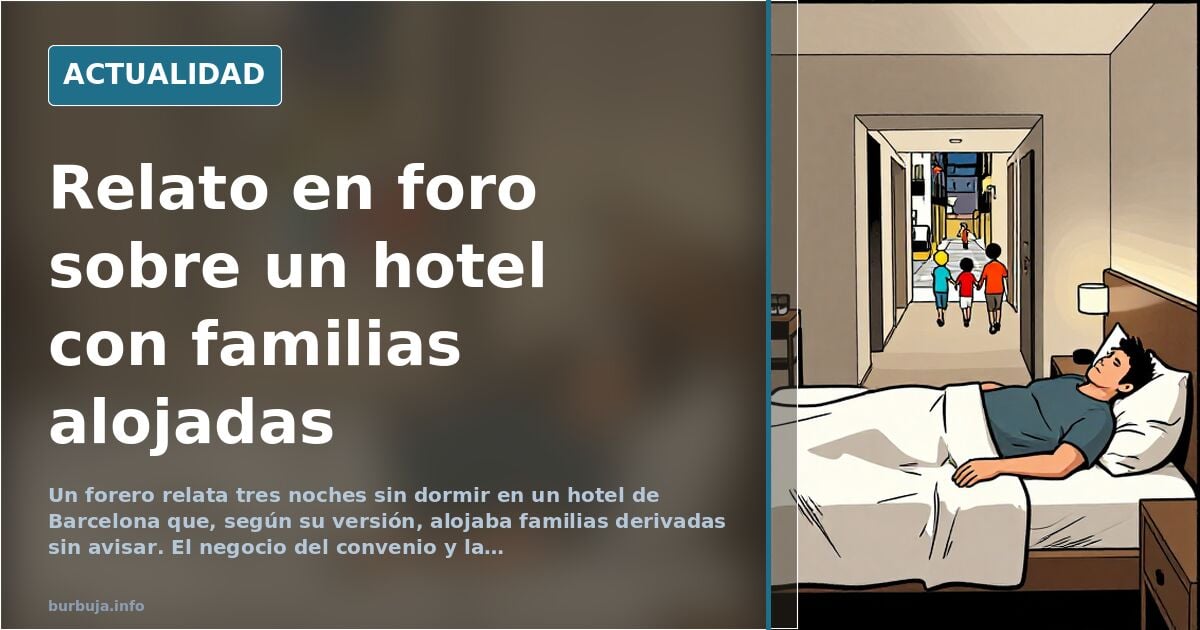
A forum user claims to have booked three nights online at a mid-range Barcelona hotel. On the first night, he complained about noise from children. On the second, he discovered he was sharing a floor with entire families cooking in rooms, leaving doors open, and coming and going at all hours. There was no night reception. He barricaded his door with a chair. He slept like this for three nights.
The story, published on a current affairs forum, has generated over a hundred replies and reveals a recurring pattern: bookings made without prior warning, floors filled via low-season agreements, and tourists who discover the arrangement only after checking in. The underlying question is not who sleeps next door, but who pays the difference.
What happens when hotels don't disclose migrant family housing
The described case shares a common element with others in the conversation: the establishment does not inform. When customers complain, the response is that other clients' data cannot be disclosed. This sounds like data protection but functions as commercial shielding: the hotel gets paid twice, once by the public program and once by the tourist who doesn't know who they share the hallway with.
Some argue that no hotel with real tourist demand would degrade itself by accepting relocated residents, as it would destroy its platform ratings. This logic holds during high season. In low season, the calculation changes: an empty floor generates zero revenue, while an agreement guarantees occupancy.
The agreement business: who wins and who loses
The most repeated thesis is economic: the State pays per place, the hotel collects, and the unknowing tourist bears the cost through noise, insecurity, and an experience they cannot claim compensation for. It's easy money today, hunger tomorrow, summarizes the initial post: the customer doesn't return, and the review remains.
Counterarguments also appear: if the hotel owner could choose, they would accept the highest-paying guest. The discussion then shifts to whether the problem lies with the hotel, the public program, or the lack of transparency in booking. No one disputes that the customer deserved to know before paying.
Reviews, blacklists, and boycotts: customer responses
The most frequent reaction is identical: make it public. Negative reviews on booking platforms, warnings on maps, shared lists of establishments operating with such agreements. The logic is simple: if the hotel doesn't warn, let previous customers do so.
Some go further, proposing an icon on accommodation listings, alongside those for safes or hairdryers, indicating the presence of relocated residents. Formulated with irony, the idea points to a real problem: currently, there is no standard channel to know this before booking.
Pattern repeats outside Barcelona
The conversation extends to other cases. A hostel in Sabiñánigo, Huesca, formerly used for international motorcycle rallies, is cited as an example of a facility converted into a reception center. Sitges is also mentioned. The pattern is the same: large facilities, low season, public agreements, and tourists finding out too late.
The debate intensifies when migration issues enter the discussion. Some participants argue the problem is coexistence and lack of adaptation; others respond that noise has no nationality and the true conflict is commercial. The article does not resolve this tension because the material provided doesn't either.
What travelers can do before booking
Circulating recommendations are based on common sense: choose small, family-run hotels, avoid chains with empty floors in low season, read recent reviews, and don't rely solely on average scores. Calling directly to ask if the establishment has agreements with any housing programs is also suggested.
None of these measures are foolproof. Customers still depend on the hotel's willingness to disclose information. As long as there is no obligation to inform, the asymmetry persists: the establishment knows the full occupancy list, while the tourist sees only a photo of the room.
Should hotels be required to disclose that they house relocated residents before confirming a reservation?
A forum user claims to have booked three nights online at a mid-range Barcelona hotel. On the first night, he complained about noise from children. On the second, he discovered he was sharing a floor with entire families cooking in rooms, leaving doors open, and coming and going at all hours. There was no night reception. He barricaded his door with a chair. He slept like this for three nights.
The story, published on a current affairs forum, has generated over a hundred replies and reveals a recurring pattern: bookings made without prior warning, floors filled via low-season agreements, and tourists who discover the arrangement only after checking in. The underlying question is not who sleeps next door, but who pays the difference.
What happens when hotels don't disclose migrant family housing
The described case shares a common element with others in the conversation: the establishment does not inform. When customers complain, the response is that other clients' data cannot be disclosed. This sounds like data protection but functions as commercial shielding: the hotel gets paid twice, once by the public program and once by the tourist who doesn't know who they share the hallway with.
Some argue that no hotel with real tourist demand would degrade itself by accepting relocated residents, as it would destroy its platform ratings. This logic holds during high season. In low season, the calculation changes: an empty floor generates zero revenue, while an agreement guarantees occupancy.
The agreement business: who wins and who loses
The most repeated thesis is economic: the State pays per place, the hotel collects, and the unknowing tourist bears the cost through noise, insecurity, and an experience they cannot claim compensation for. It's easy money today, hunger tomorrow, summarizes the initial post: the customer doesn't return, and the review remains.
Counterarguments also appear: if the hotel owner could choose, they would accept the highest-paying guest. The discussion then shifts to whether the problem lies with the hotel, the public program, or the lack of transparency in booking. No one disputes that the customer deserved to know before paying.
Reviews, blacklists, and boycotts: customer responses
The most frequent reaction is identical: make it public. Negative reviews on booking platforms, warnings on maps, shared lists of establishments operating with such agreements. The logic is simple: if the hotel doesn't warn, let previous customers do so.
Some go further, proposing an icon on accommodation listings, alongside those for safes or hairdryers, indicating the presence of relocated residents. Formulated with irony, the idea points to a real problem: currently, there is no standard channel to know this before booking.
Pattern repeats outside Barcelona
The conversation extends to other cases. A hostel in Sabiñánigo, Huesca, formerly used for international motorcycle rallies, is cited as an example of a facility converted into a reception center. Sitges is also mentioned. The pattern is the same: large facilities, low season, public agreements, and tourists finding out too late.
The debate intensifies when migration issues enter the discussion. Some participants argue the problem is coexistence and lack of adaptation; others respond that noise has no nationality and the true conflict is commercial. The article does not resolve this tension because the material provided doesn't either.
What travelers can do before booking
Circulating recommendations are based on common sense: choose small, family-run hotels, avoid chains with empty floors in low season, read recent reviews, and don't rely solely on average scores. Calling directly to ask if the establishment has agreements with any housing programs is also suggested.
None of these measures are foolproof. Customers still depend on the hotel's willingness to disclose information. As long as there is no obligation to inform, the asymmetry persists: the establishment knows the full occupancy list, while the tourist sees only a photo of the room.
Should hotels be required to disclose that they house relocated residents before confirming a reservation?
Also available in: Deutsch
Summary of a discussion on Burbuja.info - Foro de economía, actualidad y política., translated from Spanish and reviewed before publication. Read the full discussion (110 replies).
More summaries
-
Prison costs more than unemployment, but freedom is priceless
Spain’s prison system is criticized as a luxury hotel, but inmates face strict routines and loss of liberty, explaining why no one queues to enter.
-
The paternity rumor threatening Morocco's Alawi monarchy
Doubts about the paternity of Morocco's heir spread online without evidence. What lies behind the rumor that undermines the dynasty?
-
Yamuna River: 100% fecal matter, 200km of dead water
Iñaki Alday's Yamuna River Project aims to restore the world's most polluted urban river: 100% fecal matter, zero oxygen, and 200km without life.
-
Mataleón: Why experts advise against resisting
The mataleón is a surprise group chokehold. Experts agree: resisting is dangerous, and handing over your phone is the safest option.
-
King Felipe VI Unharmed by Falling Boom on Yacht
A yacht boom fell near King Felipe VI of Spain, who remained calm. The incident reignites ironic debates about the Bourbon dynasty's history.
-
Albacete Police Post Image of Officers Kissing, Then Delete It
Spain's Albacete Local Police posted and deleted an image of two officers kissing. Screenshots sparked debate on institutional communication.