
Málaga: shooting at Muelle Uno and stabbing in the city centre
A man was shot while dining at Muelle Uno and another, stabbed in central Málaga, lost a kidney; the shooter fled and the stabber was arrested.
English · Original discussion in Spanish · Published
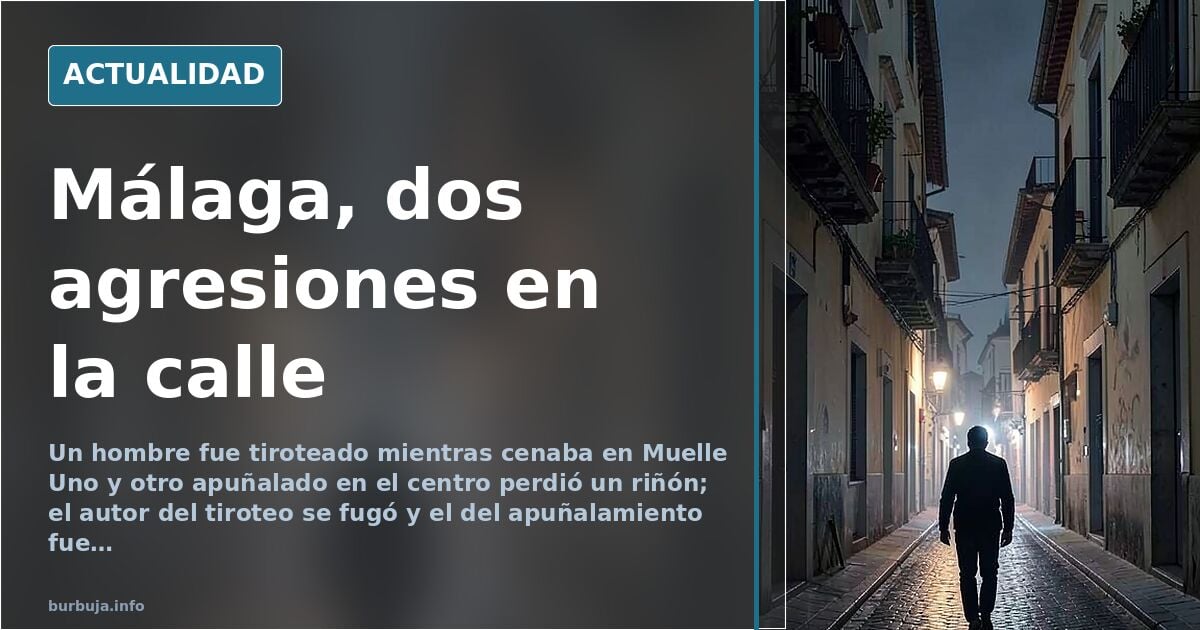
Málaga racks up two serious street attacks and the question is no longer rhetorical
How many violent attacks in the open street does a city have to endure before someone takes a serious look at the figures? In Málaga, a man was shot while dining at a restaurant in Muelle Uno; the victim was taken to hospital and the suspected shooter fled the scene. On top of that comes another incident: a man stabbed in the city centre while defending a woman lost a kidney and remains in the intensive care unit of the Hospital Regional, while the suspected attacker, with a long record of property crimes, was arrested just a few metres away and was involved in another altercation after his arrest.
Two scenes, one same street pattern
The available facts paint an uncomfortable sequence. A shooting in a busy dining area. A stabbing in the centre after intervening in an attack on a woman. And a suspect who, according to published reports, already had a record of robberies, thefts and fraud before this episode. It is not a statistical pattern, it is a narrative one: violence happening where people dine, stroll or head home.
The reaction in public debate mixes two registers that rarely speak to each other. One demands forceful responses, no sugar-coating, and warns that discontent over public safety will eventually demand tough-on-crime solutions if the problem becomes entrenched. The other downplays the diagnosis to a matter of political management and messaging. Between the two, the fact nobody disputes: there is a victim in intensive care and a suspect on the run.
What the suspect's record says
The record of the suspected stabber — property crimes, robberies, thefts, fraud — is the element that weighs most heavily in how the case is read. Not because it explains the attack, but because it feeds the suspicion that the system's response arrives too late. It is the same suspicion that resurfaces when it emerges that the suspect was involved in another altercation after his arrest.
Some argue the problem is one of resources and zero tolerance; against that weighs the argument that a single case does not allow for extrapolating incivil policy. What is hard to dispute is the human cost: a man loses a kidney for stepping in to defend a woman.
The political narrative that creeps into every incident
No serious attack escapes partisan framing anymore. One side argues the city is suffering deliberate decline because of its political colour; the other, that every incident is instrumentalised before the investigation has even pogre. The practical consequence is that the debate on public safety is settled on faith, not data.
Meanwhile, the investigation remains open: there is a critically injured victim in intensive care, a suspect with a record and a shooter on the run. With that material, any firm conclusion is superfluous. And so is any promise of an immediate solution.
In the end, the question left standing is not how many equality workshops are needed, but how many kidneys lost defending someone in the street justify reviewing what is not working. For now, the answer lies with a hospital.
Also available in: Deutsch
Summary of a discussion on Burbuja.info - Foro de economía, actualidad y política., translated from Spanish and reviewed before publication. Read the full discussion (15 replies).
More summaries
-
Man arrested in Málaga, Spain for assaulting young woman who refused a hug
Police in Málaga, Spain arrest a man who beat a young woman unconscious after she refused to hug and kiss him. The incident occurred in the city's nightlife district.
-
Police Car Crashes into Home in Alaquàs, Sparking Debate on Officer Immunity
A police vehicle collides with a house in Alaquàs, reigniting criticism of the lenient internal procedures applied to officers versus standard traffic laws for civilians.
-
Málaga, Spain's skin cancer hotspot: epidemic or scaremongering?
The head of Dermatology at Málaga's Regional Hospital warns that Spain's melanoma rate in the province is far above the national average, with diagnoses at increasingly young ages.
-
Dutch minister: young people 'can live with their parents'
The Dutch Housing Minister justifies prioritising refugees because young nationals 'can live with their parents', according to a tweet shared by…
-
Jordi Wild: "Do we have to stay in a country that solves things like this?"
Jordi Wild posts a question on X about staying in a country that "solves things like this" and links it to the rise of independence support. Here is the context.
-
Ukraine-Russia ceasefire comes into effect
The ceasefire between Ukraine and Russia took effect at 4:00 Moscow time on 27 October 2026, two days ahead of schedule. Here is what it means.