
Málaga floods: why cars stall when crossing water
Torrential rains flood Málaga, showing why vehicles stall in rising water and the critical depth limits.
English · Original discussion in Spanish · Published
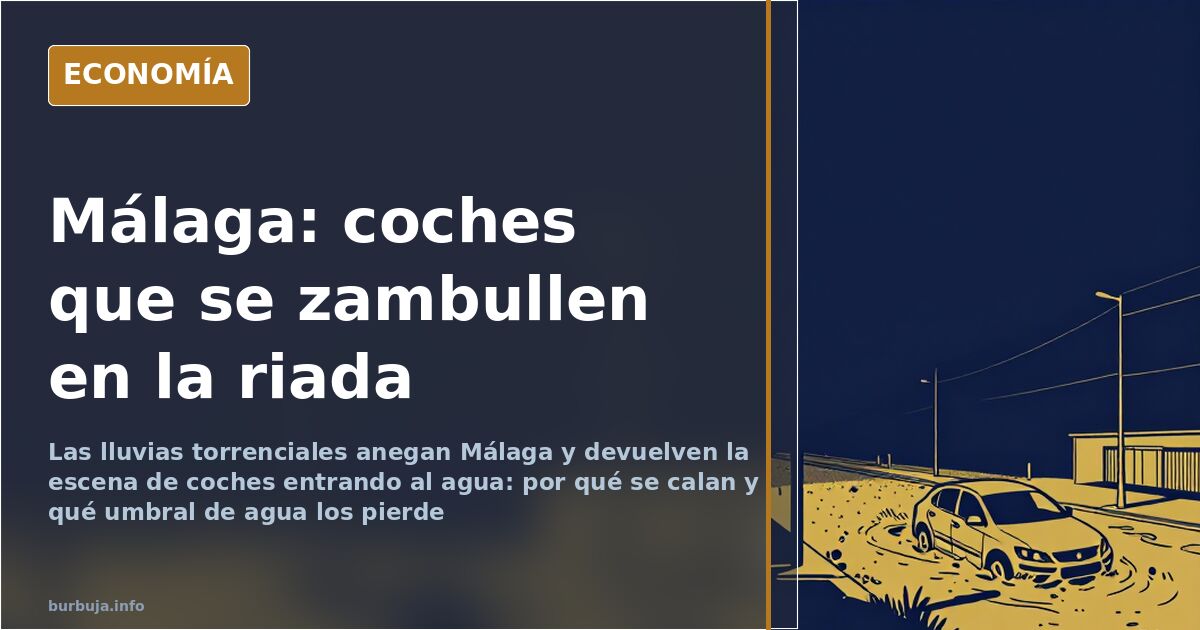
Málaga floods as drivers attempt to cross inundated streets
Heavy rains have once again placed Málaga on the map of flooding incidents, bringing back a scene familiar from Valencia: overflowing riverbeds, avenues turning into cascades, and vehicles attempting to cross where water already covers the road. This is not a new phenomenon, nor will it be the last. What changes little is the debate accompanying each episode: individual recklessness or lack of warning? In between lies a more practical issue—mechanics—which explains why an apparently capable car becomes a floating object in seconds.
What peine in Málaga?
The intense rainfall episode left streets flooded, vehicles floating and swept away by the current, and garages turned into swimming pools. The most circulated scenes share a pattern: a classic compact car—the Seat Panda and similar models—entering a flooded section, drivers flooring the accelerator to avoid stopping, and pedestrians crossing entire avenues with water up to their knees.
The sequence repeats with uncomfortable fidelity. First, the riverbed overflows, then the street becomes a torrent, and finally, someone decides their car can handle it. The result is usually the same: engine stalled, car adrift, and a scene that ends up on video.
Why a car stalls when crossing water
The technical answer is less intuitive than it seems. Crossing quickly is precisely what leaves the driver stranded: water enters through the engine's air intake pipe, obstructs the front entry, and stalls the engine. Crossing slowly, however, avoids the wave that forms in front of the vehicle, which ultimately pushes in more water than necessary.
Another widespread but nuanced idea concerns the exhaust. With the engine running, water does not enter through the exhaust pipe due to the outgoing gas pressure; indeed, it is advisable to keep the RPMs high to maintain that positive pressure. This is why off-road vehicles prepared for river wading antiestéticature elevated air intakes: it is not aesthetic whim, it is physics.
Weight also plays a role. The heavier the vehicle, the better it behaves against the water's push, an argument some use to downplay the benefits of light SUVs: the force of a muddy flood does not care about traction, and a 4x4 exempts you from nothing. The complete calculation, with thresholds and nuances, is longer than fits here.
How much water can a car withstand before being lost?
The numbers involved in these episodes are brutal because they are so narrow. With about 20 centimeters of water, the car is still safe; beyond 40 or 50 centimeters, losing the vehicle is almost certain. In Valencia, with such a short margin, many drivers tried to get their cars out of garages in the first hours, precisely because they were still in time.
At this scale, the difference between saving the car and saying goodbye to it is measured in centimeters. And in the most intense episodes, garages filled up to two meters in height, far above any manageable threshold.
The surprise factor versus prior warning
This is where the narrative splits. Some argue that the flood caught people driving unexpectedly and that the surprise factor was decisive in the first hours, when no one imagined how fast the water would rise. Counter-arguments weigh that alerts were activated in advance and that recklessness admits no excuse.
Both things can be true at the same time, and there lies the knot. A prior warning does not make prudent someone who decides to cross a torrent, but it also does not explain alone why the same scene repeats year after year.
Recklessness and rescue: where analysis gets stuck
The debate intensifies when reaching the topic of rescue. One school of thought holds that assisting those who enter a flood should have consequences, because the mobilized operation is finite and expensive. Another responds that rescue is not optional, and that turning misfortune into guilt is a comfortable way to avoid looking at urban design and risk management.
In between remains an uncomfortable certainty: the same videos, the same small car, the same sloping avenue, and the same absence of clear answers about who should have closed that street beforehand. The matter stays exactly there.
Heavy rains have once again placed Málaga on the map of flooding incidents, bringing back a scene familiar from Valencia: overflowing riverbeds, avenues turning into cascades, and vehicles attempting to cross where water already covers the road. This is not a new phenomenon, nor will it be the last. What changes little is the debate accompanying each episode: individual recklessness or lack of warning? In between lies a more practical issue—mechanics—which explains why an apparently capable car becomes a floating object in seconds.
What peine in Málaga?
The intense rainfall episode left streets flooded, vehicles floating and swept away by the current, and garages turned into swimming pools. The most circulated scenes share a pattern: a classic compact car—the Seat Panda and similar models—entering a flooded section, drivers flooring the accelerator to avoid stopping, and pedestrians crossing entire avenues with water up to their knees.
The sequence repeats with uncomfortable fidelity. First, the riverbed overflows, then the street becomes a torrent, and finally, someone decides their car can handle it. The result is usually the same: engine stalled, car adrift, and a scene that ends up on video.
Why a car stalls when crossing water
The technical answer is less intuitive than it seems. Crossing quickly is precisely what leaves the driver stranded: water enters through the engine's air intake pipe, obstructs the front entry, and stalls the engine. Crossing slowly, however, avoids the wave that forms in front of the vehicle, which ultimately pushes in more water than necessary.
Another widespread but nuanced idea concerns the exhaust. With the engine running, water does not enter through the exhaust pipe due to the outgoing gas pressure; indeed, it is advisable to keep the RPMs high to maintain that positive pressure. This is why off-road vehicles prepared for river wading antiestéticature elevated air intakes: it is not aesthetic whim, it is physics.
Weight also plays a role. The heavier the vehicle, the better it behaves against the water's push, an argument some use to downplay the benefits of light SUVs: the force of a muddy flood does not care about traction, and a 4x4 exempts you from nothing. The complete calculation, with thresholds and nuances, is longer than fits here.
How much water can a car withstand before being lost?
The numbers involved in these episodes are brutal because they are so narrow. With about 20 centimeters of water, the car is still safe; beyond 40 or 50 centimeters, losing the vehicle is almost certain. In Valencia, with such a short margin, many drivers tried to get their cars out of garages in the first hours, precisely because they were still in time.
At this scale, the difference between saving the car and saying goodbye to it is measured in centimeters. And in the most intense episodes, garages filled up to two meters in height, far above any manageable threshold.
The surprise factor versus prior warning
This is where the narrative splits. Some argue that the flood caught people driving unexpectedly and that the surprise factor was decisive in the first hours, when no one imagined how fast the water would rise. Counter-arguments weigh that alerts were activated in advance and that recklessness admits no excuse.
Both things can be true at the same time, and there lies the knot. A prior warning does not make prudent someone who decides to cross a torrent, but it also does not explain alone why the same scene repeats year after year.
Recklessness and rescue: where analysis gets stuck
The debate intensifies when reaching the topic of rescue. One school of thought holds that assisting those who enter a flood should have consequences, because the mobilized operation is finite and expensive. Another responds that rescue is not optional, and that turning misfortune into guilt is a comfortable way to avoid looking at urban design and risk management.
In between remains an uncomfortable certainty: the same videos, the same small car, the same sloping avenue, and the same absence of clear answers about who should have closed that street beforehand. The matter stays exactly there.
Summary of a discussion on Burbuja.info - Foro de economía, actualidad y política., translated from Spanish and reviewed before publication. Read the full discussion (165 replies).
More summaries
-
The Hidden Cost of Cars Lost in the Valencia Flash Floods
For many, losing a car in Valencia's DANA is losing their main asset. The debate over insurance and compensation from the Consorcio de Compensación de Seguros.
-
Valencia suspends classes and raises alert to red for heavy rain
AEMET raises red warning for torrential rain in Valencia, Castellón and Tarragona with accumulations up to 250 l/m² and classes suspended
-
Why Spain isn't having children: three underlying trends
Housing, wages, female education and immigration: the three trends that explain why Spain barely reaches 1.2 children per woman
-
Madrid Pride: €15,000 Public Spending Under Scrutiny
Madrid Pride faces renewed controversy over €15,000 in public funds for adult-oriented content, reigniting the debate on spending.
-
EU bans fluorinated gases in fridges, hitting 80% of supermarkets
The EU Council prohibits fluorinated gases; 80% of supermarkets still use them, requiring costly renovations and closures.
-
Spain's PSOE sues Vox leader Abascal for hate speech
The Spanish Socialist Workers' Party (PSOE) has filed a complaint with the Prosecutor's Office against Santiago Abascal and Vox for alleged hate crimes.