
Madrid's 'jaranafilia': Four-hour queues for burgers
Four-hour waits for burgers and 200-meter lines for fritters turn Madrid into a mass phenomenon dividing locals and visitors.
English · Original discussion in Spanish · Published
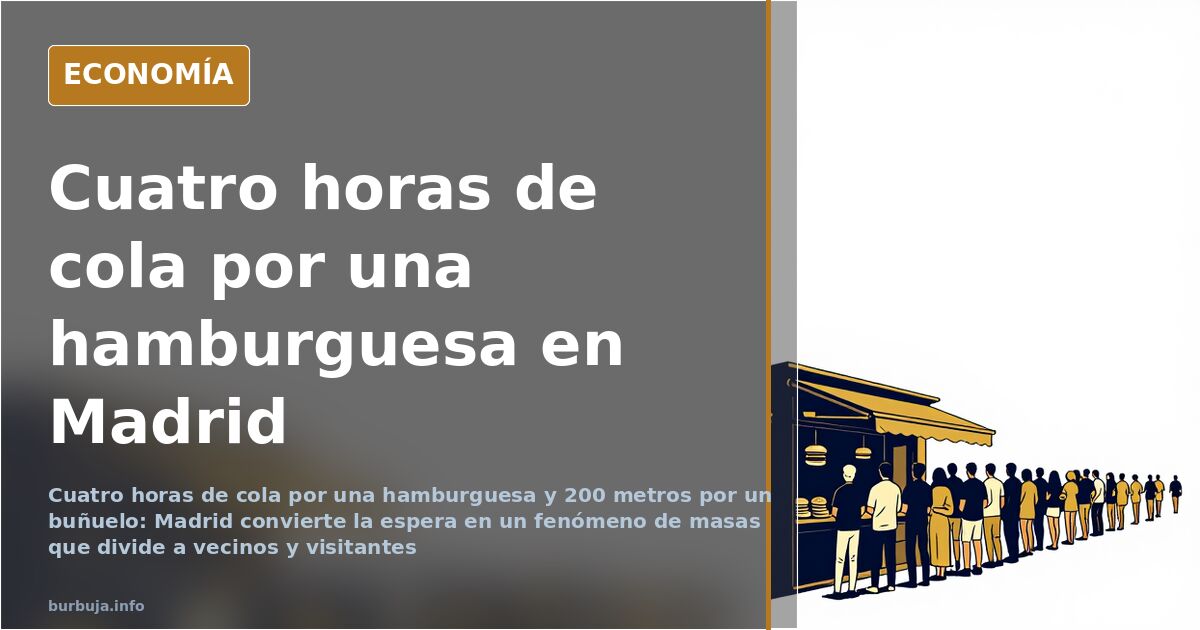
Madrid: four-hour queues for a burger
Four hours of waiting to eat a burger from a food truck. Two hundred meters of line for a cod fritter. Turns of over a hundred people for a squid sandwich. The paradox of central Madrid is not that it is crowded—this has been known for decades—but that, according to the dominant narrative in the debate, many who complain about overcrowding are the same ones who wake up early to get in line. Queues in Madrid have ceased to be a toll and become the spectacle. And the spectacle, every holiday weekend, has an audience.
Why do four-hour queues form in Madrid?
The Immaculate Conception bridge turns the city center into what a recurring description calls a dystopia of waiting. There are night-time queues for the opening of a low-cost Chinese clothing pop-up store; there are lines that go around the block at the capital’s most famous lottery office; there are fights in the queue for David Muñoz’s food truck and altercations in other lines requiring police intervention. The pattern repeats itself: when something becomes trendy, the wait stops being the price and becomes proof that the place is worth it.
The most circulated explanation has a name: jaranafilia (the urge to join the crowd). The imperative need to go where everyone else is, to set up your umbrella next to the only two others on an empty beach, to wake up early to fight for a patch of sand, or to ask those waiting in a queue why they are waiting, just in case you can join them too. One participant notes that something similar happens in Japan: if a venue has no line, it is interpreted as not being worth entering.
The center fills with visitors from other provinces
Not all are foreign tourists. Part of the analysis argues that a significant portion of Christmas crowds are made up of visitors from other provinces: families arriving to shop at department stores or furniture chains, to take children to amusement parks or ice skating rinks. Some cross the country by car—[Beight hours driving[/B]—to see Christmas lights. Others travel to eat at franchises that will soon open in their own cities.
Is Madrid the only city with queues?
No. Seville records packed streets during the December bridge, to the point that its restaurants put up "full" signs. Those defending this view ask why the capital’s center is criticized while Vigo’s or Barcelona’s are not, where tourism and housing prices push residents out equally or more. The quick answer is that Madrid acts as a mirror: everything annoying about the model is projected onto it.
The cost of centrality: rents and neighborhood displacement
The hospitality party comes with a bill. In the capital, rents are cited around 1,500 euros, and some add that public transport cannot absorb the volume on peak days. Those living in the center describe a real city—the one of old—heading toward the periphery: first prices pushed the humblest out of the center; now the appropriation of public space displaces them further. The social fabric that made the city attractive dissolves while franchises multiply.
Nine euros for patatas bravas after an hour and a half wait
The tourist menu has these prices: patatas bravas on Gran Vía for 9 euros and an hour and a half line, Christmas markets with inflated prices, a Black Friday celebrated like a local festival. The exception to the rule is marked by the neighbors themselves, who leave town during these dates. Those who stay suffer from visitors who walk slowly, looking at their phones, shouting without knowing where they are going.
The queue as voluntary prison
The most uncomfortable thesis argues that those who need the crowd do so because they cannot stand themselves; that they have turned holidays into another job and freedom into a prison. The rebuttal is immediate: no one forces anyone to queue; these are people freely choosing—and, it is added, stupidly—how to spend their time. At this point the discussion closes itself, because it is hard to argue against a preference.
With four-hour queues and two-hundred-meter lines, logic would invite fleeing. The opposite happens. What drives so many people to position themselves where no one else fits, precisely on the day when no one else fits?
Four hours of waiting to eat a burger from a food truck. Two hundred meters of line for a cod fritter. Turns of over a hundred people for a squid sandwich. The paradox of central Madrid is not that it is crowded—this has been known for decades—but that, according to the dominant narrative in the debate, many who complain about overcrowding are the same ones who wake up early to get in line. Queues in Madrid have ceased to be a toll and become the spectacle. And the spectacle, every holiday weekend, has an audience.
Why do four-hour queues form in Madrid?
The Immaculate Conception bridge turns the city center into what a recurring description calls a dystopia of waiting. There are night-time queues for the opening of a low-cost Chinese clothing pop-up store; there are lines that go around the block at the capital’s most famous lottery office; there are fights in the queue for David Muñoz’s food truck and altercations in other lines requiring police intervention. The pattern repeats itself: when something becomes trendy, the wait stops being the price and becomes proof that the place is worth it.
The most circulated explanation has a name: jaranafilia (the urge to join the crowd). The imperative need to go where everyone else is, to set up your umbrella next to the only two others on an empty beach, to wake up early to fight for a patch of sand, or to ask those waiting in a queue why they are waiting, just in case you can join them too. One participant notes that something similar happens in Japan: if a venue has no line, it is interpreted as not being worth entering.
The center fills with visitors from other provinces
Not all are foreign tourists. Part of the analysis argues that a significant portion of Christmas crowds are made up of visitors from other provinces: families arriving to shop at department stores or furniture chains, to take children to amusement parks or ice skating rinks. Some cross the country by car—[Beight hours driving[/B]—to see Christmas lights. Others travel to eat at franchises that will soon open in their own cities.
Is Madrid the only city with queues?
No. Seville records packed streets during the December bridge, to the point that its restaurants put up "full" signs. Those defending this view ask why the capital’s center is criticized while Vigo’s or Barcelona’s are not, where tourism and housing prices push residents out equally or more. The quick answer is that Madrid acts as a mirror: everything annoying about the model is projected onto it.
The cost of centrality: rents and neighborhood displacement
The hospitality party comes with a bill. In the capital, rents are cited around 1,500 euros, and some add that public transport cannot absorb the volume on peak days. Those living in the center describe a real city—the one of old—heading toward the periphery: first prices pushed the humblest out of the center; now the appropriation of public space displaces them further. The social fabric that made the city attractive dissolves while franchises multiply.
Nine euros for patatas bravas after an hour and a half wait
The tourist menu has these prices: patatas bravas on Gran Vía for 9 euros and an hour and a half line, Christmas markets with inflated prices, a Black Friday celebrated like a local festival. The exception to the rule is marked by the neighbors themselves, who leave town during these dates. Those who stay suffer from visitors who walk slowly, looking at their phones, shouting without knowing where they are going.
The queue as voluntary prison
The most uncomfortable thesis argues that those who need the crowd do so because they cannot stand themselves; that they have turned holidays into another job and freedom into a prison. The rebuttal is immediate: no one forces anyone to queue; these are people freely choosing—and, it is added, stupidly—how to spend their time. At this point the discussion closes itself, because it is hard to argue against a preference.
With four-hour queues and two-hundred-meter lines, logic would invite fleeing. The opposite happens. What drives so many people to position themselves where no one else fits, precisely on the day when no one else fits?
Summary of a discussion on Burbuja.info - Foro de economía, actualidad y política., translated from Spanish and reviewed before publication. Read the full discussion (162 replies).
More summaries
-
Six women protest fatphobia in underwear on Madrid's Gran Vía
Six women walked Madrid's Gran Vía in underwear to protest fatphobia, sparking debate on respect, desire, and healthcare costs.
-
Gran Vía Suicide Sparks Debate on Media Coverage
A young woman's suicide in Madrid's Gran Vía reignites discussion on media's role. Statistics show 4,000 suicides annually in Spain, predominantly men.
-
Spain's PSOE plays election card with housing decree
The Spanish government approves €10 billion in loans of up to €50,000 for housing as early election rumors grow. The IBEX surged on the news.
-
Seville to charge non-residents for Plaza de España entry
Seville will charge tourists for Plaza de España access, splitting revenue with the Spanish state: 75% for the city and 25% for national treasury.
-
Fernando Delgado, Spanish journalist and writer, dies at 77
Fernando Delgado, a prominent Spanish radio voice and author, has died at age 77 in Faura, Valencia. A key figure of the democratic transition era.
-
Viral Madrid Metro Fight Video Was Nearly a Year Old
A fight recorded nearly a year ago circulated as breaking news in the Madrid Metro, sparking debate over its authenticity.