
Madrid's Cibeles Fountain Lights Up for Ecuador Independence
Cibeles Fountain lit in Ecuadorian colors sparks debate on migration costs, demographics, and public narrative.
English · Original discussion in Spanish · Published
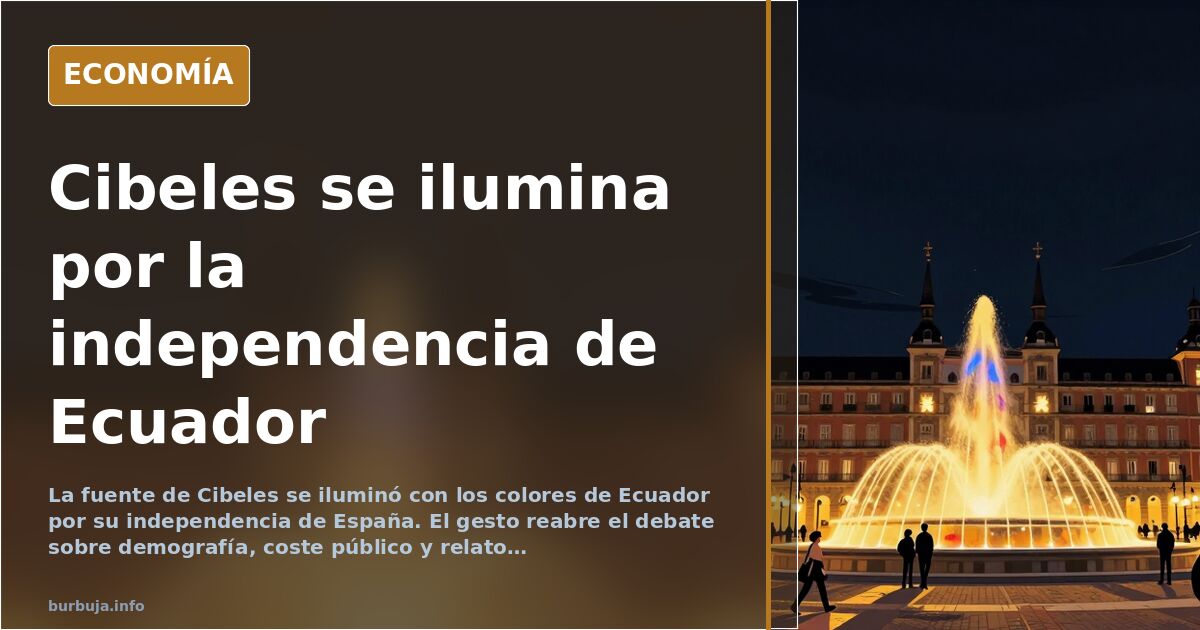
Madrid's Cibeles Fountain Lights Up for Ecuador Independence
Does it make sense for Madrid’s most iconic square to host the commemoration of a country that separated from Spain? The sight of the Cibeles Fountain illuminated in Ecuador’s national colors to celebrate its independence has ignited a discussion far beyond municipal protocol. What began as a complaint about the use of public space has evolved into a debate on demographics, public spending, and the historical narrative of independence.
What Peine at the Cibeles Celebration
The starting point is specific: the Cibeles Fountain was lit with the colors of the Ecuadorian flag to commemorate Ecuador’s independence from Spain. The choice of venue—the symbolic heart of Madrid—is what turned a ceremonial act into a flashpoint. Some argue it is an unnecessary offense; conversely, others contend it is a celebration by a resident foreign community, not a state act against Spain.
The figure hovering over the entire discussion is the 430,000 Ecuadorians residing in Spain cited in the material. That volume turns any institutional gesture toward this community into an issue with political, economic, and symbolic consequences. Lighting a building for a diaspora of thousands is not the same as doing so for a colony of hundreds of thousands.
The Cost Argument: Healthcare, Education, and Votes
Part of the analysis frames the issue in terms of fiscal cost. The reasoning goes like this: if Ecuador had not gained independence, it would be another province today, requiring healthcare, education, social security, and police services, plus voting rights. This hypothesis suggests that independence saved Spain from administering 17 million people.
Opposing this is the counterargument that such savings are fictitious: migration flows have brought part of that population to Spain, shifting the cost from the colony to the metropolis. The debate then moves to public expenditure associated with caring for the migrant population and remittances sent back to the country of origin.
Why Ecuador’s Independence Is Celebrated in Madrid
The most frequently repeated paradox is chronological. Ecuador gained independence from Spain, and two centuries later, a portion of its population emigrates precisely to Spain. This movement is viewed through two opposing lenses: as proof that the home country lacks opportunities, or as evidence that Spain remains an attractive destination.
A demographic datum helps size the phenomenon: Ecuador had barely 1 million inhabitants in 1900 and around 3 million in 1950, figures comparable to Norway or Denmark at the time. Today, Ecuador approaches 20 million, while Norway and Denmark remain around 5 million. This demographic divergence is used to explain the volume of migration.
The Narrative of Independence and Its Two Versions
One current questions the bicentennial narrative itself: the modern State of Ecuador emerged from the separation of Gran Colombia in 1830, not directly from Spain, and that anniversary is not celebrated with the same enthusiasm. This observation suggests the chosen date reflects nation-building more than strict chronology.
The discussion shifts to comparisons with Catalonia, where separatists have commemorated defeats for centuries. The irony of a community that broke away from Spain celebrating its independence on Spanish soil does not go unnoticed.
What Data Says Against the Noise
Beyond the tone, the material offers quantifiable elements. The size of the Ecuadorian community in Spain, the Andean country’s demographic evolution, and the comparison with Nordic nations are the three pillars supporting the analysis. The rest is noise.
The underlying question—whether it makes institutional sense to light up Cibeles to commemorate a country’s independence from Spain—has no technical answer. It is a political decision disguised as protocol. And like any political decision, it allows for pro and con interpretations without either being unreasonable.
In the end, the most honest conclusion is that the controversy says more about those fueling it than about the act itself. Lighting a fountain does not change history. It does, however, change the conversation.
Also available in: Deutsch
Summary of a discussion on Burbuja.info - Foro de economía, actualidad y política., translated from Spanish and reviewed before publication. Read the full discussion (164 replies).
More summaries
-
Madrid lights up Cibeles for Ecuador's independence, sparking fierce debate
Madrid City Hall lights up Cibeles for Ecuador's independence, triggering an intense debate on Burbuja about identity and immigration policy.
-
Madrid Mayor Plans Car-Free Boulevard Between Cibeles and Alcalá Gate
José Luis Martínez-Almeida announces a plan to remove three car lanes in central Madrid, transforming the area into a pedestrian boulevard.
-
Suspect arrested in Madrid over Norwegian woman's death
Anne Mathea Morken, a 22-year-old Norwegian, was found dead on a Torremolinos sidewalk in 2023. A suspect was detained in Madrid in late February.
-
Macron to address France after riots as Paris imposes curfew
Macron addresses France after days of riots as Paris imposes a curfew from 23:00 to 06:00 and bans demonstrations in sensitive areas.
-
Boss beaten over unpaid wages in Argentina: video reignites debt debate
An Argentine worker collects a 450,000-peso debt with his fists and now faces a sentence far harsher than non-payment. The video reignites the deadbeat boss debate.
-
Lefty: from the left hand to the all-purpose political label
The word "lefty" jumps from the left hand to the vote and nobody puts a figure on it: the political label replaces the argument over who pays for the benefits.