
Madrid sees 455 new evangelical churches in five years
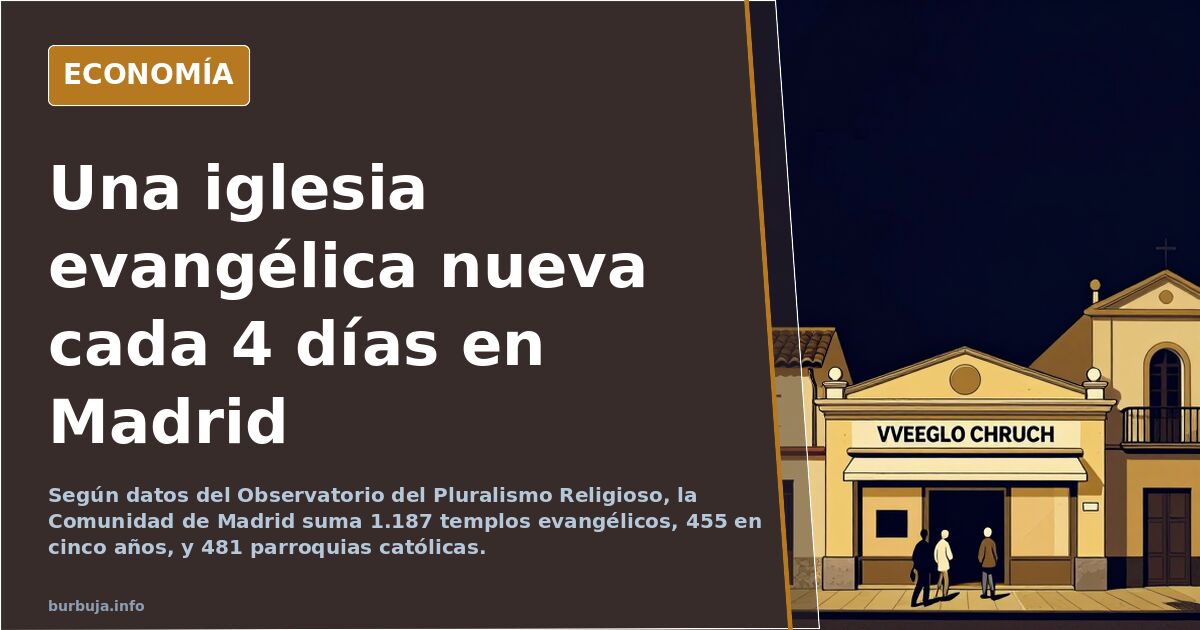
Spain's Madrid region now has 1,187 evangelical temples, up by 455 in five years, compared to 481 Catholic parishes.
English · Original discussion in Spanish · Published
Madrid adds 455 evangelical temples in five years
How many evangelical churches fit into Madrid? According to data from the Observatory of Religious Pluralism cited in the debate, the Community records 1,187 temples, of which 455 have peine in the last five years. An average of one every four days. Meanwhile, Catholic parishes have remained stable: 481. The ratio has inverted, and today there are 2.5 evangelical temples for every Catholic parish. This phenomenon is not a neighborhood anecdote: it is a silent reconfiguration of Madrid's religious map.
A temple in a basement with blue curtains
In the Pilar neighborhood, Pastor Freddy and his vvife, Julia Esparza, organize an event called Healing and Miracles in a basement with blue curtains covering the walls. On them hang pictures depicting the four pillars of their church, Destellos de Gloria Global (Global Flashes of Glory): "Healing, deliverance, filling of the Holy Spirit, and inner healing." The church has been open for five years and, according to reports, is starting to grow. Apostle Jorge Díaz attended the gathering, having arrived from Colombia supposedly to heal the faithful.
The profile of attendees varies. Gabriela, a 42-year-old Ecuadorian, works at a call shop and met Esparza there. Pilar, a waitress, changed congregations after a friend convinced her: "I came one day and felt God's presence," she explains. These are not isolated cases. Most of these churches are evangelical and Pentecostal in character, and their doctrine focuses on divine healings through miraculous oils, promises of economic blessings—especially to those most generous with donations—and, above all, the restoration of the family.
Why they grow faster than Catholic parishes
The growth has an explanation that goes beyond strictly theological reasons. Part of the analysis suggests that these congregations offer something the traditional parish structure does not provide: community. It is not about showing up on Sundays and going home, but rather a space where everyday problems are discussed, where the pastor gets involved, and where social events are organized. In contrast to the distant priest, there is the neighbor who lends a hand.
Some add a demographic factor: the arrival of Latin American population has brought with it a religiosity that was already predominantly evangelical in their countries of origin. Evangelicalism has been growing in Latin America for decades, and this transfer is now being replicated in Madrid. The thesis that there is a cultural Catholic affinity with newcomers is, at least, nuanced by the data.
The business behind the pulpit
The suspicion that not everything is faith runs through the debate. Attention is drawn to a model of cleptoreligion in which donations—with the classic tithe of 10% of salary—support opaque structures. Pastor Freddy, it is said, charges per lecture and looks at yacht catalogs. These are unverified accusations, but the pattern repeats in other cases: a pastor from Chaco who visited Milei is being investigated for money laundering trinc the supposed miracle of pesos converted into dollars.
The comparison with pyramid scheme business models is not gratuitous. To build such a structure requires a considerable volume of believers willing to donate. And here fits the promise of healing and economic prosperity: the more you give, the more you receive.
The religious map that no longer matches
The Catholic Church maintains the same number of parishes from Cañada Real to La Sarracena, covering the entire social spectrum. Evangelical churches, however, are concentrated in the periphery, among large industrial warehouses and small premises. It is a different geography, with a different logic.
The Observatory of Religious Pluralism recorded 732 temples of this type in 2020. Today there are 1,187. A growth of 62% in five years. The question is no longer whether the phenomenon is relevant, but what it implies that Madrid has become, along with São Paulo, one of the world's epicenters of evangelicalism.
In the end, faith moves mountains. And apparently, it also moves the real estate market for industrial premises in Madrid's periphery.
How many evangelical churches fit into Madrid? According to data from the Observatory of Religious Pluralism cited in the debate, the Community records 1,187 temples, of which 455 have peine in the last five years. An average of one every four days. Meanwhile, Catholic parishes have remained stable: 481. The ratio has inverted, and today there are 2.5 evangelical temples for every Catholic parish. This phenomenon is not a neighborhood anecdote: it is a silent reconfiguration of Madrid's religious map.
A temple in a basement with blue curtains
In the Pilar neighborhood, Pastor Freddy and his vvife, Julia Esparza, organize an event called Healing and Miracles in a basement with blue curtains covering the walls. On them hang pictures depicting the four pillars of their church, Destellos de Gloria Global (Global Flashes of Glory): "Healing, deliverance, filling of the Holy Spirit, and inner healing." The church has been open for five years and, according to reports, is starting to grow. Apostle Jorge Díaz attended the gathering, having arrived from Colombia supposedly to heal the faithful.
The profile of attendees varies. Gabriela, a 42-year-old Ecuadorian, works at a call shop and met Esparza there. Pilar, a waitress, changed congregations after a friend convinced her: "I came one day and felt God's presence," she explains. These are not isolated cases. Most of these churches are evangelical and Pentecostal in character, and their doctrine focuses on divine healings through miraculous oils, promises of economic blessings—especially to those most generous with donations—and, above all, the restoration of the family.
Why they grow faster than Catholic parishes
The growth has an explanation that goes beyond strictly theological reasons. Part of the analysis suggests that these congregations offer something the traditional parish structure does not provide: community. It is not about showing up on Sundays and going home, but rather a space where everyday problems are discussed, where the pastor gets involved, and where social events are organized. In contrast to the distant priest, there is the neighbor who lends a hand.
Some add a demographic factor: the arrival of Latin American population has brought with it a religiosity that was already predominantly evangelical in their countries of origin. Evangelicalism has been growing in Latin America for decades, and this transfer is now being replicated in Madrid. The thesis that there is a cultural Catholic affinity with newcomers is, at least, nuanced by the data.
The business behind the pulpit
The suspicion that not everything is faith runs through the debate. Attention is drawn to a model of cleptoreligion in which donations—with the classic tithe of 10% of salary—support opaque structures. Pastor Freddy, it is said, charges per lecture and looks at yacht catalogs. These are unverified accusations, but the pattern repeats in other cases: a pastor from Chaco who visited Milei is being investigated for money laundering trinc the supposed miracle of pesos converted into dollars.
The comparison with pyramid scheme business models is not gratuitous. To build such a structure requires a considerable volume of believers willing to donate. And here fits the promise of healing and economic prosperity: the more you give, the more you receive.
The religious map that no longer matches
The Catholic Church maintains the same number of parishes from Cañada Real to La Sarracena, covering the entire social spectrum. Evangelical churches, however, are concentrated in the periphery, among large industrial warehouses and small premises. It is a different geography, with a different logic.
The Observatory of Religious Pluralism recorded 732 temples of this type in 2020. Today there are 1,187. A growth of 62% in five years. The question is no longer whether the phenomenon is relevant, but what it implies that Madrid has become, along with São Paulo, one of the world's epicenters of evangelicalism.
In the end, faith moves mountains. And apparently, it also moves the real estate market for industrial premises in Madrid's periphery.
Also available in: Deutsch
Summary of a discussion on Burbuja.info - Foro de economía, actualidad y política., translated from Spanish and reviewed before publication. Read the full discussion (150 replies).
More summaries
-
Two theories behind a possible snap election in Spain
Speculation grows over a snap election: gas would rise 50% and oil hovers around $100, according to calculations circulating in the debate.
-
Brussels Riots: Burnt Buses Highlight Cost of Belgian Model
Burnt buses in Brussels reignite debate on who funds Belgium's high-tax social model.
-
Navarra's PSOE grants €1.4m to Basque media, Diario de Noticias gets €46k
Call BDNS 896538 distributes €1,446,000 among 27 recipients. Ttipi-Ttapa Fundazioa receives €221,995.98 and Zeroa Multimedia, publisher of Diario de Noticias, gets €46,511.97.
-
Franco's Economy: The Myth of a Better Life Returns
In 2026, the debate on Franco's economic legacy resurfaces, citing four million homes and repression amid AI fears.
-
Musk's Wealth Myth: Viral Video Exposes Liquidity Reality
Less than 0.1% of Elon Musk's fortune is cash. A fake video humiliating a host for demanding donations reveals the paradox of illiquid wealth.
-
Spanish flamenco star Rafael Amargo detained in Madrid
El Mundo reports the arrest of flamenco dancer Rafael Amargo and his partner after a late-night altercation at their Madrid home.