
Madrid Retiro hits record 100.1mm rain; transport chaos
Retiro recorded 100.1mm, a series high since 1887, while Barajas saw 73mm. Heavy rains disrupted Madrid transport and sparked climate debates.
English · Original discussion in Spanish · Published
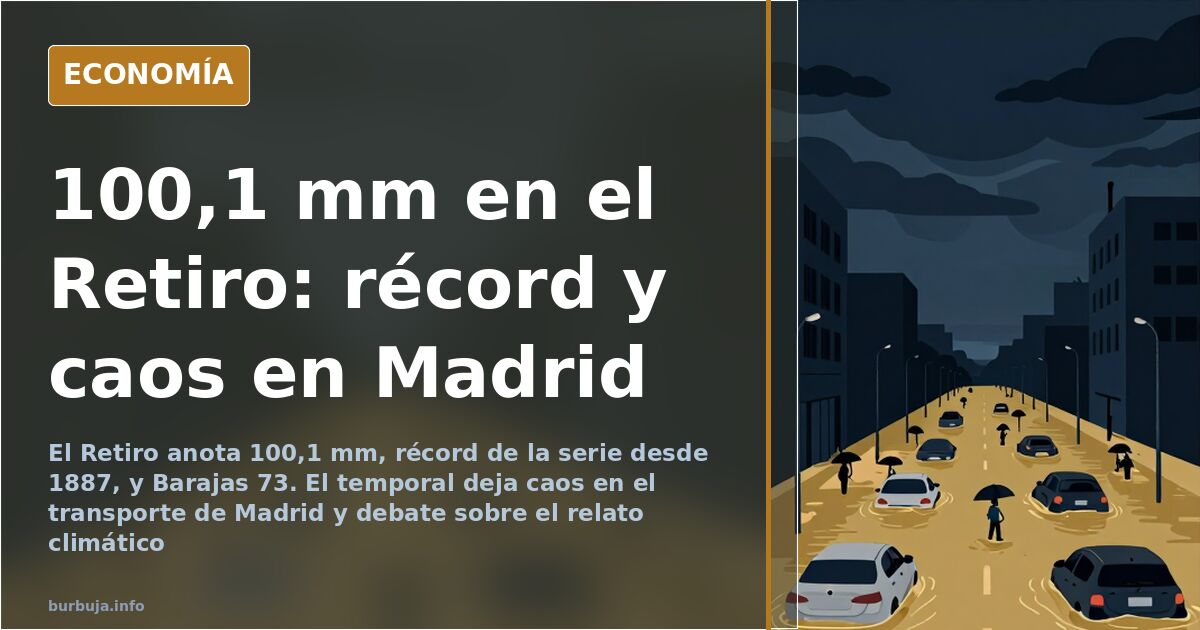
Madrid's Retiro records 100.1mm rainfall, reigniting climate debate
One hundred point one millimeters. According to data cited in the thread, this is the figure recorded at the Retiro observatory: one hundred liters per square meter of intense rain falling on Madrid in a single day. In Barajas, 73 liters fell. Amidst these records, the city gridlocked: public transport failed across the Moncloa area, reaching destinations required countless detours, and the Cercanías network became a lottery. The official explanation was the rain. Public doubt remains whether rain alone explains what peine or if it merely masks longstanding issues.
With two controversies attached—whether the data is truly historic and if anyone exploited the puddle to push a specific narrative—the day leaves a simple question hanging: has it rained more than ever, or are we just reporting it better? The answer depends on who you ask.
How much rain fell in Madrid and which record was broken
The key data point is from Retiro, according to records discussed in the thread: 100.1 mm, exceeding the previous maximum of the historical series, which begins in 1887. The record surpassed was 87 liters on September 21, 1972. This is not an October record, but the highest for the entire series. This nuance—the complete series rather than just the month—is what turns the day into something more than a mere nuisance shower.
In Barajas, the station recorded 73 liters, a figure that would justify headlines on its own. Another matter is how it is interpreted. One view takes it as confirmation that the climate has gone off the rails; the opposing view recalls that in wet Spain, this used to be normal. A participant argues that in Galicia in the late last century, around one hundred days like this occurred annually and no one wrote about it. The comparison unsettles both sides.
Why Madrid's public transport gridlocked
The short version is that it rained heavily and the system couldn't cope. The long version starts that same morning: transport failures in the Moncloa zone and a labyrinthine feeling for anyone moving through the northwest of the capital. Someone who has used Madrid's public transport since the 1980s claims never to have seen anything similar and, above all, does not recall such chaos with comparable rainfall.
From this arises the most uncomfortable reproach: that rain is a convenient excuse to avoid discussing maintenance, drainage, or management. It is a known pattern. When infrastructure fails, the weather report arrives before any audit.
Leaves, sewers, and street design
Part of the diagnosis points to the mundane: in autumn, fallen leaves clog drains, and with blocked inlets, water has nowhere to go. There are no millions of euros to collect leaves, goes the argument, so water ends up where it shouldn't. Added to this is suspicion that many recent roads were designed with drainage criteria that, when tested, cannot withstand even light rain.
The diagnosis even extended to trees: pines shed needles year-round, have large stature, and trunks that grow twisted without low branches, so when wind topples them, the damage is massive; deciduous trees, by losing leaves, create less sail effect and let light pass. No one disputes the downpour. What is disputed is what is planted beneath.
Weather control PDF and drought as business
Then there is the conspiratorial layer, which is never missing. A document from the US DTIC repository titled Operational Defenses through Weather Control in 2030 circulated, used as evidence—without any—that someone manipulates the weather. Another current holds that everything serves to sell climate change: rain, drought, snow, whatever falls. The most elaborated version is economic. If the country is left without water, agricultural exports and tourism fall, adjustment is justified, and what remains is privatized. It is an unverified hypothesis, and should be treated as such.
What is striking is not the theory. It is that the precipitation record, instead of closing the discussion, peine it with more noise than before.
The 1990s precedent no one wants to repeat
To gauge whether this is exceptional or simply old news, look back. In the mid-1990s, a storm discharged with such intensity that train tracks and platforms flooded, and the distance between the station curb and the train was enough to leave passengers soaked as if they had exited a pool fully clothed. The M-30 ring road collapsed because, according to remembered accounts, those responsible for opening the Manzanares River gates were stuck in traffic, causing the river to overflow.
That did not happen this time. That is precisely where the analysis stalls. With an absolute precipitation record at Retiro, the system held up better than in episodes with fewer liters. If the problem were only the water, the math doesn't add up. If the problem is something else, no one has yet provided the number to prove it.
One hundred point one millimeters. According to data cited in the thread, this is the figure recorded at the Retiro observatory: one hundred liters per square meter of intense rain falling on Madrid in a single day. In Barajas, 73 liters fell. Amidst these records, the city gridlocked: public transport failed across the Moncloa area, reaching destinations required countless detours, and the Cercanías network became a lottery. The official explanation was the rain. Public doubt remains whether rain alone explains what peine or if it merely masks longstanding issues.
With two controversies attached—whether the data is truly historic and if anyone exploited the puddle to push a specific narrative—the day leaves a simple question hanging: has it rained more than ever, or are we just reporting it better? The answer depends on who you ask.
How much rain fell in Madrid and which record was broken
The key data point is from Retiro, according to records discussed in the thread: 100.1 mm, exceeding the previous maximum of the historical series, which begins in 1887. The record surpassed was 87 liters on September 21, 1972. This is not an October record, but the highest for the entire series. This nuance—the complete series rather than just the month—is what turns the day into something more than a mere nuisance shower.
In Barajas, the station recorded 73 liters, a figure that would justify headlines on its own. Another matter is how it is interpreted. One view takes it as confirmation that the climate has gone off the rails; the opposing view recalls that in wet Spain, this used to be normal. A participant argues that in Galicia in the late last century, around one hundred days like this occurred annually and no one wrote about it. The comparison unsettles both sides.
Why Madrid's public transport gridlocked
The short version is that it rained heavily and the system couldn't cope. The long version starts that same morning: transport failures in the Moncloa zone and a labyrinthine feeling for anyone moving through the northwest of the capital. Someone who has used Madrid's public transport since the 1980s claims never to have seen anything similar and, above all, does not recall such chaos with comparable rainfall.
From this arises the most uncomfortable reproach: that rain is a convenient excuse to avoid discussing maintenance, drainage, or management. It is a known pattern. When infrastructure fails, the weather report arrives before any audit.
Leaves, sewers, and street design
Part of the diagnosis points to the mundane: in autumn, fallen leaves clog drains, and with blocked inlets, water has nowhere to go. There are no millions of euros to collect leaves, goes the argument, so water ends up where it shouldn't. Added to this is suspicion that many recent roads were designed with drainage criteria that, when tested, cannot withstand even light rain.
The diagnosis even extended to trees: pines shed needles year-round, have large stature, and trunks that grow twisted without low branches, so when wind topples them, the damage is massive; deciduous trees, by losing leaves, create less sail effect and let light pass. No one disputes the downpour. What is disputed is what is planted beneath.
Weather control PDF and drought as business
Then there is the conspiratorial layer, which is never missing. A document from the US DTIC repository titled Operational Defenses through Weather Control in 2030 circulated, used as evidence—without any—that someone manipulates the weather. Another current holds that everything serves to sell climate change: rain, drought, snow, whatever falls. The most elaborated version is economic. If the country is left without water, agricultural exports and tourism fall, adjustment is justified, and what remains is privatized. It is an unverified hypothesis, and should be treated as such.
What is striking is not the theory. It is that the precipitation record, instead of closing the discussion, peine it with more noise than before.
The 1990s precedent no one wants to repeat
To gauge whether this is exceptional or simply old news, look back. In the mid-1990s, a storm discharged with such intensity that train tracks and platforms flooded, and the distance between the station curb and the train was enough to leave passengers soaked as if they had exited a pool fully clothed. The M-30 ring road collapsed because, according to remembered accounts, those responsible for opening the Manzanares River gates were stuck in traffic, causing the river to overflow.
That did not happen this time. That is precisely where the analysis stalls. With an absolute precipitation record at Retiro, the system held up better than in episodes with fewer liters. If the problem were only the water, the math doesn't add up. If the problem is something else, no one has yet provided the number to prove it.
Also available in: Deutsch
Summary of a discussion on Burbuja.info - Foro de economía, actualidad y política., translated from Spanish and reviewed before publication. Read the full discussion (139 replies).
More summaries
-
Online thread challenges climate change consensus and debate refusal
A forum thread questions climate science with five key points on CO2, correlation, lockdowns, and the refusal to debate.
-
France Proposes Minimum Price for Low-Cost Flights in the EU
France pushes for a minimum ticket price and an aviation levy in the EU, arguing that 10-euro fares are unsustainable during the ecological transition.
-
Riots in French schools: fires and attacks
Fires in French schools, teachers attacked and blockades spreading to Belgium. The unrest is attributed to the education strike and radical groups.
-
Latin American Overqualification in Europe: Myth or Reality?
Claims that Latin Americans are overqualified for Europe clash with low global university rankings. Is it a real issue or an illusion?
-
Nurse Killed by Convicted Murderer She Loved in Missouri
A 37-year-old nurse brought a convicted murderer home, leading to her and her daughter's deaths. The case reignites debate on hybristophilia.
-
Alicante hospitality sector faces worst July in years
Alicante restaurateurs report a 7-8% sales drop and soaring prices. The middle class can no longer afford €40 paella.