
Madrid Plans Split School Day and Lower Secondary in Primary Schools
Madrid proposes split school days and lower secondary education in primary schools, impacting over 400 students with costs up to €200 monthly.
English · Original discussion in Spanish · Published
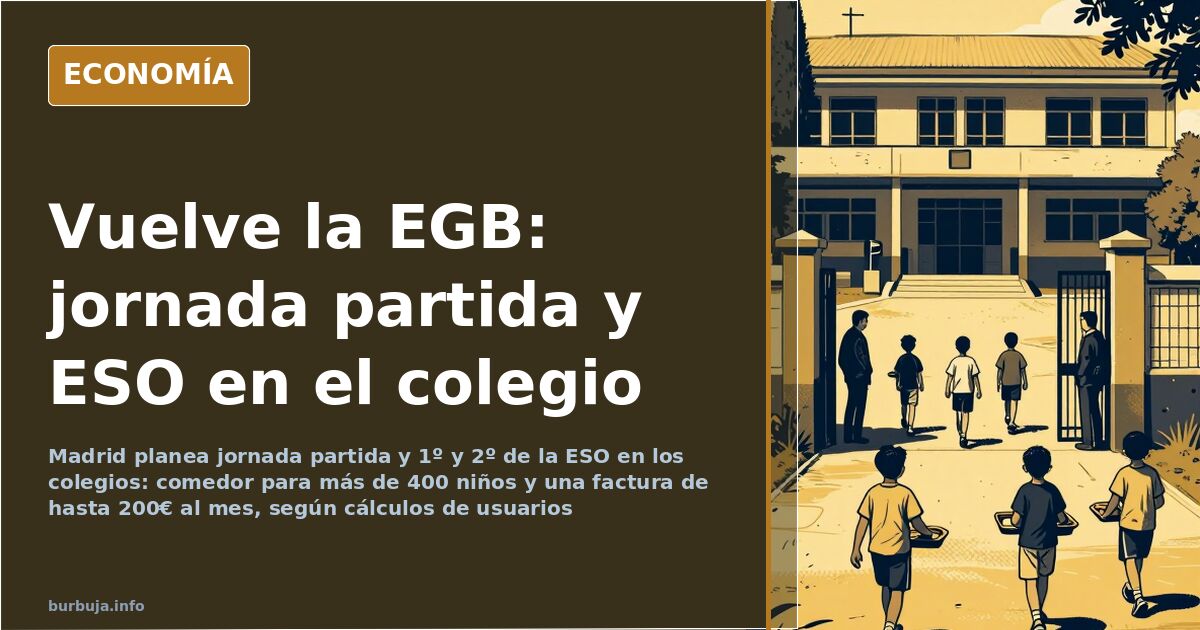
Madrid Plans Split School Day and Lower Secondary in Primary Schools
Does it make sense to keep a 12-year-old in the same building until they are 16, with a split schedule, lunch service, and afternoon classes? The plan proposed by the Community of Madrid for new infant and primary schools says yes: a split school day, incorporating 1st and 2nd year of ESO (lower secondary education)—formerly known as 7th and 8th grade of EGB—into these centers instead of high schools, with the stated goal of extending this model to existing schools. The official argument is to "protect" minors. The real argument, reading between the lines, is different: keeping students under the roof of primary teachers for two more years before releasing them into secondary education.
The measure touches three things at once, none minor: the schedule, the educational stage, and the organization of centers. In Madrid, full regional competencies on organizational aspects mix with a curriculum set by state organic law that the community cannot rewrite, only expand. That is, you can move the student to another building, but not change what they learn.
What Exactly Changes with the Return of EGB in Madrid
The core of the plan is simple to state and complicated to execute. New infant and primary schools are born with a split schedule, morning and afternoon. The first two courses of ESO are incorporated into them, so the student does not change center at age 12. The confessed intention is to replicate the scheme in existing centers, which multiplies the scope.
There is a detail lost in the headline that changes the calculation: the split schedule forces hundreds of children who previously went home to eat at the center. Going from 50 or 100 diners to more than 400 is not an administrative adjustment. It requires doubling canteen facilities and staff, translating into a monthly bill for families that, according to calculations circulating online, ranges from 150 to 200 euros per child for lunch and midday care. To this are added extracurricular activities and, in many cases, private tutoring. The work-life balance savings some celebrate are paid for by others.
Split vs. Continuous Schedule: A Conflict Where No One Wins
Here the issue stops being pedagogical and becomes a clash of lifestyle models. One block defends the continuous schedule because the child rests more, eats at home, has free time, can play sports or study without arriving exhausted at five in the afternoon. The other block responds that millions of Spaniards work split shifts and do not understand why the education system should be an exception, nor why an 11-year-old would have to wake up at seven and eat at three in the afternoon just so one group maintains its privileged schedule.
The irony is that the split schedule already exists de facto for many families: those who pay for canteens and extracurriculars to avoid picking up the child at noon. The change does not create that reality; it institutionalizes it. And along the way, the bill, which was previously voluntary, becomes structural.
Educational Level: LOGSE, EGB, and Shrinking Textbooks
The discussion quickly drifts toward the usual ground: whether EGB worked and ESO never did. The comparison relies on domestic data difficult to refute: textbooks from two years ago were used later as review material because content had been diluted course by course. Anyone who studied with older siblings' manuals knows what this means.
The dominant thesis is that LOGSE peine the door to keeping everyone in the classroom until 16, and that to ensure no one failed, standards were lowered. The result, according to this view, is a system that graduates people without foundations, with spelling errors that once cost points and today are not penalized even in a master's thesis. The counter-argument is that EGB society was not this one: fewer students, less diversity in the classroom, more social pressure to study or start working. Comparing both worlds without that context is unfair.
The Uncomfortable Argument: Separating Those Who Fall Behind
Underneath the pedagogical debate lies a harsher one that almost no one wants to put in writing. If the first two years of ESO stay in primary school, the disruptive or repeating student stays too. And the one who reaches secondary education arrives already filtered. Some say it bluntly: the measure serves so that those who do not keep pace do not contaminate high school classrooms, and so that at 16 they enter the labor market without having gone through ESO.
That reasoning clashes with economic reality: education is compulsory until 16 and at that age practically no one works. Previously, at 14, those unfit for studying started working and covered the labor demand missing today in hospitality and trades. Now they remain in the system until 16 and, in many cases, until 18 or 20, in diversification tracks or vocational cycles that do not always lead to jobs.
Who Pays the Bill for Work-Life Balance
The measure is sold as help for working families. It is true that there are parents who need to drop off the child at eight and pick them up at five, and the split schedule solves their lives. It is also true that this service is not free: canteens, monitors, extracurriculars, and filler activities come out of the pocket of those who use them, and those who do not use them end up paying anyway because the schedule leaves no alternative.
The reverse side is the group of parents who do have time or grandparents and lose the option of having the child at home at noon. The continuous schedule was not a privilege for teachers; it was also the freedom to organize the child's afternoon however each family wished. With the new model, that freedom narrows.
In the end, the question is not whether EGB was better. The question is whether one can reconstruct an educational system from forty years ago in a society that no longer resembles it, with the same schedule, the same students, and half the authority. One can try. What one cannot do is call it protection and pass the bill to the parents.
Also available in: Deutsch
Summary of a discussion on Burbuja.info - Foro de economía, actualidad y política., translated from Spanish and reviewed before publication. Read the full discussion (104 replies).
More summaries
-
School reprimand for racism in Madrid sparks discipline debate
A school disciplinary report over a racist comment at a Madrid high school reignites debates on teacher authority and double standards.
-
Death wish for Sánchez found on Madrid Christmas tree
A card on the Real Casa de Correos tree requested Pedro Sánchez's death, prioritizing it over health and happiness.
-
Madrid triggers Level 1 ES-Alert, which users cannot disable
Madrid activated the ES-Alert on September 3 at level 1, a setting users cannot turn off. The siren sounded at 14:26 after AEMET issued a red warning.
-
Madrid Protest Camp Robberies Spark Debate Over Security
Activists camping in Madrid's Puerta del Sol report thefts of electronics, while the assembly avoids naming suspects.
-
Le Pen: foreign workers who lose their job should leave France
Marine Le Pen argues that foreigners working in France should return to their home country if they lose their job. It is her take on the principle of labour migration.
-
Sahrawi candidate caught asking for weapons for Hamas in Spain
A tweet attributes to Tesh Sidi, number 2 on the Frente Amplio list, an internal message about asking for weapons for Hamas. Here is what is known and what is not.