
Madrid metro turns into street market and concert hall, commuters say
Street vending, loud music and overcrowding are making the Madrid metro a daily ordeal for many passengers. Complaints about lack of security and civility are mounting.
English · Original discussion in Spanish · Published
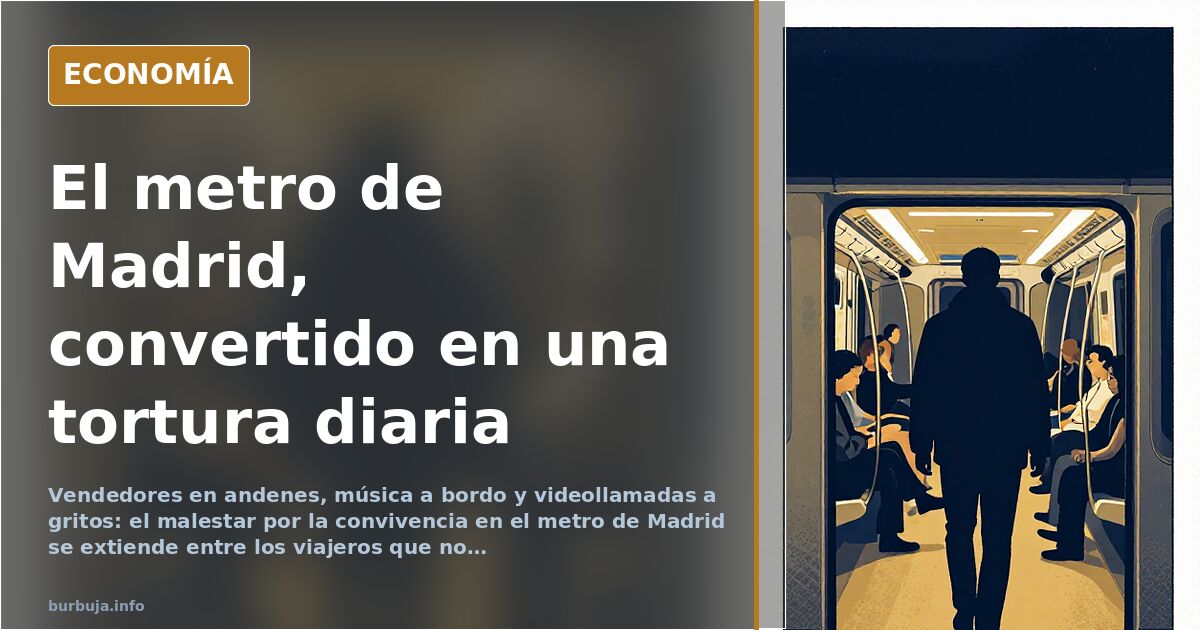
The Madrid metro has become a street market and a concert hall
Riding the metro in Madrid has become an experience that many users describe as torture. The combination of street vending, loud music, shouted video calls and overcrowding has led some people to stop using the subway altogether. At stations such as Lavapiés or Nueva Numancia, the presence of unlicensed street sellers and buskers makes it hard for commuters to get around, according to residents' complaints. The situation has generated intense discontent among passengers, who are demanding a greater security presence and effective measures.
Street vending and music: an everyday occurrence on the metro
Street vending on the Madrid metro is nothing new, but it has intensified. At Lavapiés, unlicensed sellers occupy the platforms and make it difficult to board and exit the trains. On top of that comes unauthorised live music, from bachata to dance, which turns the journey into an unwanted show. Commuters complain that Madrid Metro's rules are ignored and that security cameras do nothing to deter these practices. The sense of impunity is widespread.
The impact on users' mental health
The stress caused by the metro environment has led some people to give it up entirely. One participant says he has not taken the metro for over a month and that his mental health has improved noticeably. Constant exposure to noise, crowds and antisocial behaviour takes a psychological toll. The perception that the metro has become a chaotic space, where basic rules of coexistence are not respected, fuels that discontent.
A social debate: is the metro a reflection of the city?
The state of the metro is seen as a symptom of the city's overall condition. Some argue that Madrid has turned into a zoo, citing incidents such as electric scooters speeding along pavements. City Hall's management is criticised, with claims that the priority seems to be attracting tourism and business while residents' quality of life is neglected. Others argue that the metro has always been a diverse space and that the problem is not diversity but the lack of civility and authority.
What can be done to restore order on the metro?
Proposals range from increasing police presence to awareness campaigns. However, there is no consensus on how effective these measures would be. Some believe the solution lies in fining offenders, while others think the problem is structural and requires a profound change in how the city is run. The lack of official data on metro incidents makes it hard to assess the true scale of the problem.
In short, the Madrid metro has become a barometer of urban discontent. How much discomfort are we willing to normalise as part of the price of living in a big city?
Also available in: Deutsch
Summary of a discussion on Burbuja.info - Foro de economía, actualidad y política., translated from Spanish and reviewed before publication. Read the full discussion (13 replies).
More summaries
-
IMF: Spain lags in productivity despite EU funds
The IMF identifies Spain as the only major eurozone economy losing productivity since 2018, despite receiving €100 billion in European funds.
-
The astrology that predicted social unrest and failing trains
The astrology that warned of social upheaval and failing trains: can a birth chart anticipate a server collapse in London or a derailment in Spain?
-
Partycracy's 'slaves' are scum who deserve to die: abusive rhetoric with no facts
A message mixing sabotage accusations, insults and slurs against an entire country shows the degradation of political language. No data to back it up.
-
Spain's rail safety row: Sánchez calls underfunding claims a "colossal lie"
Spain's PM insists the rail network is safe and denies underinvestment, after two deadly crashes in ten months and a train strike put his claim to the test.
-
Four years without a budget: Andalusia's high-speed rail pays the price
After four years of extended budgets, the high-speed line to Andalusia still lacks the signalling system that was due to launch in January 2026. Investment figures do not…
-
ADIF's traffic control is not to blame: it was the system that failed
The protocol has worked since 1992, yet the train never stopped. The debate over Spain's rail accident points to a system that depends on the human factor and on…