
Madrid Metro: the viral stage for a marriage proposal
A marriage proposal on the Madrid Metro goes viral and sparks a debate about wedding costs, housing and the role of the underground as a social barometer.
English · Original discussion in Spanish · Published
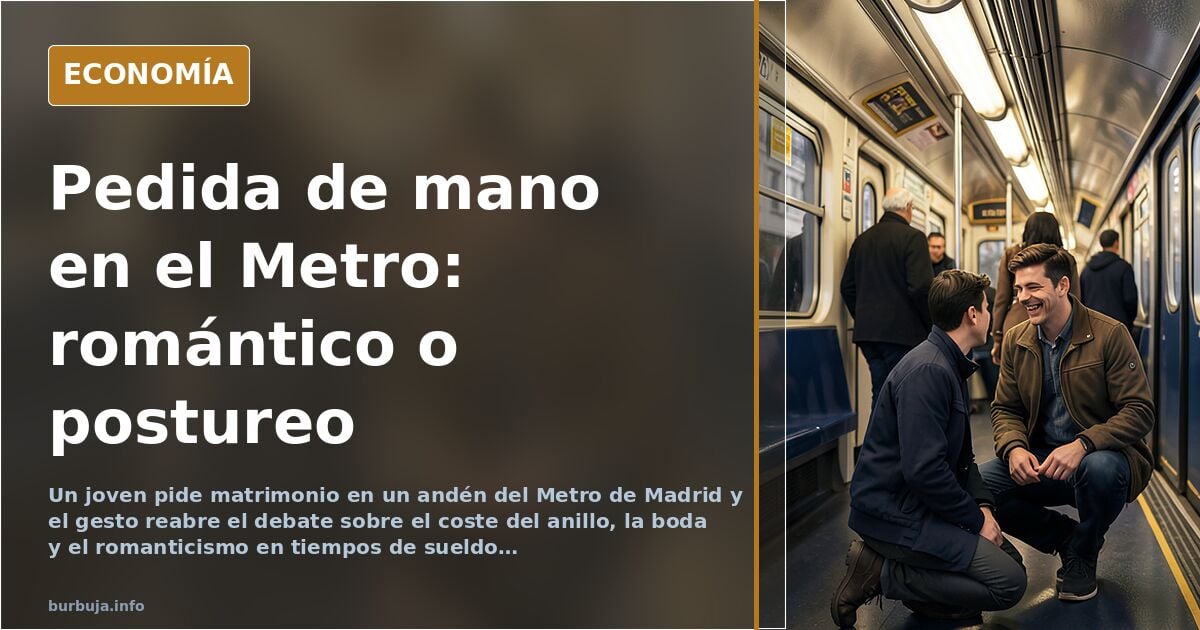
A marriage proposal on the Madrid Metro ends in an economic debate
How much does romance cost at rush hour? A video circulating on social media shows a young man proposing to his partner on a platform of the Madrid Metro, apparently in a central station with a classic vaulted ceiling. The scene, celebrated by some and ridiculed by others, has turned into a discussion that goes far beyond the ring: from the cost of the wedding to the role of public transport as a showcase for a city that is changing.
The gesture, according to those who have commented on it, is nothing new. Madrid's underground has always been a snapshot of the region: once full of office workers with briefcases, today of a more diverse population. The anecdote serves to talk about who rides the metro, who pays for the party and what lies behind a moment designed to go viral.
The real cost of a marriage proposal
A ring, a song and a staged performance can swallow an entire month's salary, according to a calculation doing the rounds in the debate. That is the first takeaway from the episode: the spending that comes with a marriage proposal is rarely accounted for, least of all when it becomes social media content. The question hanging in the air is who picks up the bill for the wedding afterwards.
The backdrop doesn't help. With an average wage that, in purchasing power terms, has been flat for decades, spending a month's salary on a romantic performance is an economic decision, not just an emotional one. And the chosen setting — a platform where the ride costs 1.50 euros — adds a layer of irony: the most expensive romance is on display in the cheapest infrastructure.
The Metro as Madrid's social barometer
Madrid's underground concentrates what the city is and what it was. Its carriages bring together the old-school office worker and the newly arrived worker, and that mix has become a subject of analysis. Some argue the metro is now a geopolitical test at rush hour; others simply see a snapshot of the labour market, where foreign labour fills sectors that native workers no longer cover.
Demographics are the backdrop. An ageing population, with birth rates at record lows, has pushed the Spanish state to import contributors rather than fix the underlying problem, according to one participant in the debate. That patch holds as long as the economy grows; with a serious contraction, the story changes. The marriage proposal, in that context, is an anecdote that opens up a far more uncomfortable discussion.
From the platform to housing: the thread nobody wants to pull
The price of housing emerges as the real limit of the model. An ordinary flat costs between ten and twelve annual salaries, and every new tenant pushes rents up another notch. The metro scene, romantic to some, reminds others that many young people cannot afford independence, let alone the wedding they celebrate.
The conversation drifted towards hopelessness: people aged 35 to 45 who studied and worked without ever managing to buy a home, older people with pensions recalculated downwards, and young people who have done the maths and found the numbers don't add up. Seen that way, the proposal on the platform is a gesture of optimism in a country that regards itself with suspicion.
In the end, the question is not whether the groom paid for the ring by card or in cash. It is how many of those applauding the video could afford the same gesture without flinching at the end of the month.
Also available in: Deutsch
Summary of a discussion on Burbuja.info - Foro de economía, actualidad y política., translated from Spanish and reviewed before publication. Read the full discussion (46 replies).
More summaries
-
Social Tension Over Latin American Presence in Madrid Metro
Analysis of social friction caused by the visible presence of Latin American migrants in central Madrid metro stations.
-
Forum user claims Alvise could cost PP and Vox up to 10 seats
A forum poster argues Alvise Pérez will win no seats of his own but could cost the PP and Vox up to ten seats in Spain's general election. Some doubt he can repeat his 800,000 votes.
-
Pensioner vote in Spain and the maths that debunks the polls
Spain's pensioner vote could triple the PP's tally and leave Vox in third place, according to circulating calculations. The D'Hondt law explains why the polls…
-
Branded aspirin sells without prescription, generic requires one
A user reports that branded aspirin is sold without a prescription while the generic requires one; Spain's AEMPS decides presentation by presentation, and the consumer pays the…
-
Adif: the firewall Spain's government is preparing to save Puente
Spain's government is weighing the sacrifice of Adif's chairman to shield minister Óscar Puente and Pedro Sánchez after the Urda rail crash, with four technical failures reported before the collision.
-
Spain's transport minister posted on X minutes after deadly train crash
Óscar Puente's tweet about 'the moral superiority of the left' went up at 09:08, 14 minutes after the crash in Urda (Toledo), which left 46 dead.