
Pensioner vote in Spain and the maths that debunks the polls
Spain's pensioner vote could triple the PP's tally and leave Vox in third place, according to circulating calculations. The D'Hondt law explains why the polls…
English · Original discussion in Spanish · Published
Pensioner vote in Spain and the maths that debunks the polls
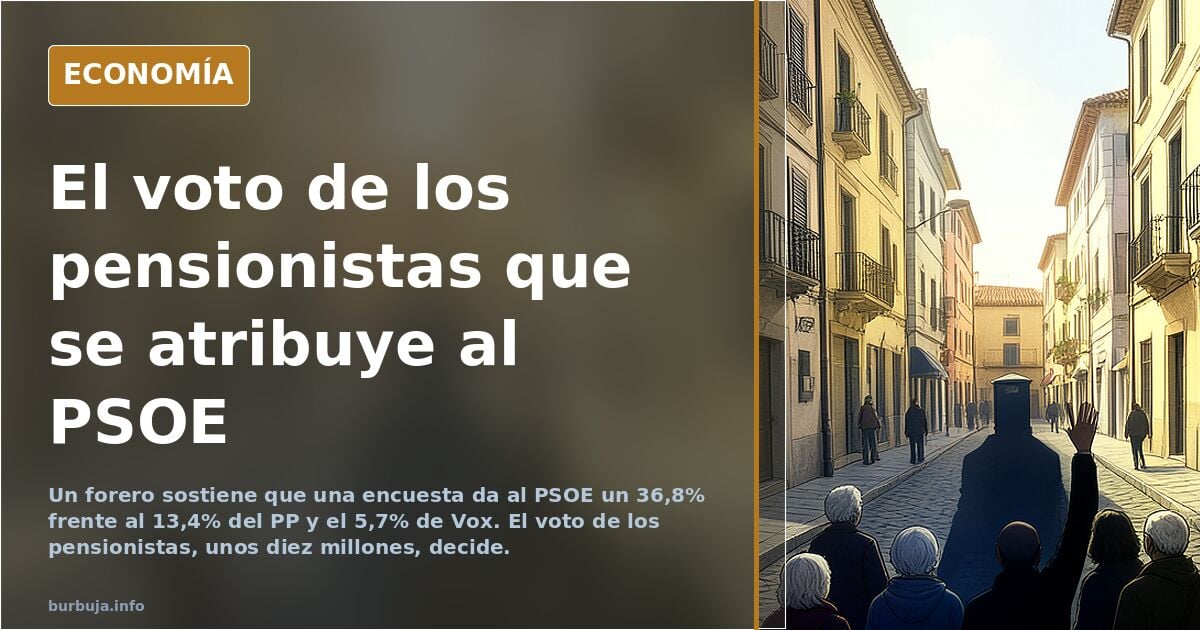
A poll that asks "who would you vote for tomorrow?" is not worth the same as one that asks about previous voting behaviour, party loyalty and the real likelihood of actually turning up at the ballot box. That is the thesis that opens this analysis: the published surveys underestimate the weight of the pensioners' captive vote, a bloc of around ten million people who, according to the calculations doing the rounds, would cast three times as many ballots as the PP and leave Vox in a near-irrelevant third place. The PSOE with 36.8% of the vote, the PP with 13.4% and Vox with 5.7%. These figures do not square with the narrative of conventional polls, yet they do fit the electoral sociology of an ageing country.
The diagnosis is not new, but the tone has grown harsher. Some argue that the pension system is a ticking time bomb that will ruin an entire generation of young people while today's retirees collect their pensions with nobody auditing the model's sustainability. A transition to a capitalisation system, they claim, is the only way out. Facing them is the argument that touching pensions is a double-edged sword: whoever tries it will lose the most disciplined voting bloc on the electoral roll.
The arithmetic of the D'Hondt law and the seat that slips away
Adding up the votes of the PP and Vox is not enough. The D'Hondt law allocates seats by province and calculates separate quotients, so the same aggregate percentage can produce one fewer MP if the right-wing vote is split. The example being used is telling: in a province with five seats, with the PSOE at 38% and the left at 12%, a PP with 35% and Vox with 15% wins three seats; a PP with 25% and Vox with 25% wins two. The same 50% of the vote, one seat fewer, and that seat goes to the PSOE without it gaining a single extra vote. The conclusion is uncomfortable: the fragmentation of the conservative vote is not neutral, and the polls that ignore it are selling a picture that does not match the final seat allocation.
The retiree who votes differently depending on their income
The sociology of pensioners is not monolithic. a civil servant in the justice system, a doctor with four properties and a retired banker share neither income, nor wealth, nor political leanings. The idea that all older people vote as a bloc is a simplification that hides differences of class and working life. What they do share is risk aversion: any reform that threatens their payslip is perceived as a direct attack, and that mobilises more than any speech about sustainability.
There lies the edge. Whoever promises cuts or capitalisation gains ground among young people who no longer believe in the system, but loses among those collecting a pension today. And those collecting today vote more. The question hanging over this analysis is whether the PP and Vox have calculated that trade-off correctly, or whether they have peine a hunting season that the PSOE will exploit with the antiestéticar of losing one's pension as its banner.
Antiestéticar as an electoral weapon
Antiestéticar works. The threat of the pension vanishing is more powerful than any promise of capitalisation thirty years down the line. That is why the PSOE can attack on that front without breaking a sweat: it only needs to point out that the right wants to touch the system to mobilise its most loyal electorate. The paradox is that the PSOE itself has applied reforms that extended the retirement age and changed how pensions are calculated, but none of that matters when the narrative beats the newspaper archive.
The generation leaving and the one that stays
There is one fact that does not appear in the polls: the young people leaving the country. The warning that many pensioners will not realise what is happening until their grandchildren tell them they are leaving points to a generational rift that no survey captures. The system, the argument goes, will ruin an entire generation because of the cowardice of maintaining a lie that is convenient for reaching power. If that is true, the older vote does not just decide elections: it decides the future of those who cannot yet vote.
The closing note is a prediction with reservations: if the pensioner vote proves as massive as these calculations suggest, conventional polls will have failed once again. But the fine print of the system, the part that explains why the same percentage of votes yields one fewer seat, will remain the detail nobody looks at and that decides who governs.
Also available in: Deutsch
Summary of a discussion on Burbuja.info - Foro de economía, actualidad y política., translated from Spanish and reviewed before publication. Read the full discussion (99 replies).
More summaries
-
128,000 pesetas in 1988: the salary that supported a family now barely covers one person
A salary of 128,000 pesetas in 1988 supported a family of four. Adjusted for today, that's €2,368, not enough to live alone in a big city.
-
Viral hoax about a multimillion-euro theft that matches no train
The thread claims a theft with no figures or sources, and accuses the government of 67,000 million euros over Spain's bank bailout, with no link to the president's wife.
-
Prosecutors seek 40 years in prison and €3.6 million over Spain Bar hoax
Spanish prosecutors are seeking 40 years in prison and 3.6 million euros from the author of the Spain Bar hoax. The case reopens the debate over proportionality of the sentence and the…
-
The thesis blaming AI for shutting most people out of the system
The argument that AI merely accelerates a pre-existing design: eugenics by incentives, falling birth rates and the parallel with Constantine are the focus of the analysis
-
Branded aspirin sells without prescription, generic requires one
A user reports that branded aspirin is sold without a prescription while the generic requires one; Spain's AEMPS decides presentation by presentation, and the consumer pays the…
-
Adif: the firewall Spain's government is preparing to save Puente
Spain's government is weighing the sacrifice of Adif's chairman to shield minister Óscar Puente and Pedro Sánchez after the Urda rail crash, with four technical failures reported before the collision.