
Madrid Archdiocese bans civil weddings in religious venues
The Madrid Archdiocese prohibits civil ceremonies in sacred spaces following a same-sex wedding at a private estate chapel.
English · Original discussion in Spanish · Published
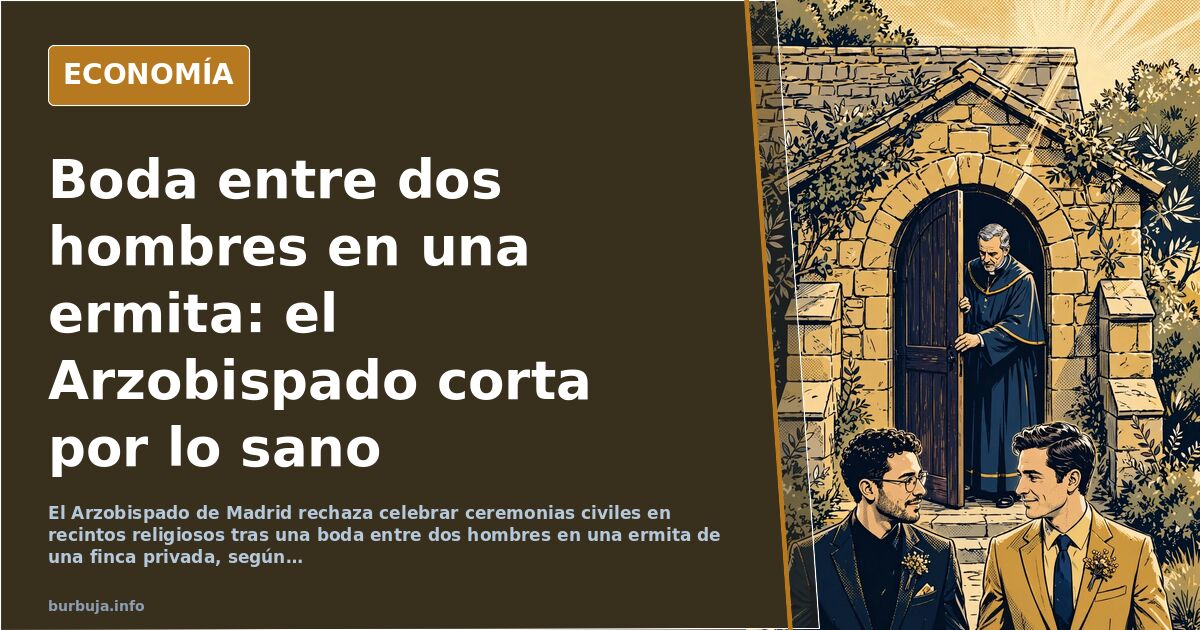
Madrid Archdiocese closes door to civil ceremonies in religious venues
Can you hold a civil wedding in a chapel? The official answer is no, and the case that sparked this debate has names: a ceremony between two men in the chapel of a private wedding estate in Madrid. The Madrid Archdiocese has reacted by rejecting civil ceremonies in religious venues, according to material circulated recently. The episode, recorded and shared by attendees, prompted the archdiocese to distance itself from what it considers an improper use of sacred space.
This scene is not an isolated Saturday afternoon incident. It is the tip of a debate simmering for years: what can and cannot be done in a temple, who authorizes it, and why a private estate with a chapel becomes the perfect setting to bypass protocol. The video, public on social media, shows the union in a consecrated space, notably not a standard parish but a chapel integrated into a celebration complex.
What exactly does the Madrid Archdiocese say
The Madrid Archdiocese has not commented on the specific case but has made its position clear: civil ceremonies have no place in religious venues. The institution reminds us that a temple is a place of worship reserved for liturgical celebrations, not social or civil acts, even if held on private property.
The underlying issue concerns ownership and jurisdiction. Many chapels located on private estates do not directly depend on the diocese, creating an administrative limbo. The estate rents the space, couples book the package, and a priest or officiant appears to give approval. No one asks whether it is a religious wedding, a civil one, or a commercial hybrid.
Some argue the archdiocese acts late and poorly: the rule existed but was not enforced. Others defend that the institution cannot control every corner of every Madrid estate. In the middle are the couples, who likely did not know they were participating in a tug-of-war between the diocese and the wedding business.
The business of estates with chapels: a real estate goldmine
Wedding estates with chapels are a growing product. They offer couples a symbolic setting, beautiful photos, and a veneer of solemnity that hotel halls lack. Renting these spaces has become a profitable niche in the events sector, with the chapel as the differentiating asset.
Conflict erupts when civil use clashes with doctrine. The chapel is not just decor: for the Church, it is a consecrated place. Allowing a civil ceremony inside is, from that perspective, a hard-to-sustain contradiction. The archdiocese decided to cut through the noise and remind everyone that those wanting a civil marriage have other avenues.
The paradox is that the rejection came after the video went viral. The institutional reaction was reactive, not preventive. This leaves a trail of questions: How many similar ceremonies have been held without objection? How many estates still offer the chapel as part of their package?
Clash of arguments: between doctrine and "anything goes"
The episode uncovered a clash of mental frameworks. On one side, those defending that religious spaces have non-negotiable rules. On the other, those considering society has changed and doctrinal rigidity is a burden. In the middle, many people simply want to celebrate their wedding where they like.
The discussion has been tainted by parallel debates: the role of the Church in public life, the commercial use of the sacred, and growing tension between civil and religious spheres in Spain. Each wedding in a chapel becomes, willingly or not, a small cultural battlefield.
The archdiocese opted for the institutional route: reject and warn. It announced no sanctions nor named anyone. The ball is now in the court of the estates, which must decide whether to continue renting the chapel or convert it into a banquet hall.
What happens now with weddings in private chapels
In the short term, it is expected that estates will review contracts and some may remove the chapel from their catalogues. Others will continue offering it as long as no one complains. Legal ambiguity and lack of systematic inspection allow the limbo to persist.
For couples, the message is clear: if you want a civil ceremony, choose a courthouse or town hall. If you want a religious ceremony, you must meet Church requirements. The hybrid seen in the video has days numbered, at least on paper.
It remains to be seen if the archdiocese moves from declaration to action, sending concrete instructions to parishes and estates with chapels. Until then, the norm remains: everyone does as they please until someone complains. And then, everyone prays.
Also available in: Deutsch
Summary of a discussion on Burbuja.info - Foro de economía, actualidad y política., translated from Spanish and reviewed before publication. Read the full discussion (171 replies).
More summaries
-
Morocco renews claim to Ceuta and Melilla, Spain divided
Mohamed VI calls for the liberation of the "occupied cities" and Spain debates between ceding or defending Ceuta and Melilla. The economic cost takes center stage.
-
Pola Jankowska champions the traditional couple
Polish psychologist Pola Jankowska champions the traditional couple — and a commenter calls her out for preaching a model she hasn't built herself.
-
Economy after the mosque ban: the Madrid case
A proposal to turn the M-30 mosque into a slaughterhouse clashes with the Constitution, private property and declining religious attendance.
-
Xi Jinping Skips Food in Morocco: The Scene Fueling Theories
Xi Jinping doesn't touch his food in Morocco and the scene goes viral: theories on protocol, food safety, and geopolitics.
-
Rentier tax proposal to fund basic income in the AI era
Mozz suggests taxing rentiers to fund a basic income as artificial intelligence advances. The debate over who pays for automation is now on the table.
-
If I buy a home priced in lunch menus: they've fallen over 20 years
A lunch menu in Plaza Castilla cost 7 euros in 2006 and 15 today. On that pattern, housing has not doubled since the bubble peak.