
Madrid 2025: 1999 Astra banned, hybrid Cayenne allowed
A 1999 Opel Astra is barred from Madrid, while a 740 hp Porsche Cayenne with zero-emission label enters freely.
English · Original discussion in Spanish · Published
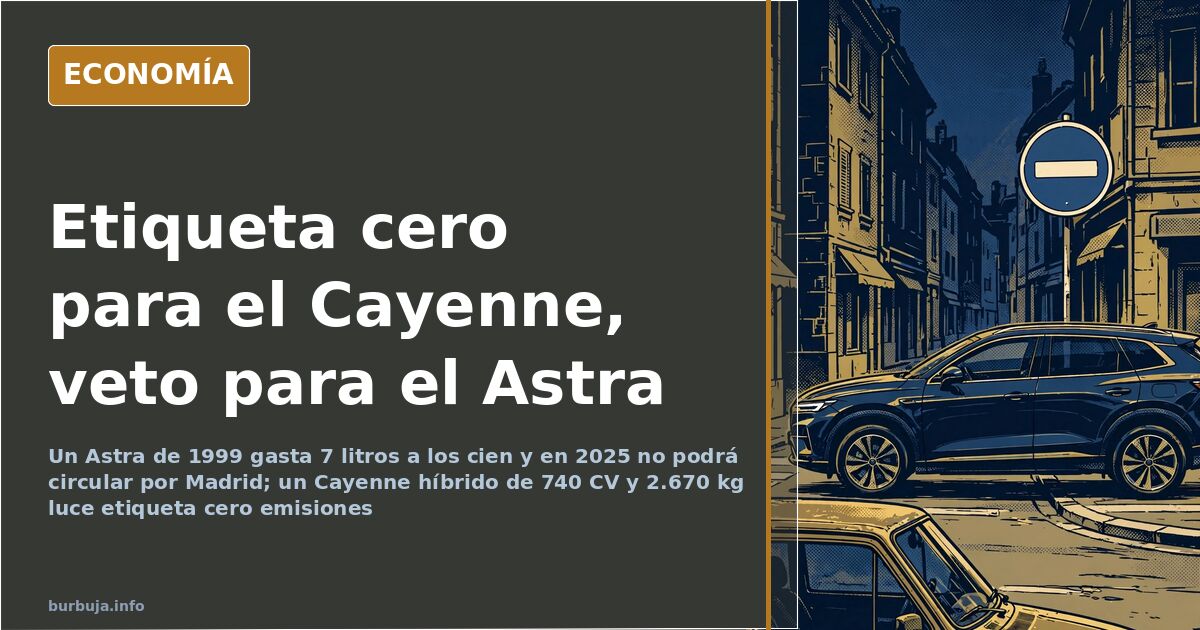
A 1999 Astra is banned from Madrid; an 186,000€ Cayenne is allowed
Why is a 1999 compact car barred from Madrid while a hybrid SUV of 2,670 kg and 740 hp enters the M-30 without issue? The criteria are not emissions. It is the DGT environmental label, which is bought with technology and price. From 2025, those who cannot afford a new car are excluded from much of the city.
How much does a 1999 Astra really pollute?
The car opening the complaint is a 1999 registered Opel Astra 1.6 petrol. Its owner claims it consumes 7 liters per 100 km on the highway, similar to modern petrol cars, and boasts it pollutes less than a lighter. The rebuttal was swift: the technical sheet for that same Astra shows average consumption above 9 liters. Neither figure makes this a matter of household ecology.
The problem is different. Vehicle classification is done by registration date and homologation time, not current emissions. A Astra from that era is Euro 3, and some cars from the same batch carry a worse classification than deserved because the manufacturer did not declare values correctly. The most repeated argument: if the ITV measures real emissions annually, that should suffice. The 20-year-old car passing the test should circulate; the five-year-old one failing it, no.
The label bought by a Porsche Cayenne
The list of grievances includes a staggering figure: a 2023 Porsche Cayenne Turbo E-Hybrid Coupé. Eight cylinders, 4.0 liters, 740 hp, 2,670 kg, and 186,000 euros in price. Its distinction is the zero-emission label, the same as a pure electric vehicle, thanks to 72 km of homologated electric autonomy and a declared WLTP consumption of 1.7 liters per 100 km.
With these figures, the anger is understood. Homologation rewards the plug and penalizes the year of manufacture, not the result measured in a real alucinación. There are more uncomfortable examples: micro-hybrid cars of two tons that with a small generator already display the ECO label. There is even the case of a 2011 petrol sedan that polluted more in real use than the old car it replaced.
What fee is paid to enter a Low Emission Zone?
The draft Sustainable Mobility Law, approved by the Council of Ministers and under parliamentary review, empowered town councils to create a new fee for vehicles entering Low Emission Zones (ZBE). The price would be around the cost of parking in a public car park in the same municipality. In other words: access to the center is not entirely prohibited, it has a price.
For the driver of an old car, there are two options. The first is the historic registration, requiring a minimum outlay of 500 euros and a mountain of paperwork, with the DGT working on a decree to simplify it. The second is adapting the engine to LPG, which does not work for all: it only offers the ECO label from the Euro 4 standard, thus excluding late-nineties engines. Madrid maintained and expanded the ZBE after announcing its withdrawal; Barcelona is preparing a net around vehicles with the B label; London and Stockholm have been charging for entry for years.
Is there enough public transport to leave the car at home?
The defense of the measure is simple and repeated without nuance: Madrid has ample metro and bus services, and those who cannot afford a new car should not assume the maintenance of an old one. From there, it quickly jumps from practical argument to sarracena judgment on those who insist on entering the center with a vehicle from two decades ago.
The other half of the balance does not dispute the existence of public transport, but the principle. It is argued that banning entry based on registration year is a measure with income bias, and the honest comparison is not 'old car vs. metro,' but 'old car vs. new car.' The M-30 is not just any ring road: it is the edge of the municipal term, and bypassing it via the M-45 is not always an option for those crossing the city daily.
Why are there no demonstrations against ZBEs?
There were demonstrations by driver associations when regulated parking zones started, and support was rather scarce. The diagnosis circulating is that division makes protest impossible: some have new cars, others do not; some live in the center, others enter to work. Add fatigue.
Practically, driving without authorization in a ZBE is a serious offense. Those thinking of not paying the fine face salary and bank account seizure, unless they have exited the economic system, a strategy some describe but which does not scale to millions of drivers.
There remains the intermediate path: continue driving the old car until the first sanction arrives and then decide. And another much more elegant one. Buy a 186,000-euro plug-in hybrid. That not only enters the center: it enters boasting zero emissions.
Why is a 1999 compact car barred from Madrid while a hybrid SUV of 2,670 kg and 740 hp enters the M-30 without issue? The criteria are not emissions. It is the DGT environmental label, which is bought with technology and price. From 2025, those who cannot afford a new car are excluded from much of the city.
How much does a 1999 Astra really pollute?
The car opening the complaint is a 1999 registered Opel Astra 1.6 petrol. Its owner claims it consumes 7 liters per 100 km on the highway, similar to modern petrol cars, and boasts it pollutes less than a lighter. The rebuttal was swift: the technical sheet for that same Astra shows average consumption above 9 liters. Neither figure makes this a matter of household ecology.
The problem is different. Vehicle classification is done by registration date and homologation time, not current emissions. A Astra from that era is Euro 3, and some cars from the same batch carry a worse classification than deserved because the manufacturer did not declare values correctly. The most repeated argument: if the ITV measures real emissions annually, that should suffice. The 20-year-old car passing the test should circulate; the five-year-old one failing it, no.
The label bought by a Porsche Cayenne
The list of grievances includes a staggering figure: a 2023 Porsche Cayenne Turbo E-Hybrid Coupé. Eight cylinders, 4.0 liters, 740 hp, 2,670 kg, and 186,000 euros in price. Its distinction is the zero-emission label, the same as a pure electric vehicle, thanks to 72 km of homologated electric autonomy and a declared WLTP consumption of 1.7 liters per 100 km.
With these figures, the anger is understood. Homologation rewards the plug and penalizes the year of manufacture, not the result measured in a real alucinación. There are more uncomfortable examples: micro-hybrid cars of two tons that with a small generator already display the ECO label. There is even the case of a 2011 petrol sedan that polluted more in real use than the old car it replaced.
What fee is paid to enter a Low Emission Zone?
The draft Sustainable Mobility Law, approved by the Council of Ministers and under parliamentary review, empowered town councils to create a new fee for vehicles entering Low Emission Zones (ZBE). The price would be around the cost of parking in a public car park in the same municipality. In other words: access to the center is not entirely prohibited, it has a price.
For the driver of an old car, there are two options. The first is the historic registration, requiring a minimum outlay of 500 euros and a mountain of paperwork, with the DGT working on a decree to simplify it. The second is adapting the engine to LPG, which does not work for all: it only offers the ECO label from the Euro 4 standard, thus excluding late-nineties engines. Madrid maintained and expanded the ZBE after announcing its withdrawal; Barcelona is preparing a net around vehicles with the B label; London and Stockholm have been charging for entry for years.
Is there enough public transport to leave the car at home?
The defense of the measure is simple and repeated without nuance: Madrid has ample metro and bus services, and those who cannot afford a new car should not assume the maintenance of an old one. From there, it quickly jumps from practical argument to sarracena judgment on those who insist on entering the center with a vehicle from two decades ago.
The other half of the balance does not dispute the existence of public transport, but the principle. It is argued that banning entry based on registration year is a measure with income bias, and the honest comparison is not 'old car vs. metro,' but 'old car vs. new car.' The M-30 is not just any ring road: it is the edge of the municipal term, and bypassing it via the M-45 is not always an option for those crossing the city daily.
Why are there no demonstrations against ZBEs?
There were demonstrations by driver associations when regulated parking zones started, and support was rather scarce. The diagnosis circulating is that division makes protest impossible: some have new cars, others do not; some live in the center, others enter to work. Add fatigue.
Practically, driving without authorization in a ZBE is a serious offense. Those thinking of not paying the fine face salary and bank account seizure, unless they have exited the economic system, a strategy some describe but which does not scale to millions of drivers.
There remains the intermediate path: continue driving the old car until the first sanction arrives and then decide. And another much more elegant one. Buy a 186,000-euro plug-in hybrid. That not only enters the center: it enters boasting zero emissions.
Summary of a discussion on Burbuja.info - Foro de economía, actualidad y política., translated from Spanish and reviewed before publication. Read the full discussion (297 replies).
More summaries
-
Madrid fines 200 euros for driving without environmental label
Madrid ends grace period: 200 euro fine for driving without label in low-emission zone, new ordinance pending.
-
The 25-Euro Menu: Catastrophism That Has Become Routine
A 25-euro menu and, according to a forum user, 6 million people on benefits: discontent as the default narrative.
-
Retired journalist sleeps in metro with 830 euro pension in Barcelona
Joan-Ignasi Ortuño, 67, earns 830 euros monthly, while Barcelona room rentals average 640. He spent days sleeping on the metro after losing his apartment.
-
Used car prices defy forecasts: promised 35% drop missing
Expected 15-20% price cuts in Q1 2024 clash with used cars selling at five-year-old prices, defying market predictions.
-
King Felipe VI Cannot Block Amnesty Law: Why He Must Sign
Spain's King must approve the amnesty bill under the Constitution. Refusal would trigger an unpredictable institutional crisis, as his role is strictly formal.
-
7 Million Spaniards Seek Public Sector Jobs as Wage Gap Widens
Seven million citizens prepare for public exams, with 74% favoring government jobs. Public salaries exceed private sector pay by 58%, driving a massive shift toward state employment.